
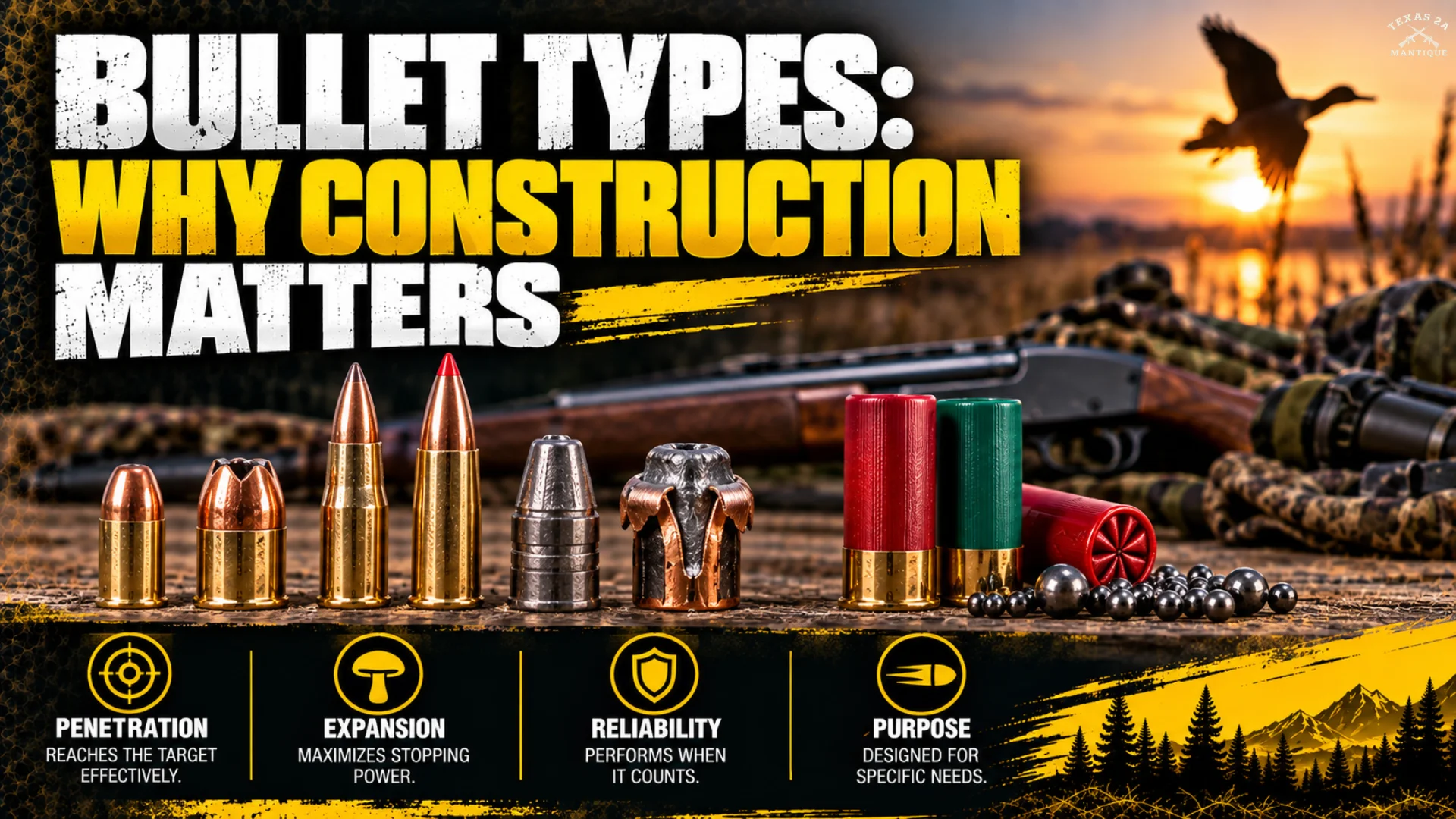
When people argue about ammunition, they usually argue about the wrong thing. They fight over caliber – 6.5 Creedmoor versus .308, 9mm versus .45 – but the caliber is just the size of the hole. What actually does the work once the trigger is pulled is the bullet itself, and more specifically, how that bullet is built. Two rounds of the exact same caliber can behave in completely different ways downrange simply because their bullets are constructed differently.
If you want to actually understand your ammunition – for hunting, home defense, or just being an informed shooter – you need to understand bullet construction. Here’s a deeper, but still simple, breakdown of how these bullets are built and why it matters.
Why Bullet Construction Matters More Than Caliber

A hunter can pick the “best” cartridge on paper and still get poor results if the bullet inside it isn’t suited to the situation. This isn’t a small effect – it’s the whole game. A cartridge only supplies velocity and energy; the bullet decides what happens with that energy the instant it meets flesh, bone, or barrier material.
Here’s the physics in plain terms: a bullet in flight carries kinetic energy based on its weight and speed. When it hits a target, that energy has to go somewhere. A bullet that’s built to expand converts that energy into a wider wound channel and faster tissue damage – what’s often called hydrostatic shock. A bullet that’s built to stay rigid instead drives that same energy forward into deep, straight-line penetration. Neither approach is “better” in isolation; it depends entirely on what you’re shooting and why. A modest caliber loaded with a well-matched bullet can out-perform a bigger caliber loaded with the wrong one, because the bullet – not the cartridge case – is what interacts with the target.
Lead Bullets: Where It All Started
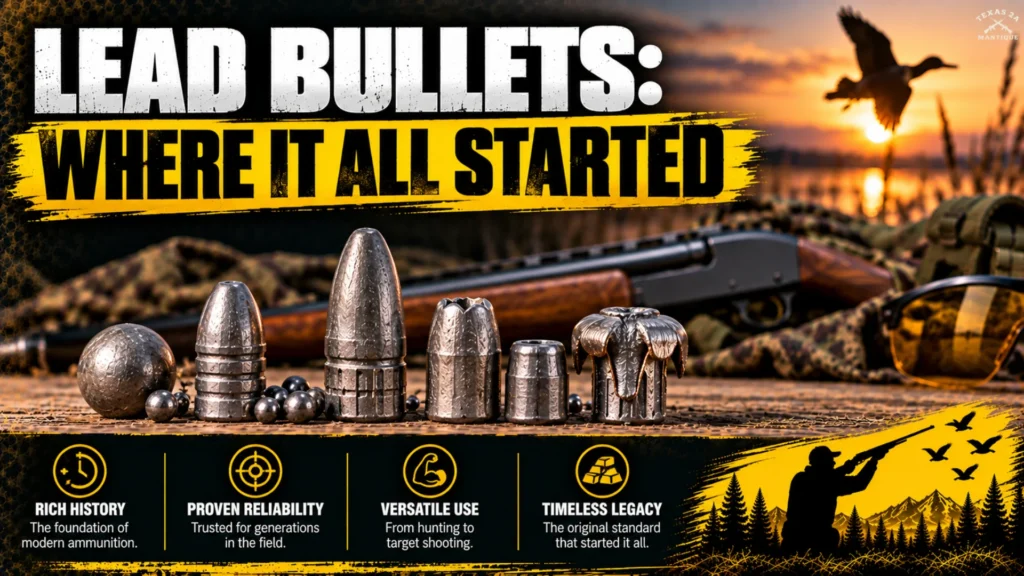
The earliest centerfire bullets were solid lead. Lead was cheap, dense, and soft enough to shape with nothing more than a mold and a heat source, which made it ideal for shooters on the frontier who needed to cast their own ammunition. It still has a place today, especially in cast-bullet handloading and some handgun applications.
But pure lead has real mechanical limitations. Because it’s so soft, it deforms under the pressure of the rifling as it travels down the barrel, leaving lead deposits (“leading”) that build up and eventually hurt accuracy. It’s also prone to expanding too early or too aggressively on impact, which can limit penetration. Adding a small percentage of antimony – a hardening alloy – produces “hard-cast” bullets that resist deformation better and penetrate more predictably, but even hard-cast lead doesn’t solve the fouling problem entirely. This is essentially why the entire jacketed-bullet industry exists.
Jacketed Bullets: Adding a Copper Shell
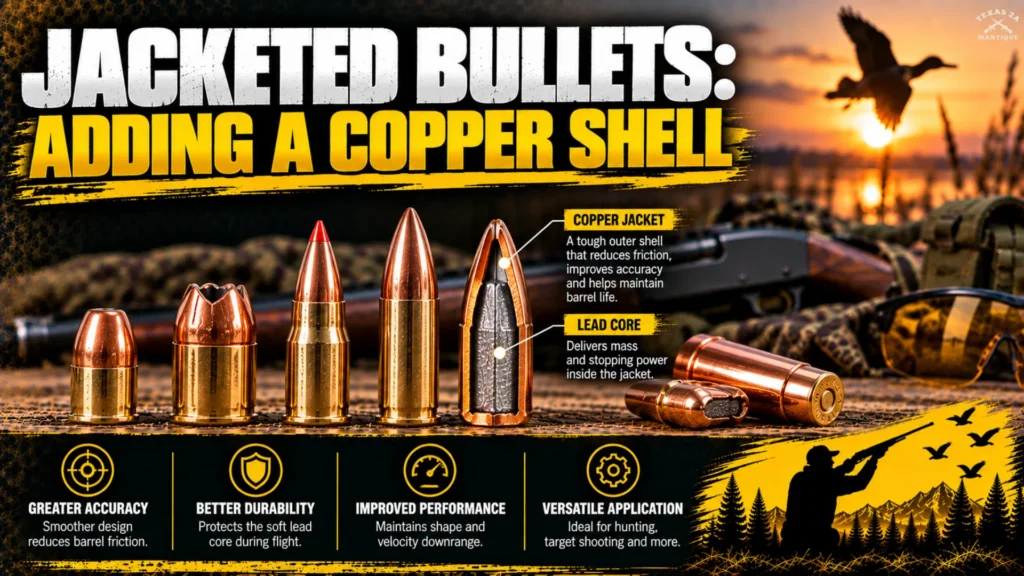
Wrapping the lead core in a thin shell of copper or copper alloy – starting around the 1880s – solved several problems at once. The harder copper jacket sharply reduces barrel fouling, while still being soft enough that the rifling can engrave into it and impart the spin needed for accuracy. Just as importantly, the jacket acts as a control mechanism: by adjusting how thick or hard that jacket is, and whether it’s scored or tapered at the nose, engineers can precisely tune how quickly – or slowly – the bullet expands on impact. This single innovation split ammunition design into two very different philosophies.
Full Metal Jacket (FMJ)
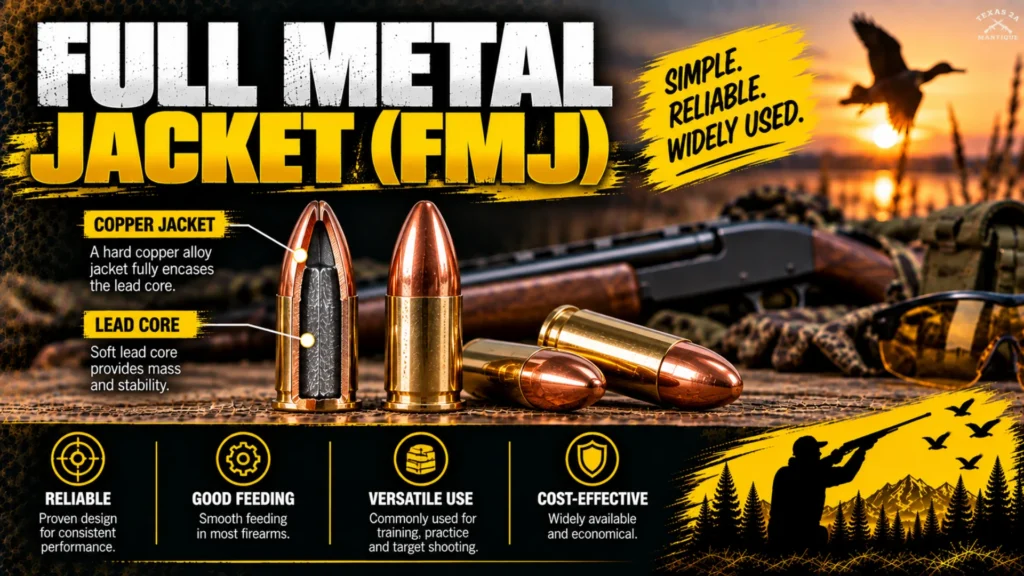
An FMJ completely encloses the lead core in copper, including at the nose. Because there’s no exposed lead to peel back, the bullet resists expansion almost entirely and instead punches through in roughly its original shape. This is precisely why military ammunition is built this way – the 1899 Hague Convention prohibits the use of expanding bullets in warfare, so armies standardized on the FMJ design.
For target and practice shooting, this is a strength: FMJs are cheap to manufacture (no complex jacket tuning needed), consistent, and accurate. For hunting or personal defense, that same non-expanding trait becomes a serious weakness. Because the bullet doesn’t open up, it transfers less energy into the target and tends to over-penetrate – passing through with substantial force still remaining, which raises real safety concerns about what (or who) is behind the target.
Hollow Points
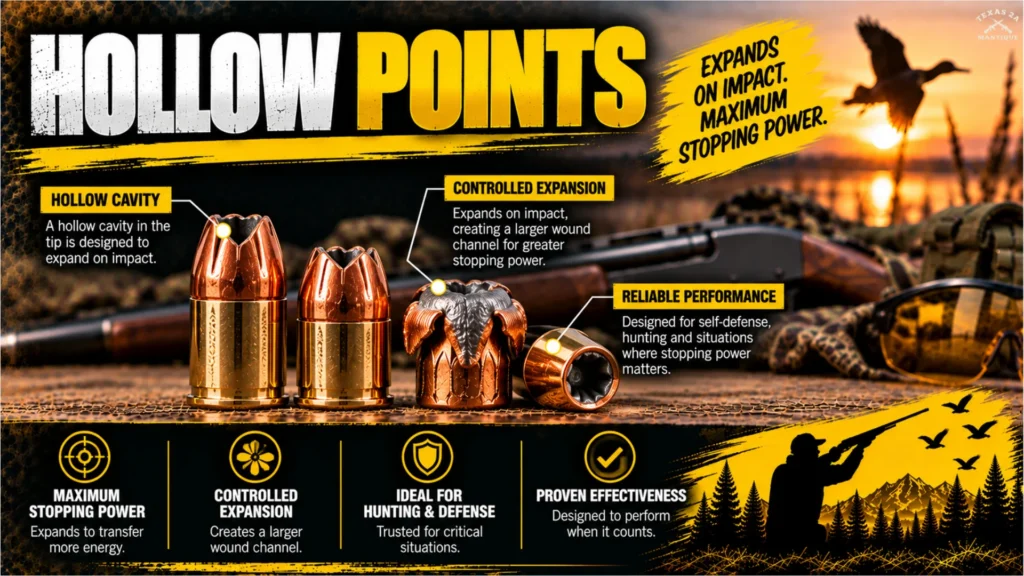
A hollow point removes material from the nose, leaving an open cavity. On impact, that cavity fills with tissue or fluid, which forces the surrounding copper and lead to peel outward – the bullet “mushrooms.” This does two things at once: it enlarges the wound channel dramatically, and it slows the bullet down faster, dumping its energy into the target rather than carrying it through and out the other side.
Modern defensive hollow points refine this basic idea to solve specific failure points:
- Federal Hydra-Shok uses a center post inside the hollow cavity so the cavity can’t plug up with clothing fibers or other debris before it has a chance to expand.
- Federal HST uses a specially designed crimp that locks the jacket to the core mechanically, so the two don’t separate during expansion – a common cause of inconsistent performance in older hollow-point designs.
- Speer Gold Dot uses a bonded core (explained below), which increases weight retention and keeps expansion controlled rather than explosive.
In testing through bare ballistic gel, clothing, and gypsum board (a stand-in for drywall), premium bonded hollow points like these typically produce 12 to 14 inches of penetration with expansion to roughly 1.5 times their original diameter – numbers widely used as a benchmark for reliable defensive performance, including by law enforcement agencies.
The Three Main Hunting Bullet Designs
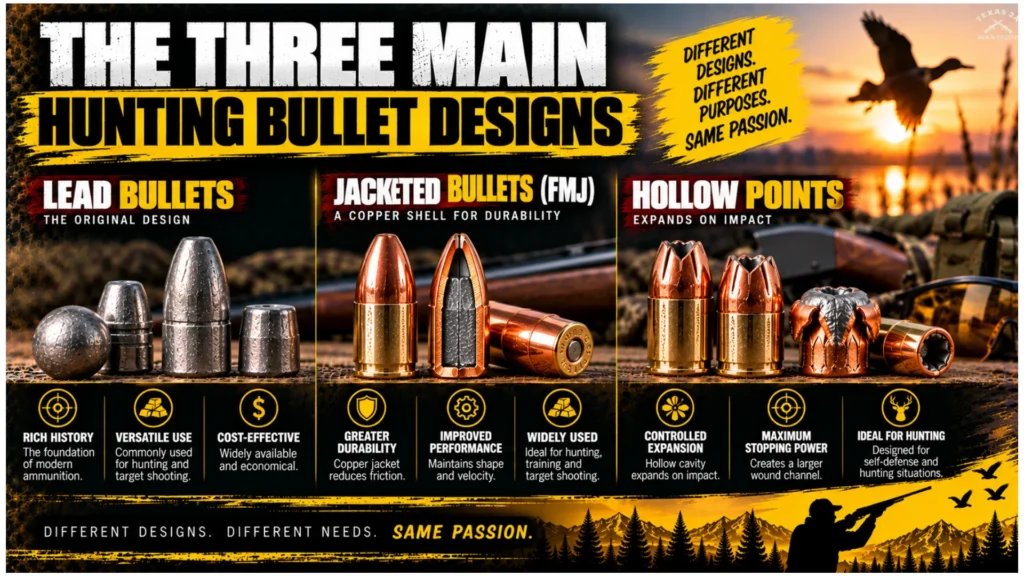
Hunting bullets face a harder engineering problem than defensive bullets, because the range of conditions is much wider – impact velocity can vary enormously between a 50-yard shot and a 400-yard shot, and the bullet may need to punch through heavy shoulder bone on one animal and thin rib cartilage on another. Nearly every modern hunting bullet on the market solves this with one of three core architectures.
1. Cup-and-Core
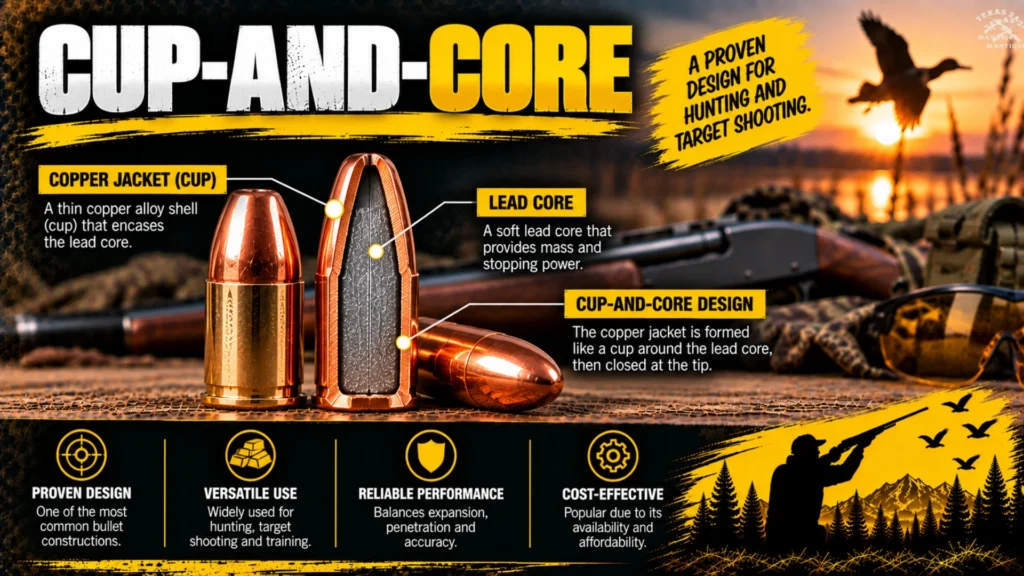
This is the original – and still most common – hunting bullet design: a lead core seated inside a copper jacket, held together mechanically rather than chemically. Bullets like the Remington Core-Lokt and Winchester Power-Point have probably taken more North American big game, from whitetail deer to elk, than any other design in history.
The engineering logic is simple: a thinner jacket lets the lead core mushroom rapidly on impact, creating a large wound cavity and transferring energy efficiently. This works extremely well within a defined “operating window” – generally inside 200 yards, on broadside or lightly quartering shots, at moderate impact velocities.
The problem shows up at the edges of that window. Because the core and jacket aren’t bonded, high impact velocity (a close shot) or a hit on heavy bone can cause the jacket and core to separate – the jacket peels away while the lead core fragments or sheds mass faster than intended. The result isn’t a lack of lethality; it’s a loss of consistency, since a bullet that loses too much mass too early may not carry enough energy to reach the vitals. This doesn’t make cup-and-core bullets unethical to use – it defines the conditions under which they perform as intended.
2. Bonded Bullets
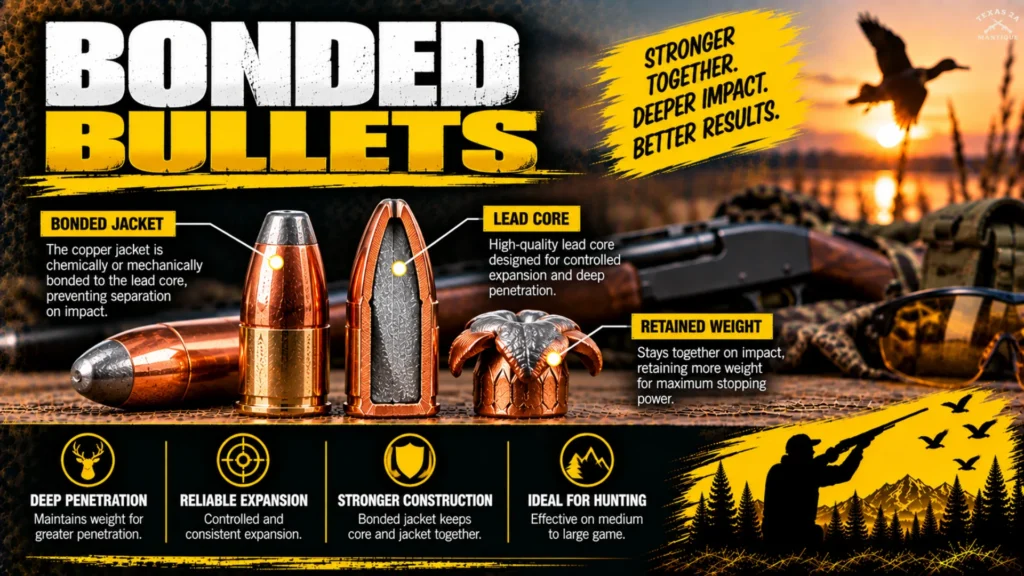
Bonded bullets solve the separation problem directly by chemically or electrochemically fusing the lead core to the copper jacket, essentially welding the two materials together at a molecular level. The practical effect: the bullet retains a much higher percentage of its original weight after impact, because the jacket can’t peel away from the core independently.
This changes the bullet’s behavior in a specific, predictable way – instead of dumping most of its mass and energy immediately, a bonded bullet expands in a controlled manner while continuing to drive forward, trading some of the “rapid energy dump” of a cup-and-core bullet for deeper, more reliable penetration across a wider range of velocities and impact angles. Federal’s Terminal Ascent is a modern example built specifically around this principle, using a bonded core paired with a polymer tip for consistent expansion even at extended range and reduced velocity.
This is precisely why bonded bullets are the standard recommendation for elk, moose, and other big-bodied game: hunters can’t always control shot angle or distance in the field, and a bonded bullet’s wider performance window acts as insurance against those unknowns. There’s a real trade-off, though – at very close range and high velocity, with a clean hit that avoids heavy bone, a bonded bullet may pass completely through with less dramatic “knockdown” than hunters expect. That’s not a malfunction; it’s the bullet doing exactly what its design prioritizes (penetration and consistency) rather than maximum energy transfer.
3. Monolithic (Solid Copper) Bullets
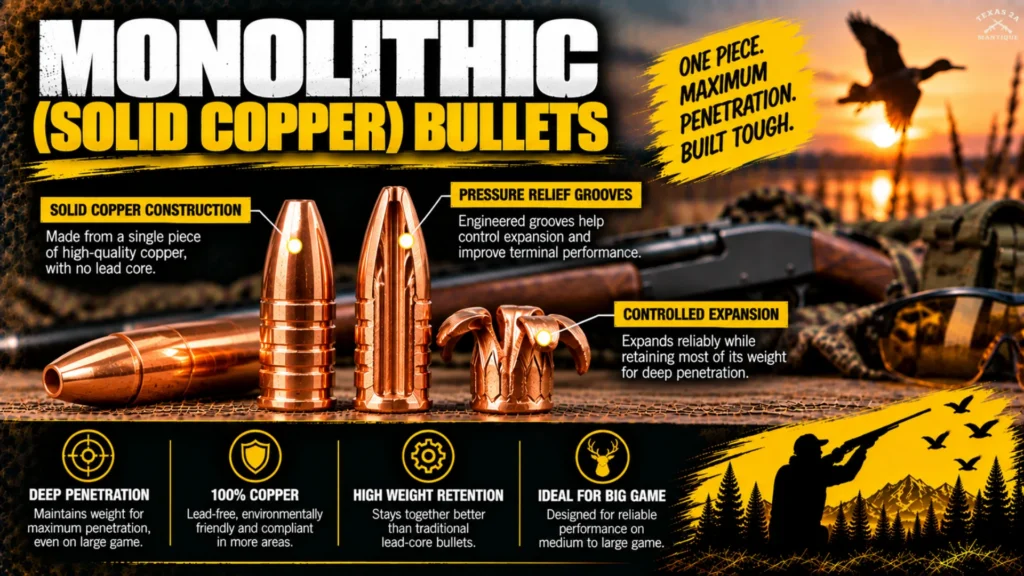
Monolithic bullets remove the lead core from the equation entirely, machining the whole projectile from a single piece of copper or copper alloy. Instead of shedding weight through fragmentation, these bullets expand by having engineered petals – essentially pre-designed cut lines at the nose – peel outward on impact while the bullet retains nearly 100% of its original weight. Structurally, this is a completely different approach: cup-and-core and bonded bullets rely on losing or reshaping mass to control energy transfer, while monolithic bullets rely on geometry and structural integrity.
The result is exceptional straight-line penetration, even through heavy bone, because there’s no lead core to fragment or separate. There are three main reasons hunters choose these bullets:
- Legal requirement – California and some other jurisdictions mandate lead-free ammunition for hunting, making copper bullets the only compliant option.
- Environmental/ethical choice – lead fragments left in a carcass or gut pile can be ingested by scavenging birds like eagles and condors; monolithic bullets eliminate that risk.
- Performance preference – some hunters simply want maximum structural toughness for deep, reliable penetration on large or heavy-boned animals.
The trade-offs are mechanical, not ethical. Copper is less dense than lead, so a monolithic bullet has to be physically longer than a lead-core bullet of the same weight to achieve the same ballistic profile – which can make it more sensitive to a rifle’s barrel twist rate and seating depth. More importantly, expansion is highly velocity-dependent: these bullets need a minimum impact speed to force the petals open reliably. At long range, where velocity has dropped well below that threshold, a monolithic bullet may fail to expand fully, resulting in a narrower wound channel (though penetration itself is rarely an issue, since the bullet’s structural strength doesn’t depend on velocity the way expansion does).
How Ballistic Coefficient Fits In
Separate from how a bullet is built internally, its external shape determines how efficiently it flies through the air – measured as ballistic coefficient (BC). A higher BC means a bullet sheds velocity more slowly, drops less over distance, and drifts less in wind, because it’s more aerodynamically efficient.
The difference this makes is measurable, not marginal. As one published comparison of 180-grain .30-caliber bullets at the same muzzle velocity (2,600 fps) shows:
| Bullet | BC (G1) | Drop at 400 yds | Velocity at 400 yds | Energy at 400 yds |
| Round nose (low BC) | .240 | -37.8 in | 1,374 fps | 755 ft-lbs |
| Nosler AccuBond (high BC) | .507 | -25.8 in | 1,953 fps | 1,525 ft-lbs |
That’s roughly double the retained energy at 400 yards, purely from bullet shape – with identical muzzle velocity and identical caliber. Wind drift shows the same pattern: the low-BC bullet drifts nearly 2.5 times more in a 10 mph crosswind than the high-BC bullet at the same distance.
Polymer tips and boat-tail (tapered) bases are the most common ways manufacturers raise BC on hunting bullets. It’s worth being precise about what these features actually change, though: a polymer tip improves aerodynamics and can help trigger expansion at lower impact velocities, but it doesn’t alter what’s underneath. A tipped cup-and-core bullet is still a cup-and-core bullet in terms of how it behaves on impact; a tipped bonded bullet is still bonded. The tip changes how the bullet flies, not fundamentally how it terminates.
Choosing the Right Bullet for the Job
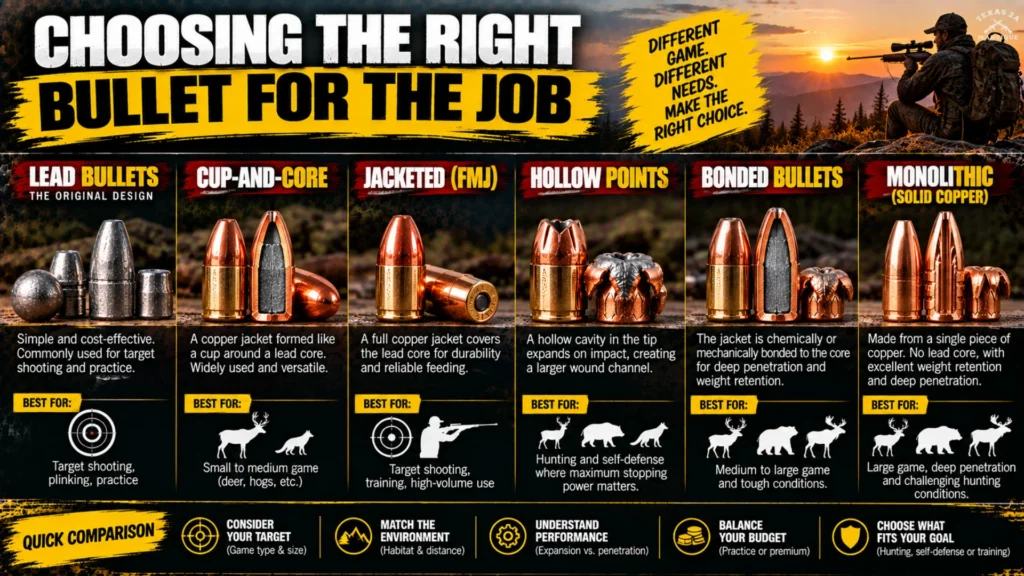
There’s no universally “best” bullet – only the best bullet matched to a specific purpose and situation:
- Target practice: FMJ or plain lead bullets – affordable and consistent, but not appropriate for hunting or defense due to poor expansion.
- Home and personal defense: A bonded, engineered hollow point (HST, Gold Dot) – built to balance rapid expansion with enough penetration to reliably stop a threat through clothing.
- Whitetail and short-to-moderate range hunting (under ~200 yards): A cup-and-core bullet – proven, affordable, and performs exactly as intended within its window.
- Big-bodied or unpredictable-angle game (elk, moose, large mule deer): A bonded bullet – offers a wider margin of consistent performance across varying distances and impact angles.
- Maximum structural penetration, lead-restricted areas, or long-range hunting: A monolithic copper bullet – provided you respect its minimum-velocity expansion threshold at extended range.
The Bottom Line
Shot placement will always outrank bullet selection—a well-placed shot through the vitals is critical to achieving the intended result, and no bullet can fully compensate for poor placement. But bullet construction determines the margin for error when conditions aren’t ideal: a steeper angle than planned, heavier bone than expected, or a shot taken closer or farther than anticipated.
Understanding the mechanics behind lead, jacketed, cup-and-core, bonded, and monolithic bullets isn’t merely a technical footnote for firearm enthusiasts – it’s an important part of understanding how different ammunition designs are intended to perform under varying conditions.
At Texas2A Mantique, we believe informed firearm ownership starts with understanding the equipment, its intended performance, and the factors that can influence results. Our goal is to provide practical, responsible information that helps firearm enthusiasts make knowledgeable decisions about ammunition and firearm-related products.


Leave a Reply