
Firearm safety is a serious responsibility. Whether you are a first-time firearm owner, an experienced shooter, or simply learning about responsible firearm ownership, understanding and following basic safety principles is essential.
A firearm should never be treated as an ordinary household item. Safe ownership requires awareness, proper handling, secure storage, appropriate training, and respect for the potential risks involved.
The following 10 firearm safety rules provide a practical foundation for responsible firearm handling. These principles are designed to help firearm owners develop consistent habits and make safety a priority every time they handle, transport, store, or use a firearm.
1. Always Treat Every Firearm as If It Is Loaded
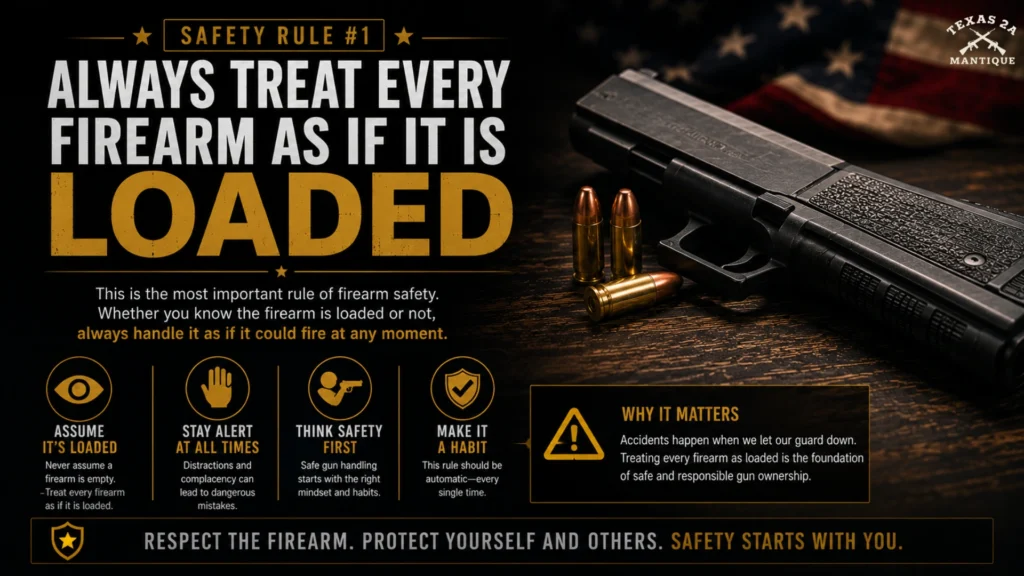
One of the most important firearm safety rules is to treat every firearm as loaded, even when you believe it is unloaded.
This simple mindset helps prevent complacency. A firearm may appear empty, but assuming it is loaded encourages you to handle it carefully and follow proper safety procedures.
Whenever you receive or handle a firearm, avoid relying solely on another person’s statement that it is unloaded. Follow the manufacturer’s recommended procedure for checking the firearm’s condition.
This principle is especially important when:
- Receiving a firearm from another person
- Handling a firearm that you have not used before
- Removing a firearm from storage
- Preparing a firearm for transportation
- Handling a firearm at a shooting range
- Picking up a firearm that you did not personally unload
Treating every firearm as loaded also means maintaining safe muzzle direction and keeping your finger outside the trigger guard.
Why This Rule Matters:
Accidents often occur when people become comfortable around firearms and stop treating them with the necessary caution. Assuming that a firearm is loaded encourages responsible behavior even when its actual condition is unknown.
The safest mindset is simple: never assume a firearm is unloaded. Verify its condition safely and handle it accordingly.
2. Always Keep the Muzzle Pointed in a Safe Direction
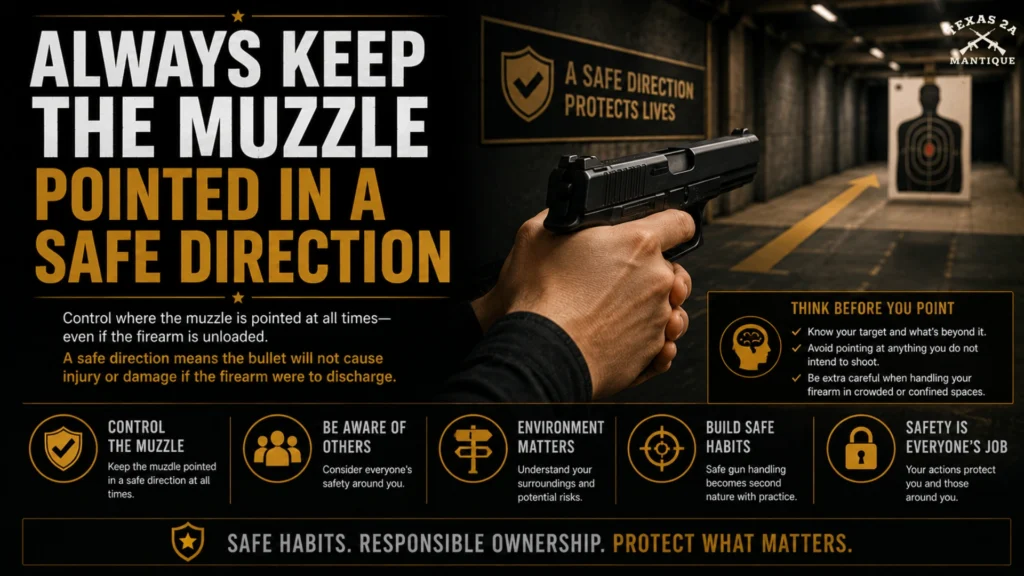
The muzzle is the end of the firearm from which the projectile exits. Controlling the direction of the muzzle is one of the most important aspects of firearm safety.
Always keep the muzzle pointed in a direction where an unintended discharge would be unlikely to injure someone or cause unnecessary damage.
Never point a firearm at:
- Yourself
- Another person
- An object you do not intend to shoot
- A location where an unintended discharge could cause injury or significant property damage
Muzzle awareness should continue whether the firearm is loaded or unloaded.
When moving around with a firearm, pay attention to how the muzzle is positioned. Avoid careless movements that could cause the firearm to sweep across another person.
Why Muzzle Control Matters:
Even if a firearm is believed to be unloaded, maintaining safe muzzle direction provides an additional layer of protection if something unexpected happens.
Safe muzzle direction is therefore not something you practice only at a shooting range. It should become a normal habit whenever you handle a firearm.
If you are unsure what constitutes a safe direction in a particular situation, stop and seek guidance from a qualified firearms instructor or responsible range professional.
3. Keep Your Finger Outside the Trigger Guard Until You Are Ready to Fire
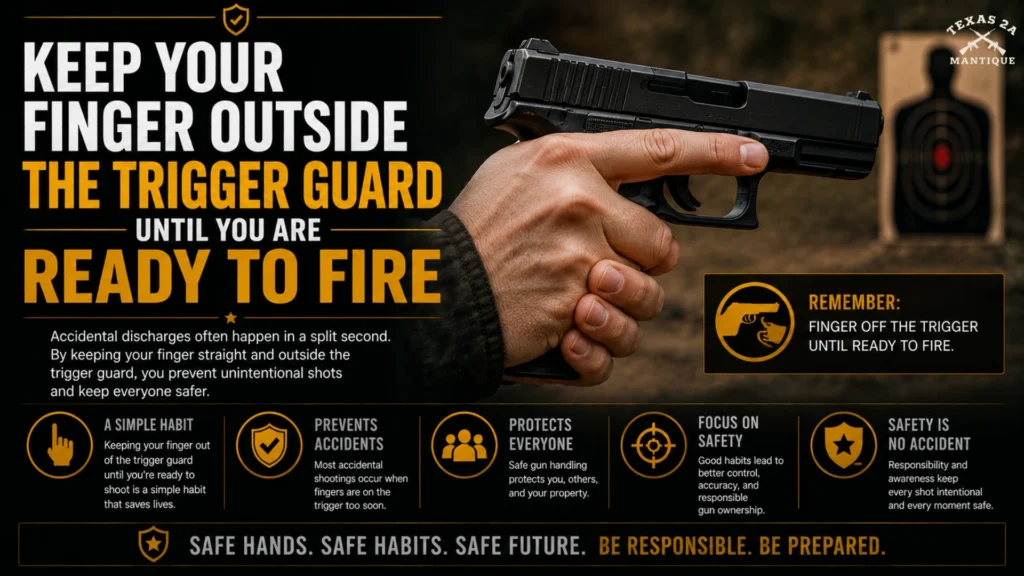
Another fundamental firearm safety rule is trigger discipline.
When handling a firearm, keep your trigger finger straight and outside the trigger guard until you have made the decision to fire and are properly positioned at your intended target.
A firearm can discharge if the trigger is pressed while the firearm is capable of firing. Keeping your finger away from the trigger helps reduce the possibility of an unintended discharge caused by an accidental movement or reaction.
Your trigger finger should remain outside the trigger guard while:
- Picking up or putting down a firearm
- Moving with a firearm
- Loading or unloading
- Checking the firearm
- Changing your position
- Responding to a malfunction
- Waiting to shoot
Develop Consistent Trigger Discipline
Good trigger discipline should become automatic. Instead of thinking about it only when you remember, make it part of your normal handling routine.
Finger off the trigger until you are ready to fire.
This is a simple habit, but it is one of the most important habits a firearm owner can develop.
4. Know Your Target and What Is Beyond It
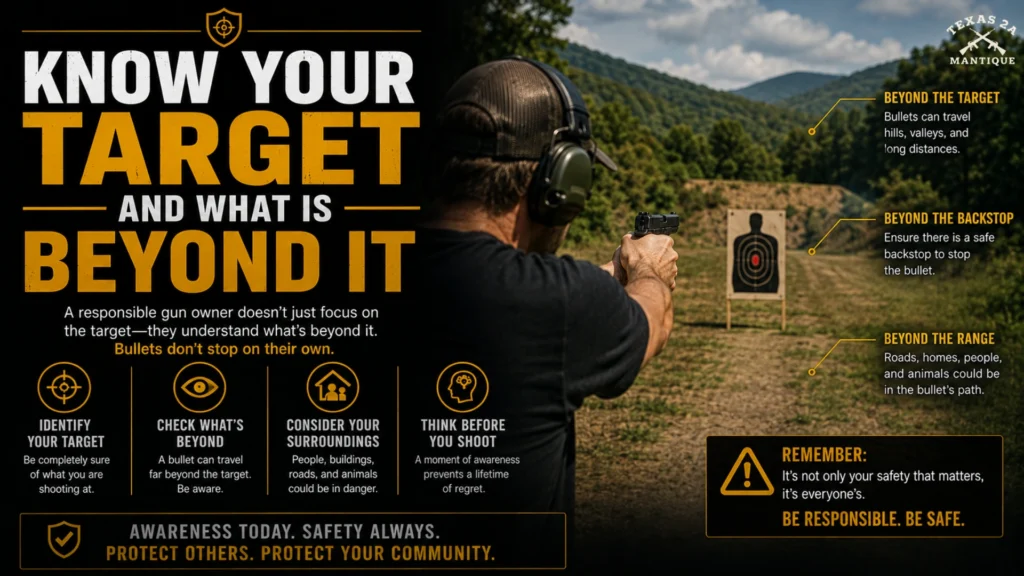
Before firing, you should positively identify your target and understand what is behind and around it.
Never fire at an unidentified object, sound, movement, or shape that you cannot clearly identify.
Knowing your target is only part of the responsibility. You must also consider what could be affected if a projectile misses the intended target or passes through it.
Before shooting, consider:
- Is the target clearly identified?
- Is the area behind the target appropriate?
- Could another person enter the area?
- Is there an adequate backstop where required?
- Could a missed shot create a danger to people or property?
Why the Area Beyond the Target Matters:
A projectile does not necessarily stop when it reaches the intended target. This is why responsible shooting requires awareness of the entire area surrounding the target.
At a shooting range, follow the range’s rules concerning targets, firing lines, backstops, and cease-fire procedures.
When hunting or participating in another lawful shooting activity, follow all applicable laws and established safety practices.
Never fire unless you are certain of your target and the area beyond it.
5. Learn How Your Firearm Works Before Handling or Using It
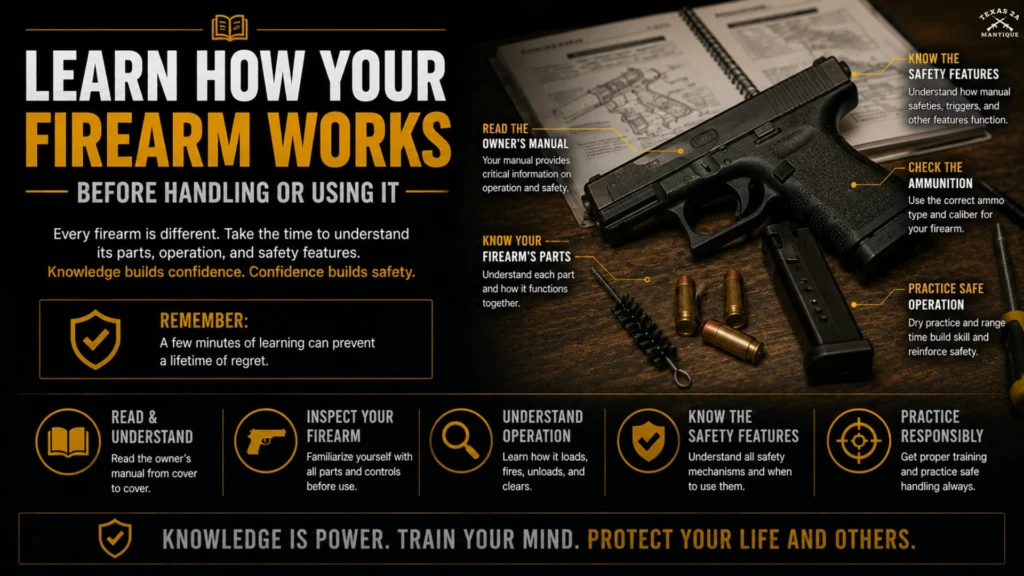
Every firearm is different. Controls, operating systems, loading procedures, safety mechanisms, and manufacturer instructions can vary.
Before using a firearm, read the manufacturer’s owner’s manual and understand the basic safety information provided for that specific model.
If you are unfamiliar with a firearm, do not guess how it operates.
Seek assistance from a qualified firearms instructor or another appropriately knowledgeable professional.
What You Should Understand
Before handling a firearm, you should understand the manufacturer’s instructions regarding:
- Basic firearm controls
- Safety mechanisms
- Safe handling procedures
- Ammunition specifications
- Safe storage
- Maintenance requirements
- Inspection procedures
- Transportation recommendations
Training Is Better Than Guesswork
Watching a random online video or relying on advice from an inexperienced person may not provide enough information for safe firearm handling.
Professional instruction can help you understand safe practices in a structured environment.
If you do not know how a firearm works, stop and get proper instruction before proceeding.
6. Always Use the Correct Ammunition
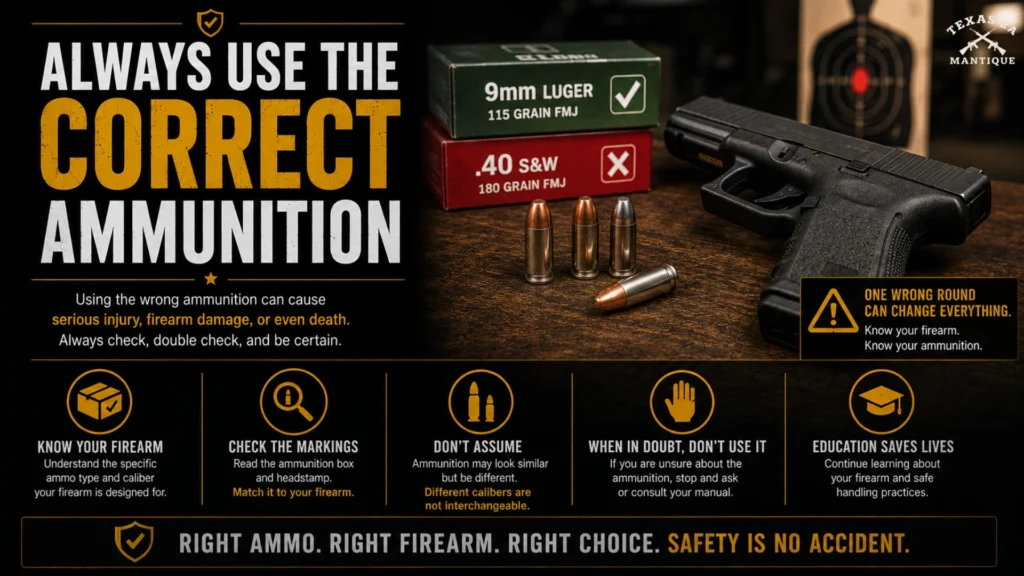
Using ammunition that is not appropriate for a firearm can create serious safety risks, including firearm damage or personal injury.
Only use ammunition that matches the specifications provided by the firearm manufacturer. Do not assume that ammunition is interchangeable simply because it looks similar or has a similar name. Before using ammunition, verify that it is appropriate for the firearm according to the manufacturer’s markings and owner’s manual.
Never Force Ammunition
If ammunition does not appear to fit correctly, do not force it into the firearm.
If you are uncertain about ammunition compatibility, stop and consult the firearm’s manufacturer’s documentation or seek assistance from a qualified professional.
Inspect Ammunition
Before use, ammunition should be handled responsibly and checked for obvious signs of damage or abnormal condition. Follow manufacturer recommendations for storage and handling.
Using the correct ammunition is a basic but critical part of firearm safety.
7. Always Wear Appropriate Eye and Hearing Protection
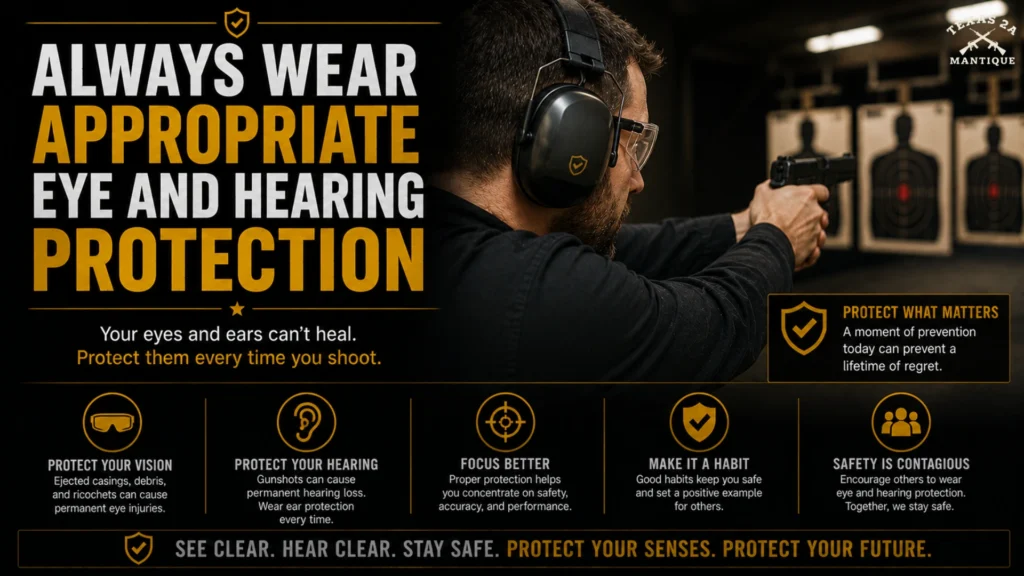
Firearms produce extremely loud sounds and can generate particles or other hazards during firing.
For this reason, appropriate eye and hearing protection should be used when shooting in environments where such protection is recommended or required.
Eye Protection
Proper eye protection can help protect your eyes from particles, debris, and other potential hazards associated with shooting.
Hearing Protection
Repeated exposure to loud firearm reports can damage hearing. Appropriate hearing protection helps reduce exposure to potentially harmful sound levels.
At a shooting range, follow the range’s requirements regarding eye and hearing protection.
Make Safety Equipment Part of Your Routine
Safety equipment should not be treated as optional equipment that you use only occasionally.
Before participating in shooting activities, make sure you have appropriate protective equipment and understand how to use it correctly.
Protecting your eyes and hearing is an important part of responsible shooting.
8. Store Firearms Securely When They Are Not in Use
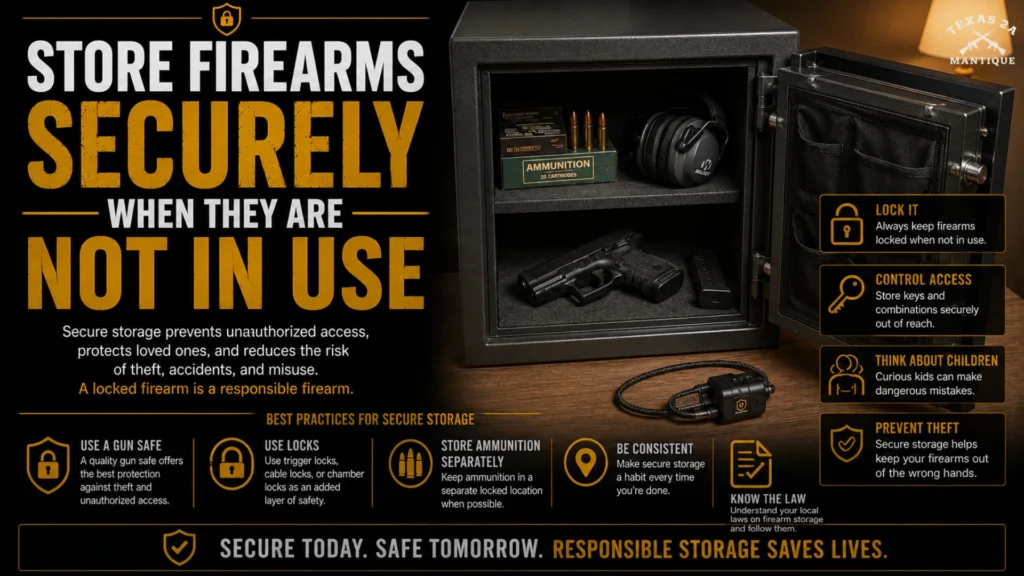
Responsible firearm ownership does not end when you stop shooting. Secure storage is an essential part of firearm safety.
When a firearm is not being used, it should be stored in accordance with applicable laws, manufacturer recommendations, and recognized safe-storage practices.
The goal is to prevent unauthorized access while maintaining appropriate control over the firearm.
Consider Who May Have Access
Firearm owners should carefully consider everyone who could potentially access a firearm, including:
- Children
- Visitors
- Guests
- Unauthorized household members
- Individuals who are not trained to handle firearms
Use appropriate locking devices or secure storage solutions designed for firearms, consistent with applicable law and manufacturer guidance.
Ammunition Storage
Ammunition should also be stored responsibly and in accordance with applicable safety recommendations and legal requirements.
Why Secure Storage Matters
A firearm that is left unsecured can create risks that extend beyond the owner. Proper storage can help prevent unauthorized access, accidental handling, theft, and other preventable incidents.
Responsible ownership includes controlling access to firearms whenever they are not under your direct supervision.
9. Never Handle or Use a Firearm While Impaired
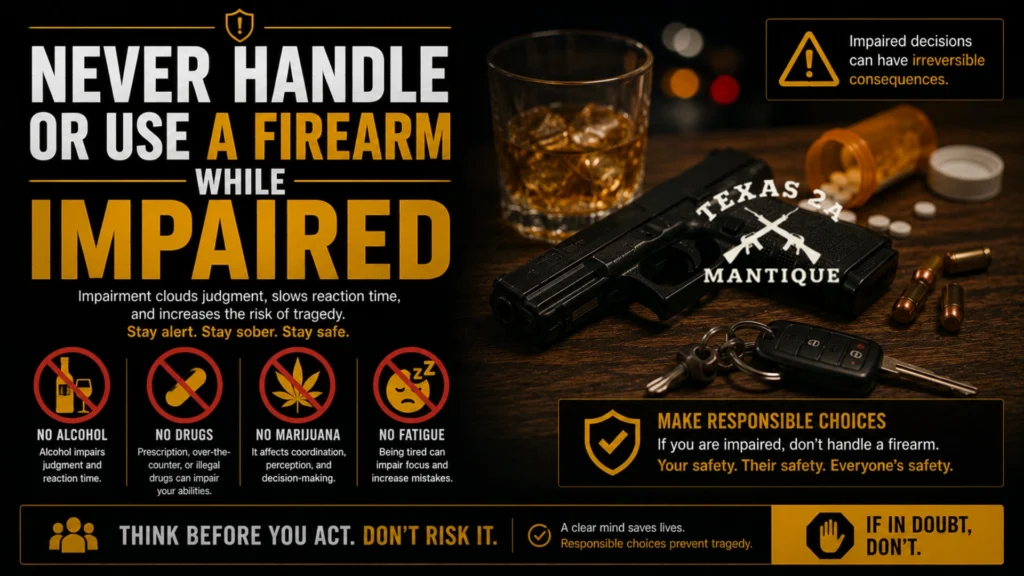
Firearm handling requires clear judgment, concentration, coordination, and the ability to respond appropriately to changing circumstances.
Never handle or use a firearm while impaired by alcohol, recreational drugs, or any substance that can affect your judgment or coordination.
Even if you believe you are capable of handling a firearm, impairment can affect decision-making and reaction time.
If You Are Impaired
The safest approach is to stay away from firearms.
Do not attempt to handle, unload, transport, clean, or otherwise manipulate a firearm while impaired.
If you have been drinking or are otherwise impaired, leave firearm handling to a responsible, unimpaired person when appropriate and lawful.
There is no reason to take unnecessary risks with a firearm. Wait until you are fully alert and capable of making responsible decisions.
10. Get Proper Firearm Safety Training and Keep Learning
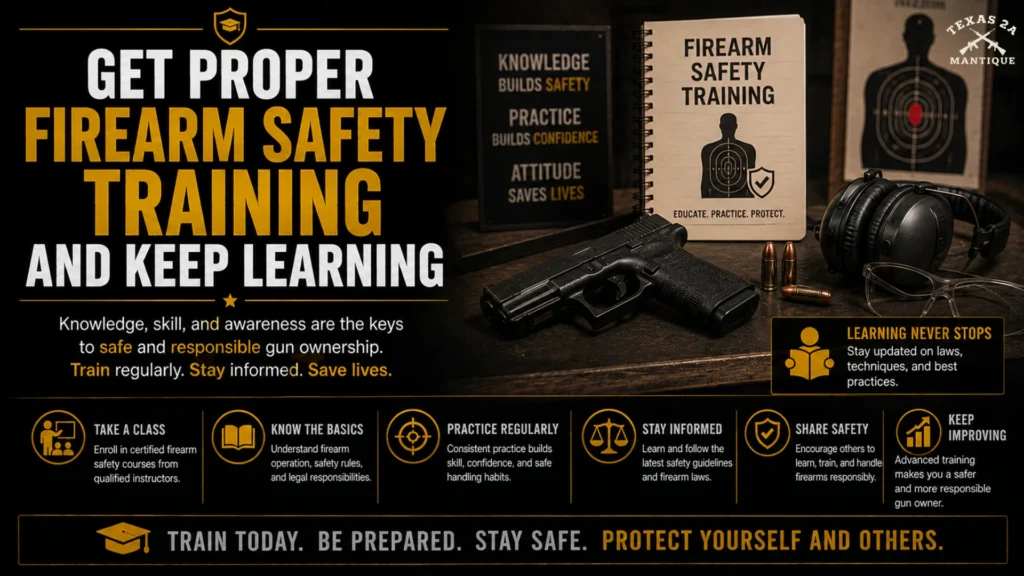
Firearm safety is an ongoing responsibility. Completing a basic safety course can be especially valuable for new firearm owners, while experienced owners can benefit from refresher training.
A qualified firearms instructor can teach safe handling practices in a controlled environment and help identify unsafe habits that may otherwise go unnoticed.
Why Professional Training Matters
Proper training can help you better understand:
- Fundamental firearm safety principles
- Safe handling practices
- Range safety procedures
- Safe storage concepts
- Firearm terminology
- Manufacturer instructions
- Applicable safety requirements
- How to respond appropriately to common safety situations
Training should be appropriate for your experience level and the type of lawful shooting activity you plan to participate in.
Keep Your Knowledge Current
Firearm safety is not a one-time lesson. Continue learning, follow manufacturer updates, and stay informed about applicable laws and regulations.
If you encounter a situation you do not understand, do not improvise.
Stop, make the situation safe, and seek qualified guidance.
Additional Firearm Safety Practices
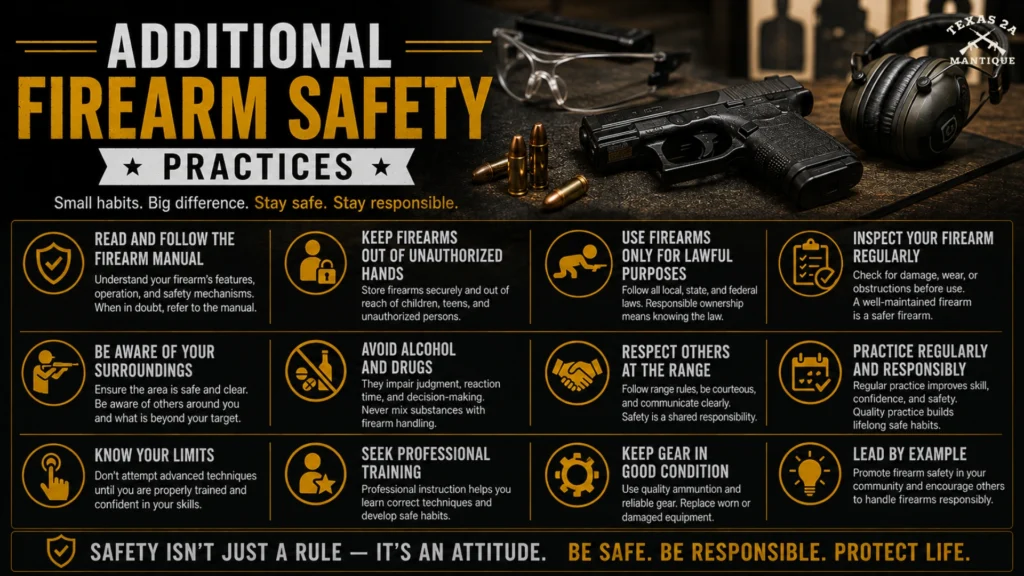
The 10 rules above provide a strong foundation, but responsible firearm ownership involves several additional habits.
Follow Manufacturer Instructions
The owner’s manual is an important source of information about your specific firearm. Follow the manufacturer’s recommendations for safe handling, storage, maintenance, and use.
Do not modify a firearm unless you understand the legal and safety implications and the work is performed appropriately by a qualified professional where necessary.
Follow Range Rules
If you are shooting at a range, follow all posted rules and instructions from range personnel.
Range rules may cover areas such as:
- Firearm handling
- Loading and unloading
- Firing lines
- Cease-fire procedures
- Target placement
- Protective equipment
- Movement around the range
Range personnel are responsible for maintaining a controlled shooting environment. Follow their instructions immediately.
Keep Your Firearm Under Control
Do not leave a firearm unattended in an unsecured location.
When transporting a firearm, follow applicable federal, state, and local laws as well as the manufacturer’s recommendations.
Avoid Distractions
Firearm handling requires your full attention.
Avoid unnecessary distractions while handling a firearm. If you are interrupted or become uncertain about what you are doing, stop and return to a safe condition before continuing.
Never Rely on the Safety Mechanism Alone
A mechanical safety is only one part of firearm safety. It should never replace the fundamental rules of safe handling.
Continue to maintain safe muzzle direction, proper trigger discipline, and responsible handling regardless of the firearm’s safety position.
Final Thoughts
Firearm safety is not about memorizing a list of rules once. It is about developing responsible habits that become part of every interaction with a firearm.
Whether you are purchasing your first firearm, visiting a shooting range, transporting a firearm, or storing one at home, safety should always come first. Treat every firearm with respect, maintain control of the muzzle, keep your finger away from the trigger until you are ready to fire, use the correct ammunition, secure firearms when they are not in use, and continue your education through reputable training.
Responsible firearm ownership also means understanding and following the laws that apply to you. Firearm laws and regulations can change, so consult current official sources and qualified professionals when you need legal guidance.
At Texas 2A Mantique, we believe responsible firearm ownership begins with knowledge, education, safe handling, and respect for the responsibilities that come with firearm ownership.
Safety should never be treated as an extra step. It should be part of every step.

Leave a Reply