
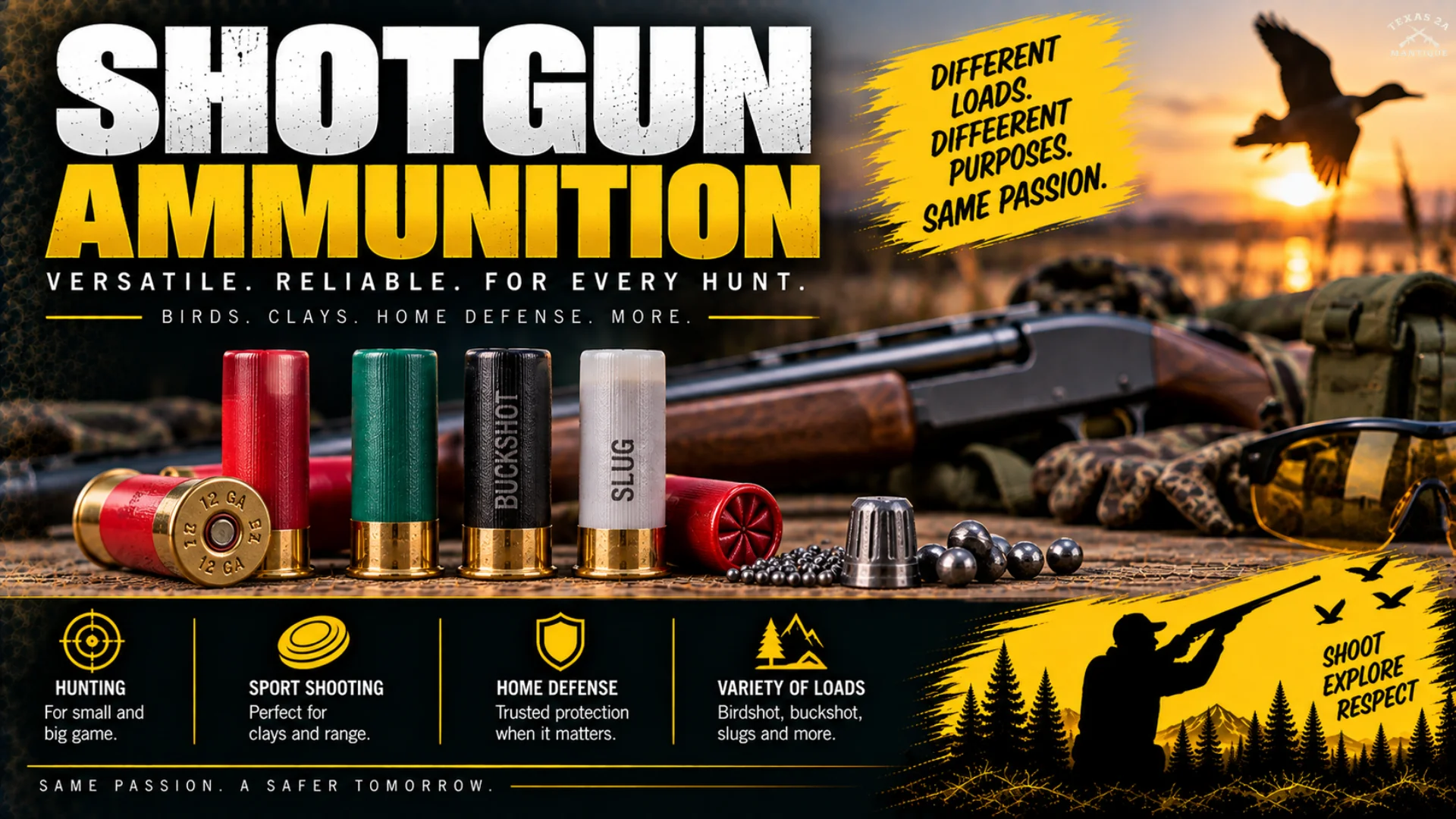
Shotgun ammunition – often called shotgun shells or shotshells – is the ammo made specifically for shotguns.
Here’s the simple difference: a rifle or handgun fires one bullet. A shotgun shell can fire many tiny pellets at once, or one solid piece, depending on how it’s loaded. That’s what makes it so flexible.
Because of this, shotgun ammunition is used for a lot of different things:
- Hunting birds, deer, and other game
- Clay target sports (trap, skeet, sporting clays)
- Home defense
- Everyday target practice
The five parts of a shell
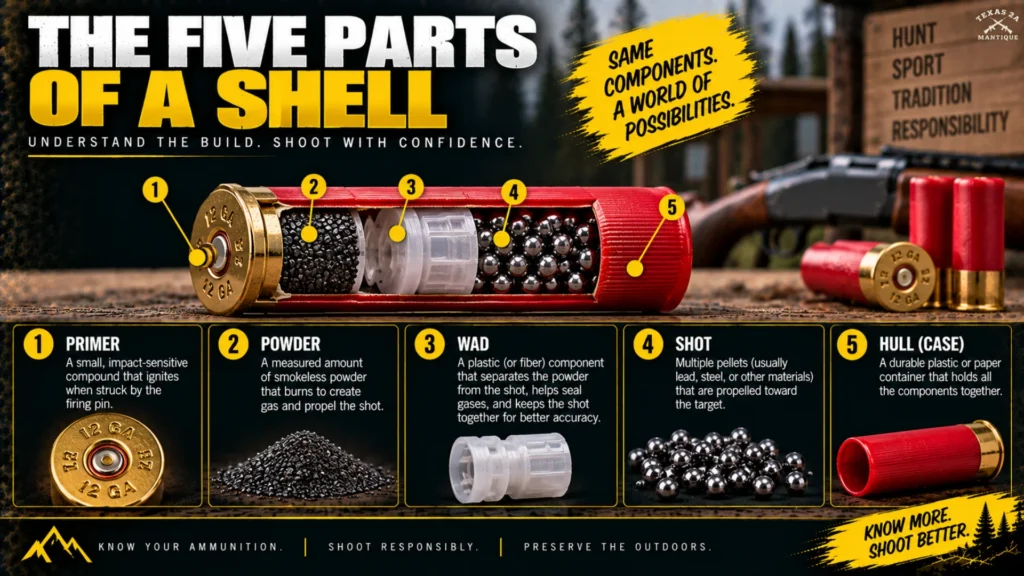
Every shotgun shell is built the same basic way. Five parts, each doing one job:
1. The hull
This is the outer tube of the shell – usually plastic with a metal ring at the bottom. Think of it as the shell’s “body.” It holds everything else inside and has to be tough enough to handle the pressure of firing.
2. The primer
A small, sensitive part at the base of the shell. When the gun’s firing pin hits it, it sparks, and that spark starts everything else moving.
3. The powder
A measured amount of gunpowder sits inside the hull. Once the primer sparks it, the powder burns fast and creates a rush of gas. That gas is what pushes everything forward.
4. The wad
A small cushion that sits between the powder and the pellets (or slug). It holds the gas behind the payload, protects the inside of the barrel, and helps shape how the shot spreads once it leaves the gun.
5. The shot or the slug
This is the part that actually leaves the gun and does the work. It’s either:
- Shot – a cluster of small round pellets
- Slug – one single solid piece
How it all fires – step by step
When someone pulls the trigger, this happens in less than a second:
- The firing pin hits the primer.
- The primer sparks and lights the powder.
- The powder burns fast and makes gas pressure build up.
- That pressure pushes the wad and the shot (or slug) down the barrel.
- The payload leaves the gun, pellets spread out into a pattern, while a slug flies on as one piece.
Safety note: The shell has to match the shotgun exactly – same gauge and a length the gun’s chamber can safely handle. Using the wrong shell can damage the gun or hurt the shooter.
What does “gauge” mean?
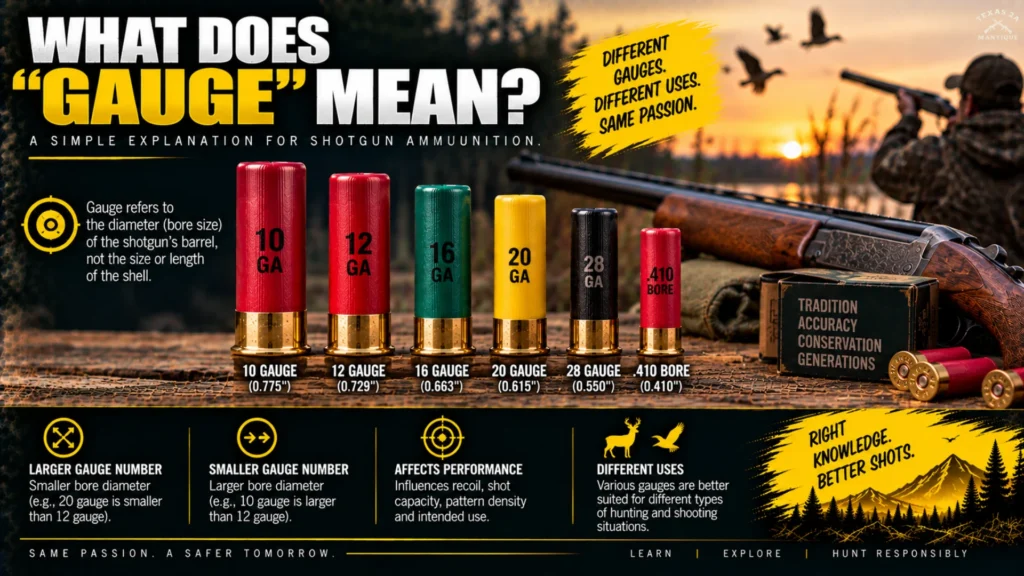
Gauge is just a way of measuring how wide the shotgun’s barrel is. It sounds backward at first: the smaller the number, the bigger the barrel. So a 12-gauge shotgun has a wider barrel than a 20-gauge shotgun.
Where does the number come from? Old-fashioned math: it’s based on how many lead balls of that exact width it would take to weigh one pound, together. A 12-gauge means 12 of those balls would weigh a pound.
One shell breaks this rule: the .410. People often call it a gauge, but it’s actually measured differently — in inches, like a caliber — not by the lead-ball method.
| Gauge | Best used for | Recoil (kick) | Good to know |
| 12 gauge | Hunting, sport, defense | Medium–High | Most common, easiest to find |
| 20 gauge | Hunting, sport | Medium | Kicks less than 12 gauge |
| 16 gauge | Hunting | Medium | Less common today |
| 28 gauge | Sport shooting | Low | Harder to find in stores |
| .410 bore | Training, small game | Very low | Not really a “gauge” |
Fun fact: shotguns used to also come in huge 4-gauge and 8-gauge sizes, and tiny 24-gauge and 32-gauge sizes. Those are mostly collector’s items now.
Shell length and the gun’s “chamber”
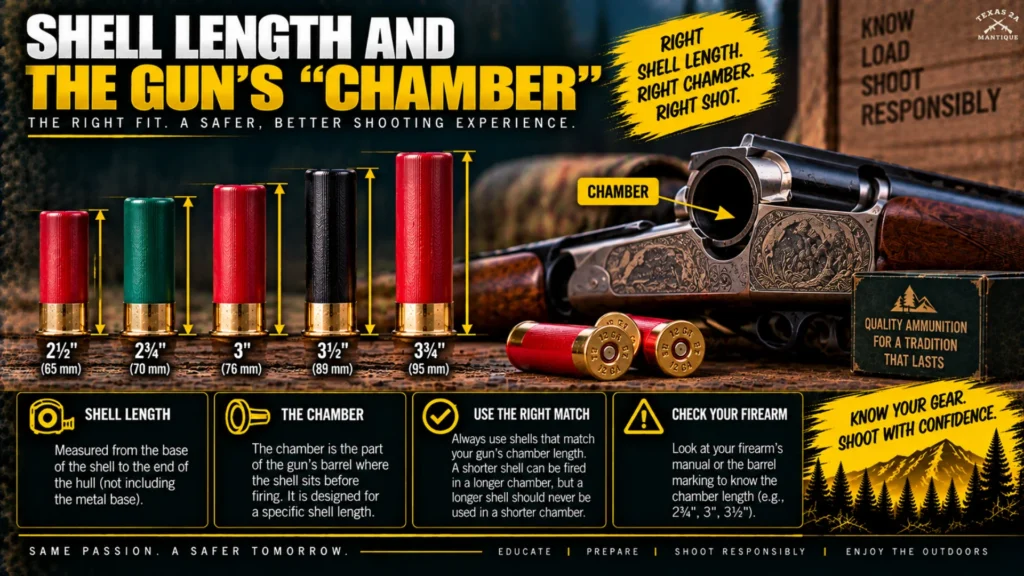
Shells also come in different lengths – usually 2¾ inches, 3 inches, or 3½ inches. Your shotgun has a part called the chamber length, which is the maximum shell length it’s built to handle safely.
Simple rule: the shell must be the same length as, or shorter than, what your gun’s chamber allows. Never longer.
Why? When a shell fires, it unfolds and takes up its full length inside the chamber. If it’s too long for the space, pressure builds up dangerously – that’s a real safety risk, not just a performance issue.
Speed (velocity) and an old measurement called “dram equivalent”
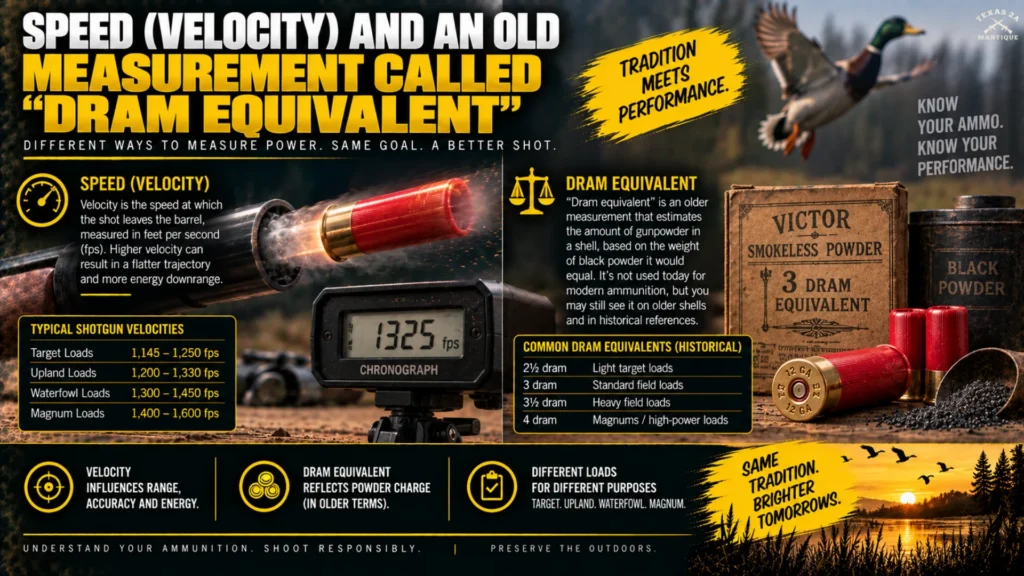
The box will usually list a speed, measured in feet per second (FPS). This tells you how fast the shot or slug leaves the barrel.
- Higher speed = more power, but usually more kick (recoil)
- Lower speed = gentler to shoot, common for target practice
You might also see “dram equivalent” on older or traditional boxes. It’s a leftover term from the days of black powder guns. It doesn’t measure anything exact today, but it’s still a rough way to compare how strong one shell is next to another – higher number, more punch.
Shot weight – how much is inside
Shot weight tells you the total weight of all the pellets in the shell, measured in ounces. It does not tell you how big each pellet is — that’s a different number (see the next section).
Common weights you’ll see: 7/8 oz, 1 oz, 1⅛ oz, and 1¼ oz.
More weight generally means more pellets and a bit more kick. Less weight is usually easier and more comfortable to shoot, especially over a long session.
Shot size –how big each pellet is
Shot size tells you the size of each individual pellet inside the shell. This is where it gets a little confusing, so here’s the trick to remember: smaller number = bigger pellet.
- Small pellets (birdshot): #9, #8, #7½ — good for birds and clay targets
- Bigger pellets: #4, #2, BB
- Largest pellets (buckshot): 00 buck, 000 buck — used for bigger game and home defense
Bigger pellets hit harder but there are fewer of them per shell. Smaller pellets spread wider and are gentler — good for small, fast-moving targets.
What are pellets made of?
Shot is usually made from lead, steel, or a tungsten blend. This matters for two reasons: material changes how the shot performs, and some places have rules about it. Many areas require non-lead shot for waterfowl hunting, for example, so it’s worth checking local laws before buying.
Lead shot
Lead has been the traditional choice for a long time. It’s heavy for its size, which helps it keep energy over distance, and it’s usually the most affordable option. The downside is that lead is toxic to wildlife if it’s left in the environment, which is why many places restrict it – especially over water, where waterfowl can pick it up from the mud.
Steel shot
Steel is lighter than lead, so for the same pellet size it doesn’t carry quite as much energy at longer range. Shooters usually go up one or two shot sizes to make up for this. Steel is required in many wetland and waterfowl hunting areas because it doesn’t poison the environment the way lead can.
Tungsten and other heavy alloys
Tungsten-based shot is denser than lead, which means smaller pellets can still hit hard at distance. It’s popular for turkey hunting, where dense, precise patterns matter a lot. The trade-off is price — tungsten loads cost noticeably more than lead or steel.
Chokes – how the barrel shapes the shot pattern
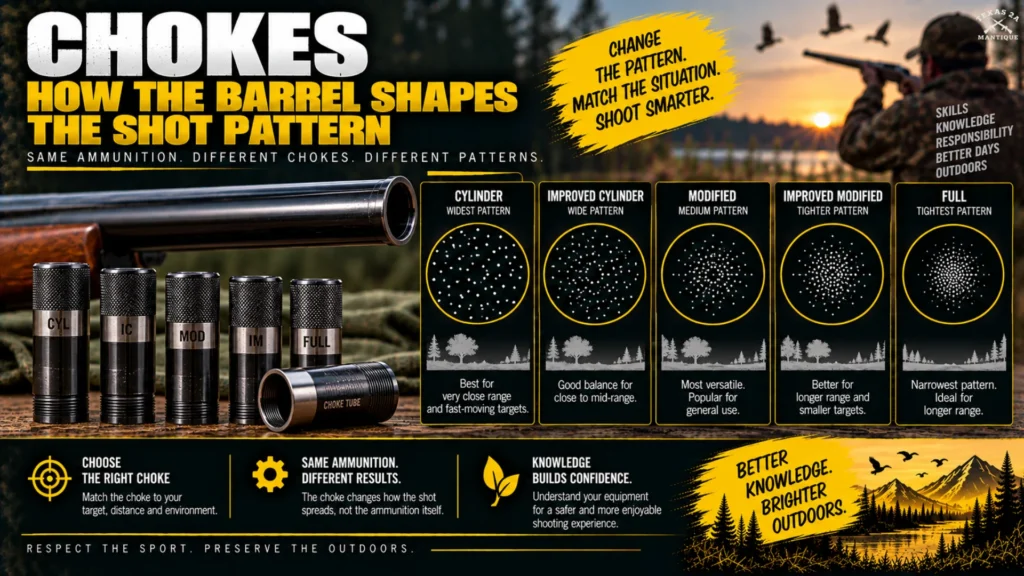
A choke is a narrowing built into the end of the barrel (or a screw-in piece that fits there). It squeezes the shot slightly as it leaves the gun, which controls how wide or tight the pattern spreads out.
- Open chokes (like Cylinder or Improved Cylinder): wider spread, better for close targets — common for home defense and close bird flushes
- Tighter chokes (like Modified or Full): narrower, denser pattern that reaches farther — common for longer shots at clays or game
The choke and the shot size work together. A tight choke with small pellets gives a very dense pattern at range; an open choke with the same pellets spreads out fast and is only effective up close. This is why the “right” ammunition depends on both the shell and the gun it’s fired from.
Patterning your shotgun – why it’s worth doing
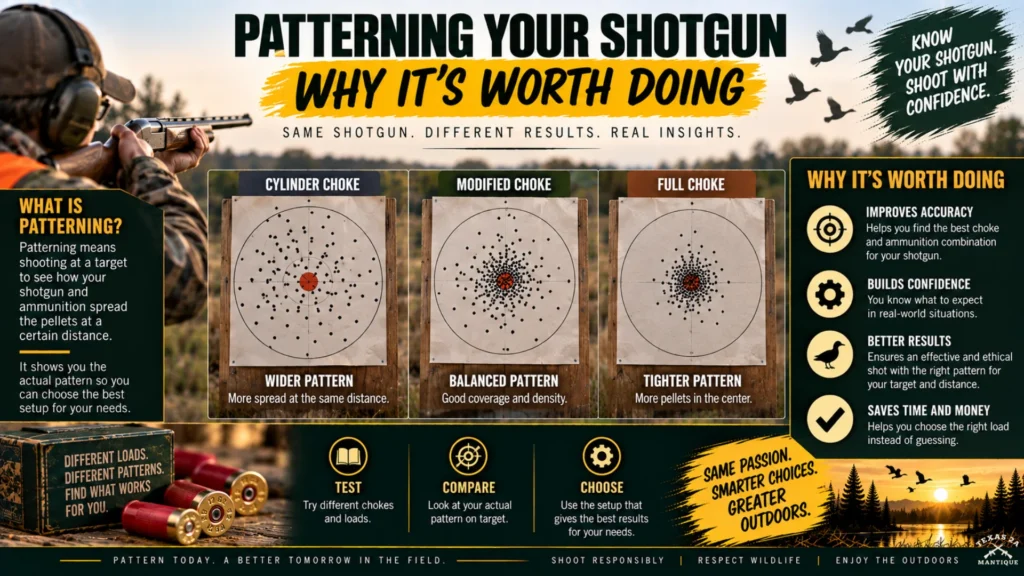
“Patterning” means firing a shell at a large paper target from a set distance, then looking at where the pellets actually landed. It sounds simple, but it’s one of the most useful things a shotgun owner can do, because two shotguns — or two different shells — rarely pattern exactly the same way.
- Set up a large sheet of paper (about 30 by 30 inches) at the distance you expect to actually shoot — for example, 15 yards for home defense, or 25–40 yards for hunting.
- Fire one shot at the center of the paper.
- Look at how the pellets spread: is the pattern even, or bunched to one side? How much of the paper do the pellets cover?
- Try a different shell or choke if the pattern is too tight, too wide, or uneven for what you need.
Why this matters: the box tells you what a shell is designed to do, but only patterning tells you how it actually performs out of your specific gun.
Birdshot vs. buckshot vs. slug – which one do you need?
Birdshot – lots of small pellets. Best for birds and clay targets, where a wide spread helps you hit a small, moving target.
Buckshot – fewer, bigger pellets. Hits harder in a tighter group. Common choice for home defense and hunting medium-sized animals.
Slug – one solid piece, not pellets at all. Goes farther and hits hardest of the three. Used for deer hunting or defense at longer range.
How to pick the right shell – 5 simple checks
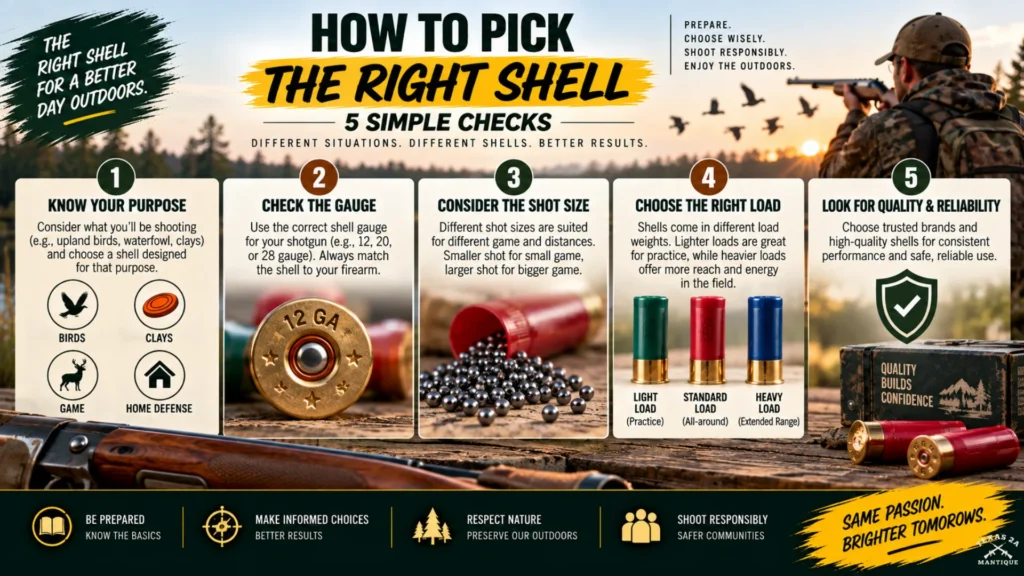
- Match the gauge exactly. The number on the box must match the number stamped on your gun. Shells don’t swap between gauges, even if they look close.
- Check the length. Never use a shell longer than your gun’s chamber allows.
- Pick the right type. Birdshot for targets and birds, buckshot for defense or medium game, slugs for bigger game or longer range.
- Look at speed and weight. These affect how much the gun kicks and how the shot performs.
- Check the material. Make sure it’s legal where you’re hunting, especially for waterfowl.
Matching ammo to the task at hand
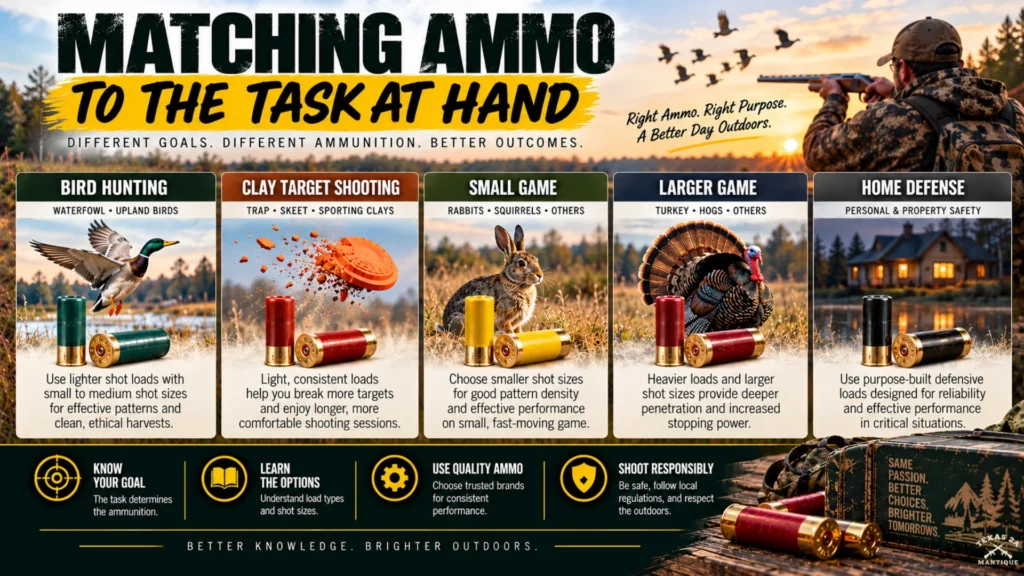
Bird hunting and clay sports
Small birdshot (like #7½, #8, or #9) is the standard choice. It throws a wide pattern of small pellets, which works well against fast, small targets like clays, doves, or quail. Lighter loads also mean less recoil over a long day of shooting.
Deer and larger game
This usually means either buckshot (in some states, for shotgun-only deer seasons) or a slug. Slugs are generally the more reliable choice for larger game because a single heavy projectile carries enough energy to make a clean, ethical shot at a reasonable range.
Turkey hunting
Turkeys have small vital areas but tough feathers, so hunters often reach for very dense, small shot — including specialty tungsten (TSS) loads — to get enough pellets into a tight pattern at the head and neck.
Home defense
Buckshot is the most common choice, since it hits hard without the extreme range of a slug. Something worth knowing: any shotgun load can pass through interior walls, so “over-penetration” (the shot going further than intended) is a real safety consideration, not just a hunting one. Many people find it worth talking to a firearms instructor about shot size and range specifically for a home environment.
Storing shotgun ammunition safely
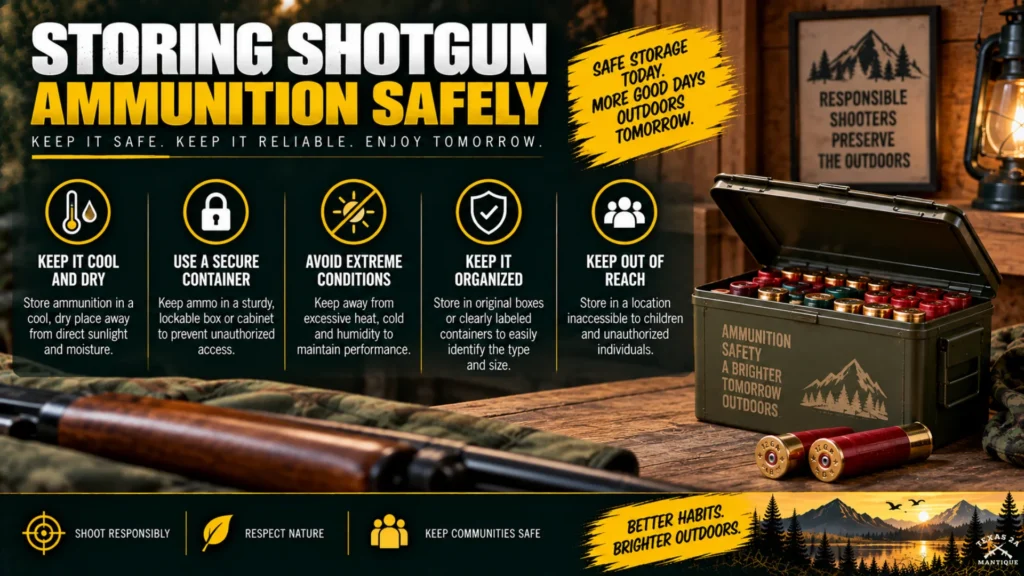
Shotgun shells are simple to store, but a few habits make a real difference in how long they last and how safely they’re kept:
- Keep them cool and dry. Moisture is the biggest enemy — it can swell the hull or damage the powder and primer.
- Avoid big temperature swings. A hot car trunk or a damp basement both shorten a shell’s usable life.
- Store shells separately from firearms, and lock both up — this is standard practice for safety, especially in a home with children.
- Keep them in their original box where possible. The box keeps the gauge and load information with the shells, which avoids mix-ups later.
- Don’t use damaged shells. A cracked hull, a dented case, or visible corrosion is a reason to safely dispose of a shell rather than fire it.
Common mistakes beginners make
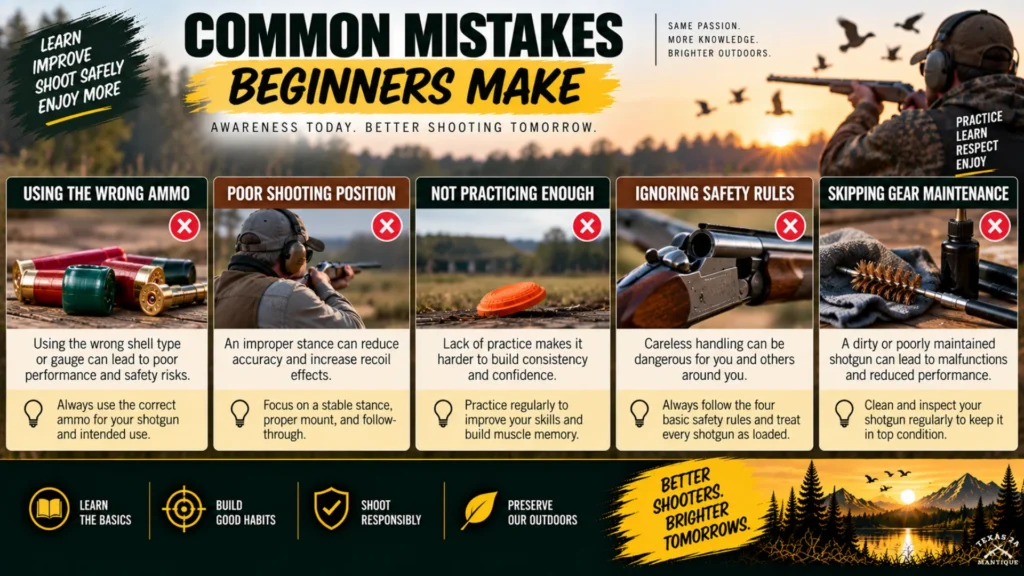
- Assuming shells are interchangeable between gauges. A 20-gauge shell can actually fall into a 12-gauge barrel and lodge itself out of sight — then a 12-gauge shell can be loaded behind it. This is a well-known, serious accident. Always double-check gauge before loading.
- Ignoring chamber length. A gun marked “2¾” only” is not rated for 3″ shells, even if they physically fit.
- Choosing shot size by habit rather than task. The load that’s great for clays isn’t the right choice for turkey, and the load that’s right for turkey is overkill — and expensive — for practice.
- Never patterning the gun. Assuming a shell will perform exactly as advertised without ever testing it on paper.
- Forgetting local shot-material laws. Lead shot is illegal for waterfowl hunting in most areas — checking local regulations takes a minute and avoids a serious problem.
Conclusion
Understanding shotgun ammunition becomes much easier once you know the basics—from gauge and chamber length to shot size, shell weight, payload types, and choke selection. The right ammunition must always be matched to the specific shotgun, intended use, and applicable local regulations. Safe storage, careful handling, and following the manufacturer’s instructions are equally important.
At Texas2A Mantique, our goal is to make firearm-related information easier to understand through clear, practical, and responsible resources. Whether you are learning the terminology for the first time or looking to refresh your knowledge, understanding how shotgun ammunition works can help you make more informed and safety-conscious decisions.
Always verify ammunition specifications against your firearm’s markings and owner’s manual, and consult a qualified firearms professional when you are unsure. Staying informed is an important part of responsible firearm ownership.


Leave a Reply