
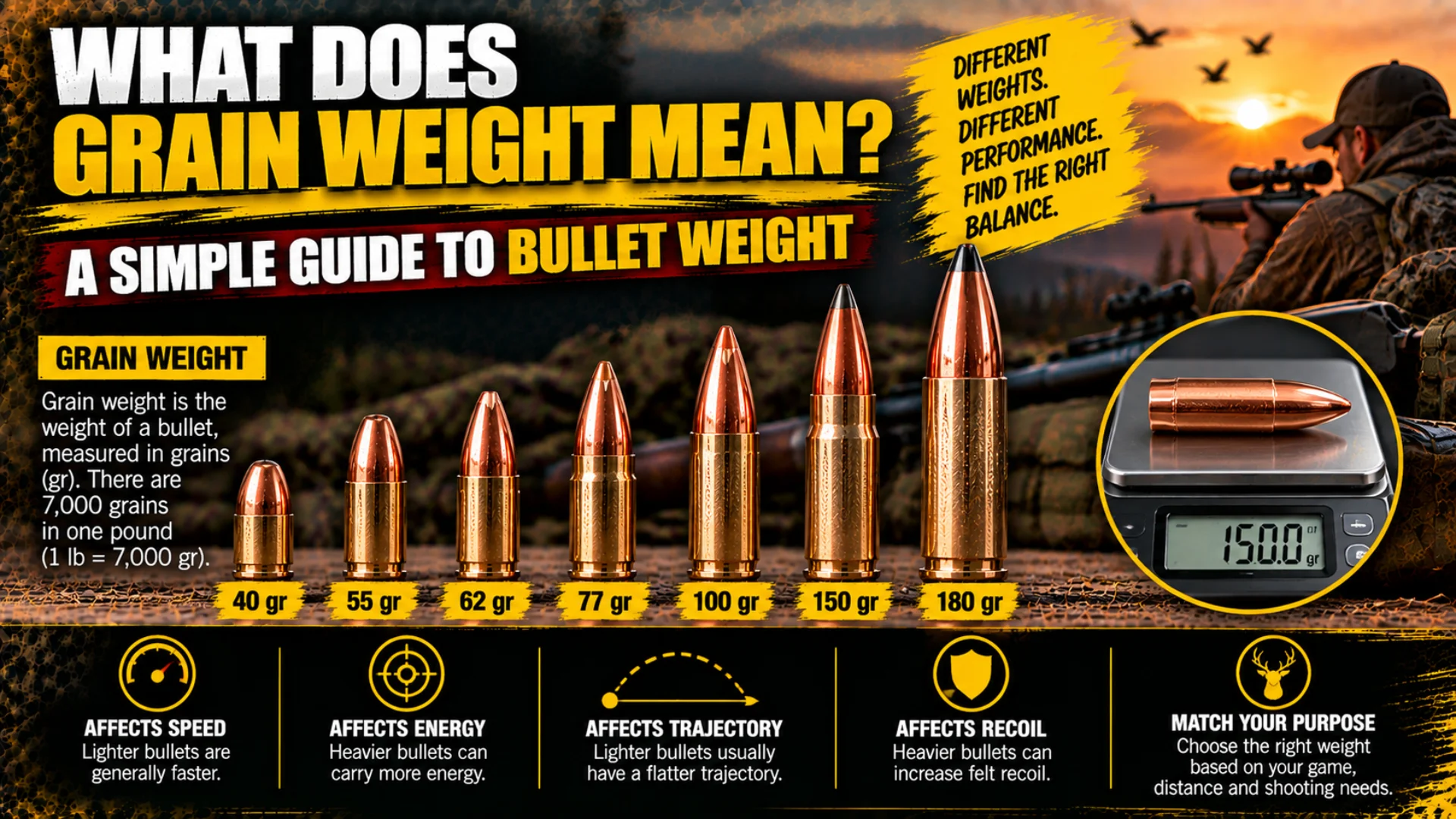
Grain weight is one of the first things you will notice when looking at ammunition specifications. You may see labels such as 115 gr, 124 gr, 147 gr, 55 gr, or 180 gr.
But what does that number actually mean?
A grain is a unit of weight used in the ammunition industry. When ammunition is described as 115 grains, the number normally refers to the weight of the projectile (bullet), not the amount of powder inside the cartridge.
Bullet weight can affect several aspects of ammunition performance, including velocity, trajectory, recoil characteristics, and stability. However, bullet weight does not work alone. Bullet design, velocity, barrel characteristics, cartridge loading, and firearm specifications also matter.
This guide explains grain weight in simple terms and shows why it matters.
Quick Answer: What Does Grain Weight Mean?
Grain weight describes the weight of the bullet or projectile.
A grain, abbreviated gr, is a small unit of mass. There are:
- 7,000 grains in 1 avoirdupois pound
- 437.5 grains in 1 avoirdupois ounce
- 1 grain ≈ 64.8 milligrams
For example, a 115-grain bullet weighs approximately 7.45 grams.
The grain number on an ammunition specification should not be confused with the amount of propellant in the cartridge. Grain is also used as a unit when describing propellant charges in handloading, but that is a different measurement.
What Is a Grain?
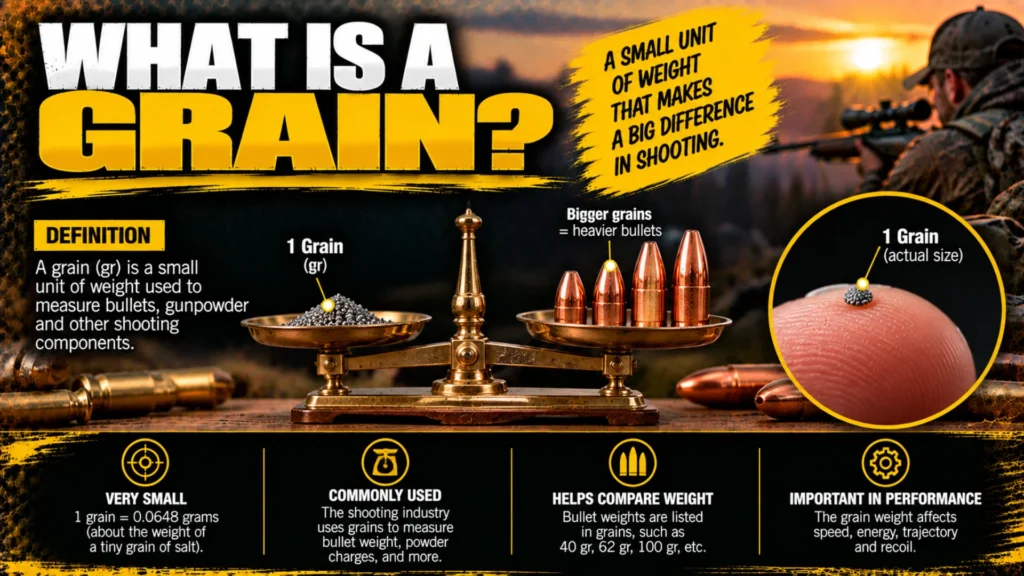
The grain is an old unit of measurement that is still widely used in ammunition specifications.
Today, it has a precise relationship with the pound:
1 pound = 7,000 grains
The grain is used in ammunition because it provides a convenient way to describe relatively small projectile weights.
Grain Weight Conversion
| Grain Weight | Approx. Weight in Grams |
|---|---|
| 40 gr | 2.59 g |
| 55 gr | 3.56 g |
| 77 gr | 4.99 g |
| 115 gr | 7.45 g |
| 124 gr | 8.04 g |
| 147 gr | 9.53 g |
| 180 gr | 11.66 g |
| 230 gr | 14.90 g |
Does Grain Weight Mean the Amount of Gunpowder?
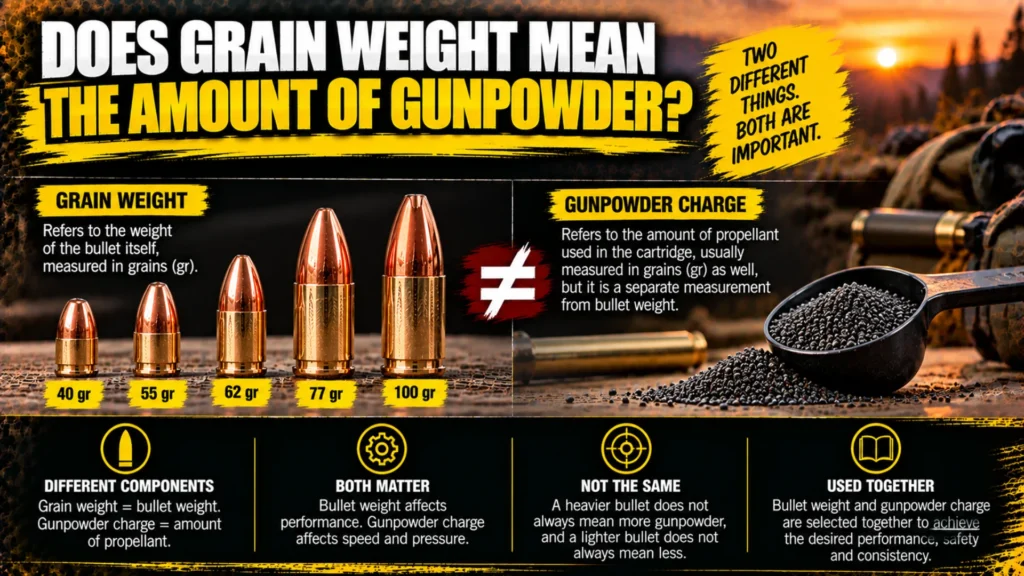
No – not when the grain number is describing bullet weight.
This is one of the most common sources of confusion.
The main cartridge components are:
- Bullet/projectile – the projectile that leaves the barrel.
- Case – the container that holds the cartridge components.
- Propellant – produces expanding gas that accelerates the projectile.
- Primer – initiates ignition of the propellant.
The same unit – grains – can also be used when discussing propellant quantities, particularly in handloading. The term grain can also refer to a particle of propellant, although “kernel” or “granule” is more precise.
Therefore, context matters.
115 gr bullet weight means the projectile weighs 115 grains.
It does not mean that the cartridge contains 115 grains of propellant.
Why Does Bullet Grain Weight Matter?
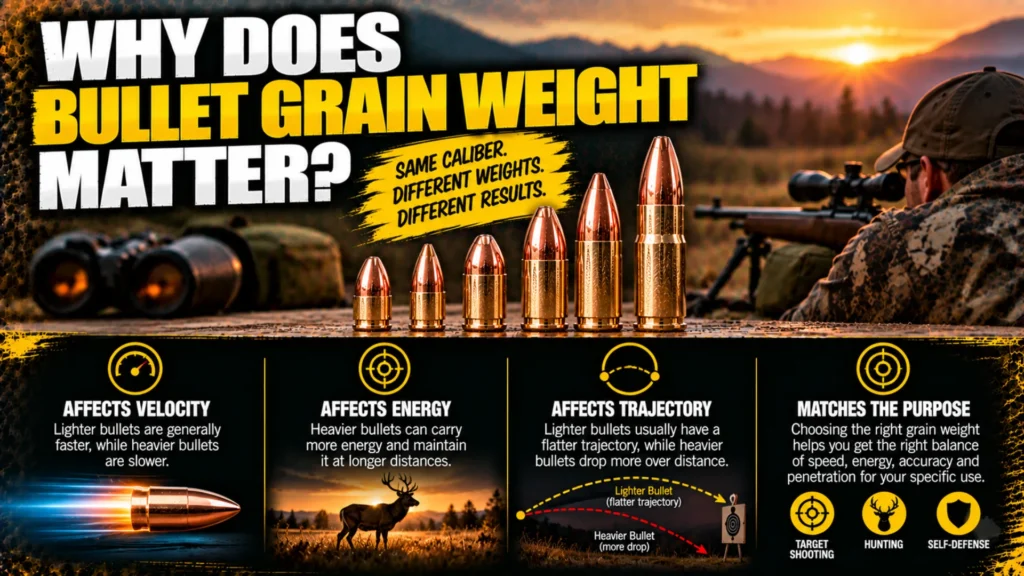
Changing bullet weight can change how a cartridge behaves.
However, bullet weight should not be considered by itself. Performance also depends on factors such as:
- Bullet shape
- Bullet construction
- Cartridge loading
- Muzzle velocity
- Barrel length
- Barrel twist rate
- Atmospheric conditions
- Firearm design
A useful way to understand the effect is to look at three stages of bullet behavior:
1. Internal Ballistics
This describes what happens while the projectile is inside the firearm. Bullet weight can influence acceleration and recoil characteristics.
2. External Ballistics
This describes what happens after the projectile leaves the barrel. Velocity, drag, trajectory, wind, bullet shape, and ballistic coefficient all influence flight.
3. Terminal Ballistics
This describes what happens when the projectile reaches a target. Bullet construction, velocity, impact conditions, and other factors can influence penetration and deformation.
Light vs. Heavy Bullets
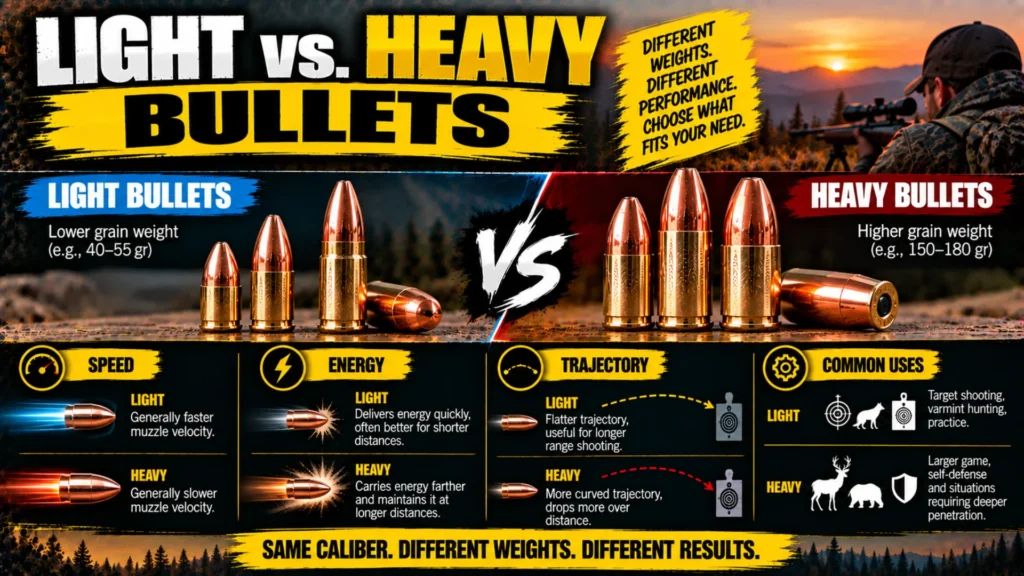
A common generalization is:
Lighter bullet → usually higher velocity
Heavier bullet → usually lower velocity
But this is not a universal rule because ammunition manufacturers can use different loads and bullet designs.
For example, Federal’s published ammunition data includes 9mm loads using both 115-grain and 124-grain projectiles, with different listed velocities and energies.
This demonstrates an important point:
Bullet weight and velocity should be considered together.
A heavier bullet is not automatically “more powerful,” and a lighter bullet is not automatically “weaker.”
How Grain Weight Can Affect Velocity
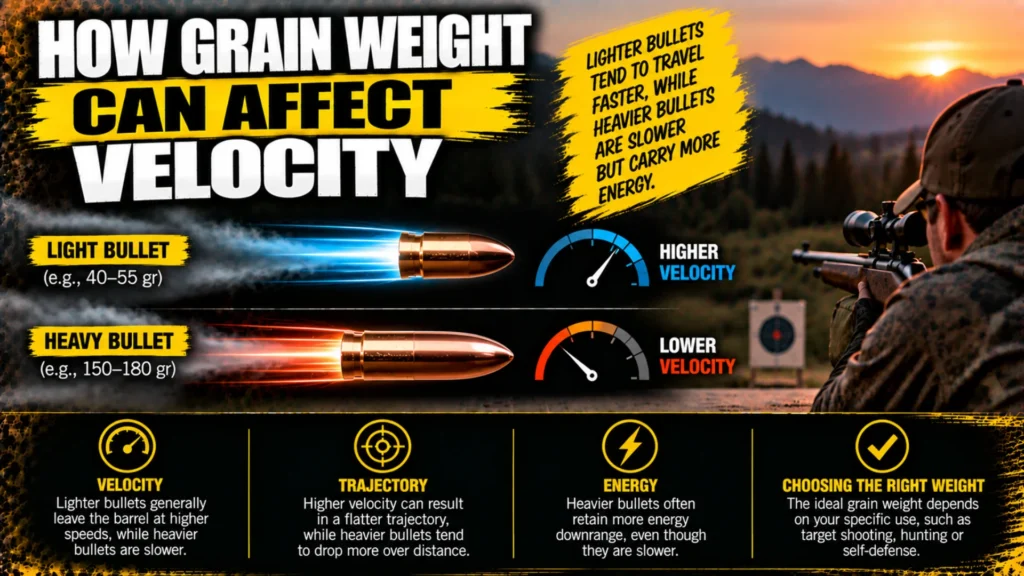
When comparing otherwise similar loads, a heavier projectile generally requires more energy to accelerate to the same velocity.
This is why different bullet weights in the same cartridge can have different muzzle velocities.
For example, two cartridges can have the same caliber but use different projectile weights.
The lighter projectile may have a higher advertised muzzle velocity, while the heavier projectile may have a lower velocity.
However, ammunition specifications are based on the complete cartridge design. You should therefore compare actual manufacturer data rather than assuming a particular velocity from bullet weight alone.
How Grain Weight Can Affect Recoil
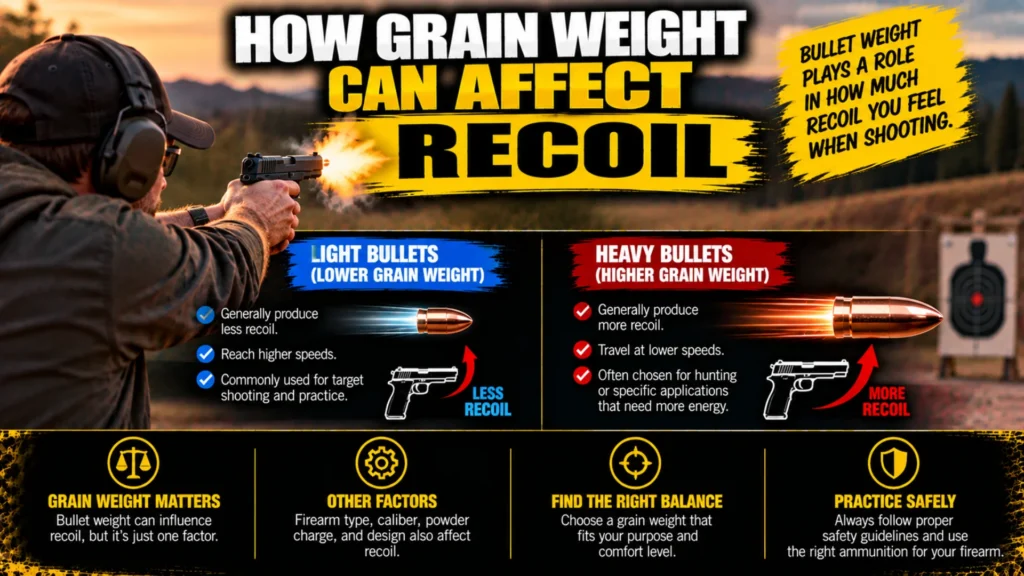
Recoil is another area where simple explanations can be misleading.
A heavier projectile has greater momentum at the same velocity. However, ammunition with different bullet weights may also use different propellant charges and velocities.
That means:
Bullet weight alone does not determine felt recoil.
The firearm itself also matters. Factors such as firearm mass, operating system, grip design, and other characteristics affect how recoil is perceived.
This is why two loads with different bullet weights can feel different even when fired from the same firearm.
Does Bullet Weight Affect Accuracy?
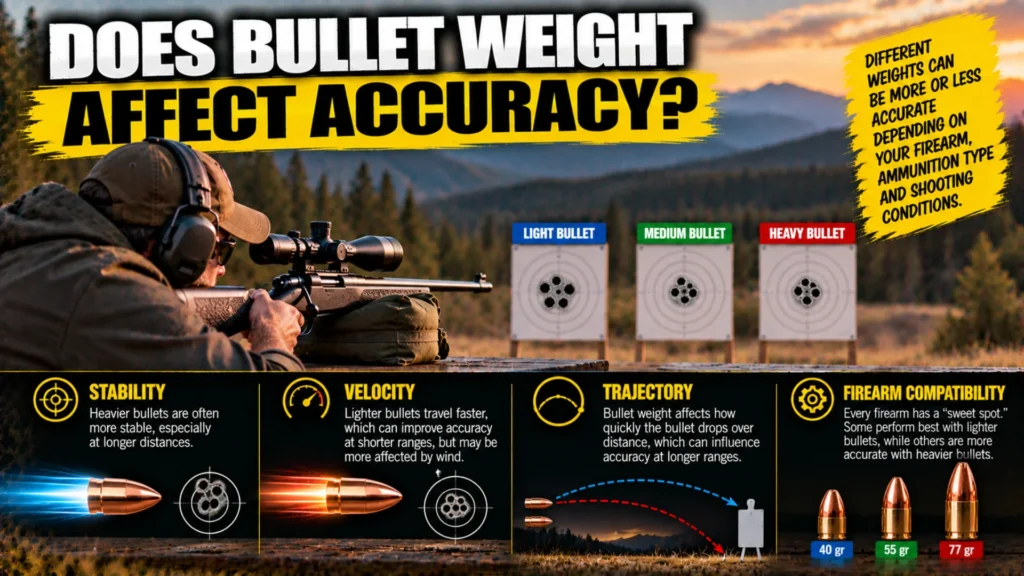
It can.
Different ammunition loads can produce different group sizes in the same firearm.
Several factors are involved, including:
- Bullet weight
- Bullet design
- Velocity
- Consistency of ammunition
- Barrel characteristics
- Twist rate
- Firearm condition
- Environmental conditions
At short distances, differences may be relatively small. As distance increases, external ballistics become increasingly important.
For this reason, accuracy should be evaluated using the ammunition and firearm combination rather than assuming that one bullet weight is automatically more accurate.
Bullet Weight and Barrel Twist Rate
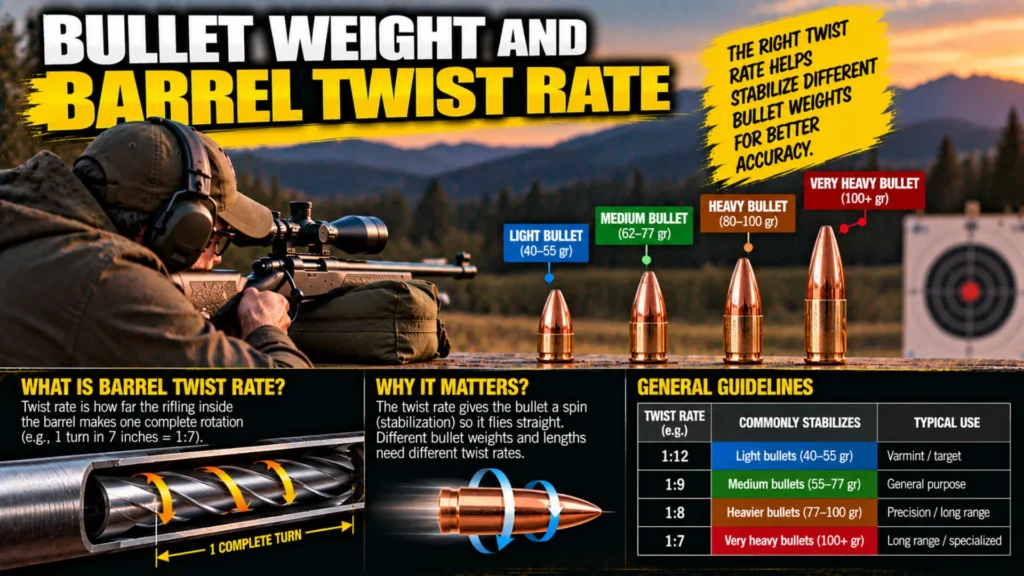
If you are reading rifle ammunition specifications, you may also encounter the term twist rate.
Twist rate describes how quickly the rifling spins the projectile.
For example:
1:8 twist
means the projectile makes approximately one complete rotation for every eight inches of barrel travel.
Bullet length, construction, and weight can all be relevant to projectile stability. In general, longer projectiles require more rotational stability.
Manufacturers therefore consider projectile characteristics when specifying suitable twist rates.
Hornady’s technical information, for example, discusses projectile stability and the relationship between projectile design, mass, and twist rate.
Important:
Do not select ammunition solely from a generic twist-rate chart.
Always follow the firearm and ammunition manufacturer’s specifications for your particular firearm and cartridge.
Does a Heavier Bullet Have More Power?

Not necessarily.
This is one of the biggest myths about grain weight.
A projectile’s performance depends on more than its weight.
Two important measurements are:
Momentum
Momentum depends on mass and velocity.
A heavier projectile moving at a particular velocity can have greater momentum than a lighter projectile moving at the same velocity.
Kinetic Energy
Kinetic energy depends strongly on velocity as well as projectile mass.
The basic relationship is:
Kinetic Energy = ½ × Mass × Velocity²
This is why velocity can have a significant effect on energy.
Therefore:
A higher grain number does not automatically mean a more powerful cartridge.
Published ammunition tables commonly report bullet weight, muzzle velocity, energy, and trajectory together rather than treating bullet weight as a standalone measure of performance.
What Is Ballistic Coefficient?
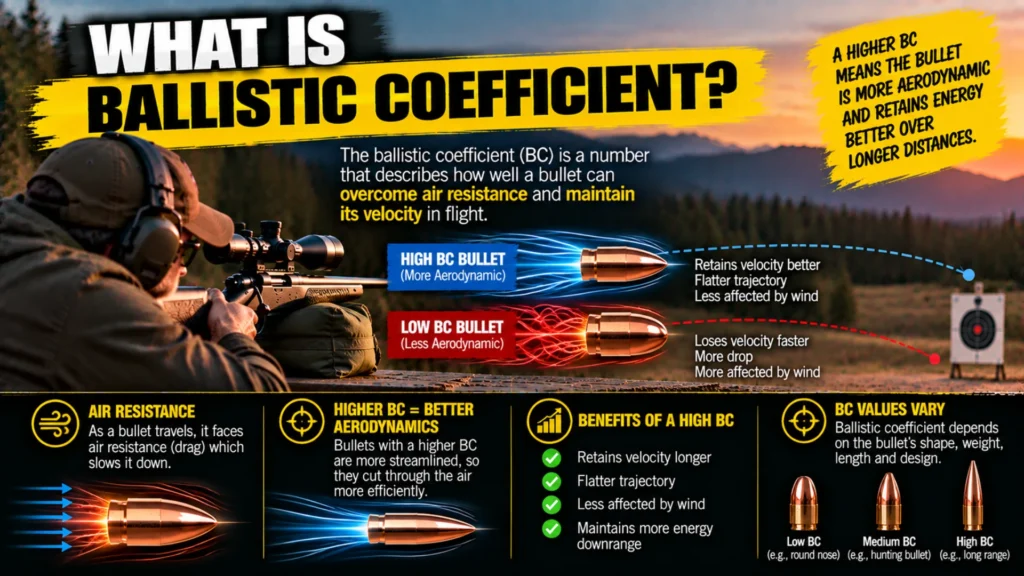
Another important term is ballistic coefficient, often abbreviated BC.
Ballistic coefficient describes how efficiently a projectile moves through the air compared with a reference projectile.
A projectile’s:
- Shape
- Diameter
- Weight
- Aerodynamic design
can influence its ballistic performance.
A higher BC can generally indicate better aerodynamic efficiency under the applicable measurement system and conditions.
However, BC is not simply a property of bullet weight.
Hornady notes that BC can change with velocity and that comparisons need to use the same measurement system and appropriate conditions.
This is why saying “heavier bullets always resist wind better” is too simple.
Bullet design matters.
Common Bullet Weights by Cartridge
The following table gives examples of commonly encountered projectile weights. Exact offerings vary by manufacturer, cartridge specification, and ammunition type.
| Cartridge | Common Example Bullet Weights |
|---|---|
| .22 LR | 30–40 gr |
| 9mm Luger | 115, 124, 147 gr |
| .40 S&W | 155–180 gr |
| .45 ACP | 185–230 gr |
| .223 Remington / 5.56 | 55, 62, 75–77 gr |
| .300 Blackout | Various light and heavy loads |
| .308 Winchester / 7.62×51 | 147–180 gr |
| 7.62×39 | Around 123–124 gr |
| 6.5 Creedmoor | Broad range depending on bullet design |
These are examples rather than universal recommendations.
Federal’s published ammunition catalog, for example, lists different bullet weights and performance figures for the same cartridge family.
Why the Same Caliber Can Have Different Grain Weights
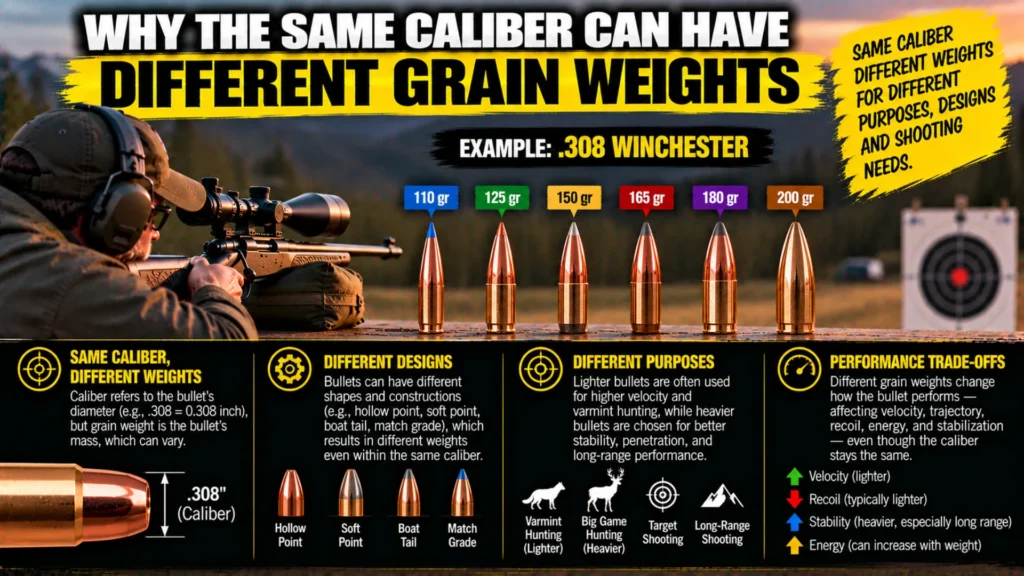
A caliber identifies a cartridge or approximate projectile diameter, but it does not determine a single bullet weight.
For example, 9mm ammunition is commonly available with different projectile weights.
The caliber describes one part of the ammunition specification.
The bullet weight describes another.
Think of it this way:
Caliber = size/designation
Grain weight = projectile weight
They are related, but they are not the same thing.
How to Read Grain Weight on an Ammunition Box
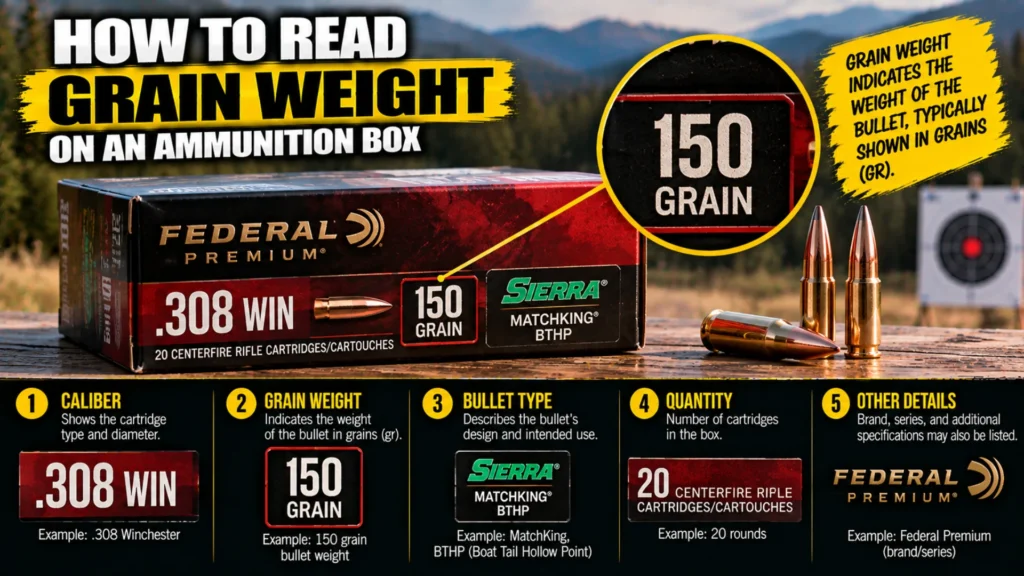
When looking at ammunition specifications, you may see something like:
9mm Luger – 124 gr
This generally means:
- 9mm Luger = cartridge designation
- 124 gr = projectile weight
You may also see additional information such as:
- Bullet type
- Muzzle velocity
- Muzzle energy
- Manufacturer
- Lot information
- Cartridge quantity
A ballistic table may provide additional information about velocity, energy, and trajectory.
How Should You Choose Bullet Weight?
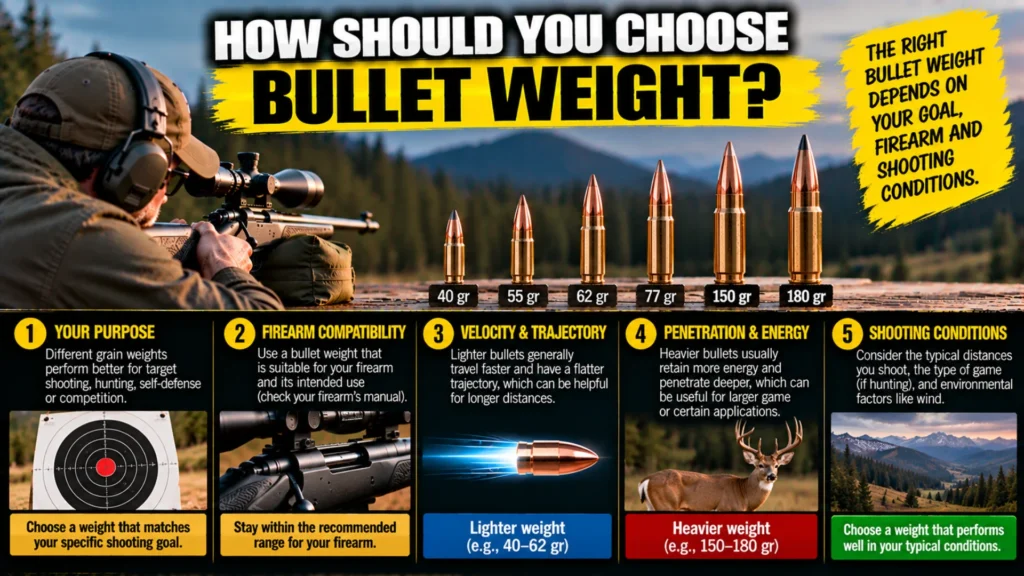
There is no universal “best” grain weight.
The appropriate ammunition depends on the firearm, cartridge, manufacturer’s specifications, and intended lawful use.
A sensible approach is:
1. Start with the firearm manual
Check the ammunition and cartridge specifications provided by the manufacturer.
2. Confirm the cartridge
Make sure the ammunition matches the firearm’s chambering.
3. Check manufacturer information
Look at the ammunition manufacturer’s published specifications for bullet weight, velocity, and other characteristics.
4. Consider your purpose
Different ammunition is designed for different applications, such as:
- General range use
- Target shooting
- Competition
- Hunting
- Other lawful applications
5. Test ammunition safely
Different firearms can produce different results with different factory loads.
Follow the firearm manufacturer’s instructions and use appropriate range safety practices.
Grain Weight: The Simple Explanation
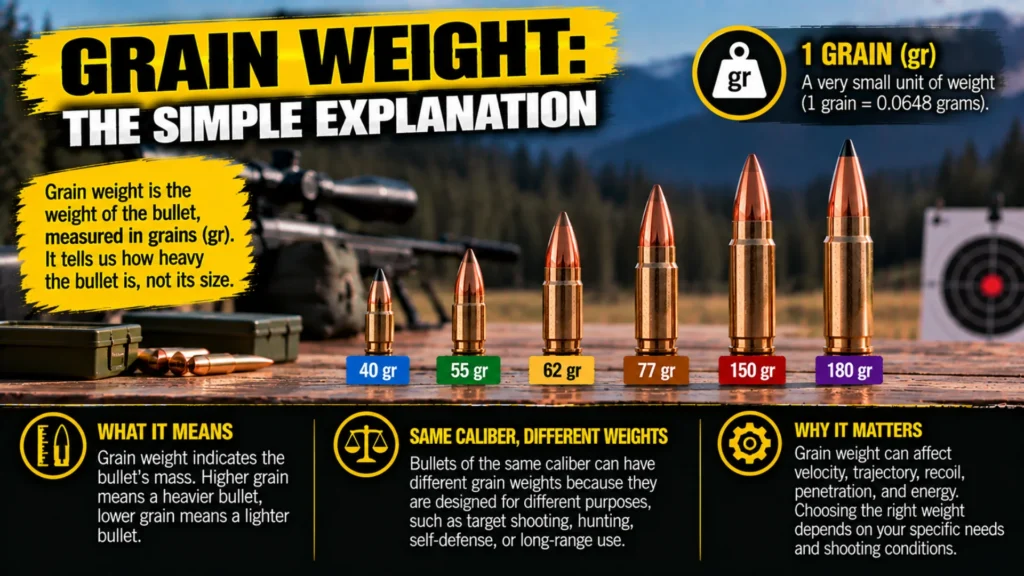
If you remember only one thing, remember this:
Grain weight tells you how much the projectile weighs.
A higher grain number means a heavier projectile.
A lower grain number means a lighter projectile.
But grain weight does not tell the entire story.
Ammunition performance is influenced by a combination of:
Bullet weight + bullet design + velocity + cartridge loading + barrel characteristics + firearm design + environmental conditions
That is why two cartridges with the same caliber can behave differently.
Understanding grain weight is therefore useful, but it should always be considered together with the complete ammunition specification.
Final Thoughts
Understanding grain weight makes ammunition specifications much easier to read and compare. A grain is simply a unit used to describe the weight of a projectile, so a higher grain number means a heavier bullet.
However, bullet weight is only one part of the overall picture. Velocity, bullet design, ballistic coefficient, barrel characteristics, and the firearm itself can all influence how a particular load performs. A heavier bullet is not automatically more powerful or more accurate, just as a lighter bullet is not automatically better.
The most important approach is to look at the complete ammunition specification and follow the firearm manufacturer’s guidance. Understanding the difference between caliber, bullet weight, velocity, and other ballistic specifications can help you make better-informed decisions and understand what the numbers on an ammunition box actually mean.
At Texas2AMantique, our goal is to provide clear, practical, and informative firearm and ammunition content that helps readers understand the technical details without unnecessary complexity. Whether you are learning what “gr” means for the first time or simply want a better understanding of ammunition specifications, knowing how grain weight fits into the bigger picture is a useful part of firearm knowledge.


Leave a Reply