5.56 NATO vs .223 Remington vs .308 Winchester vs 6.5 Creedmoor
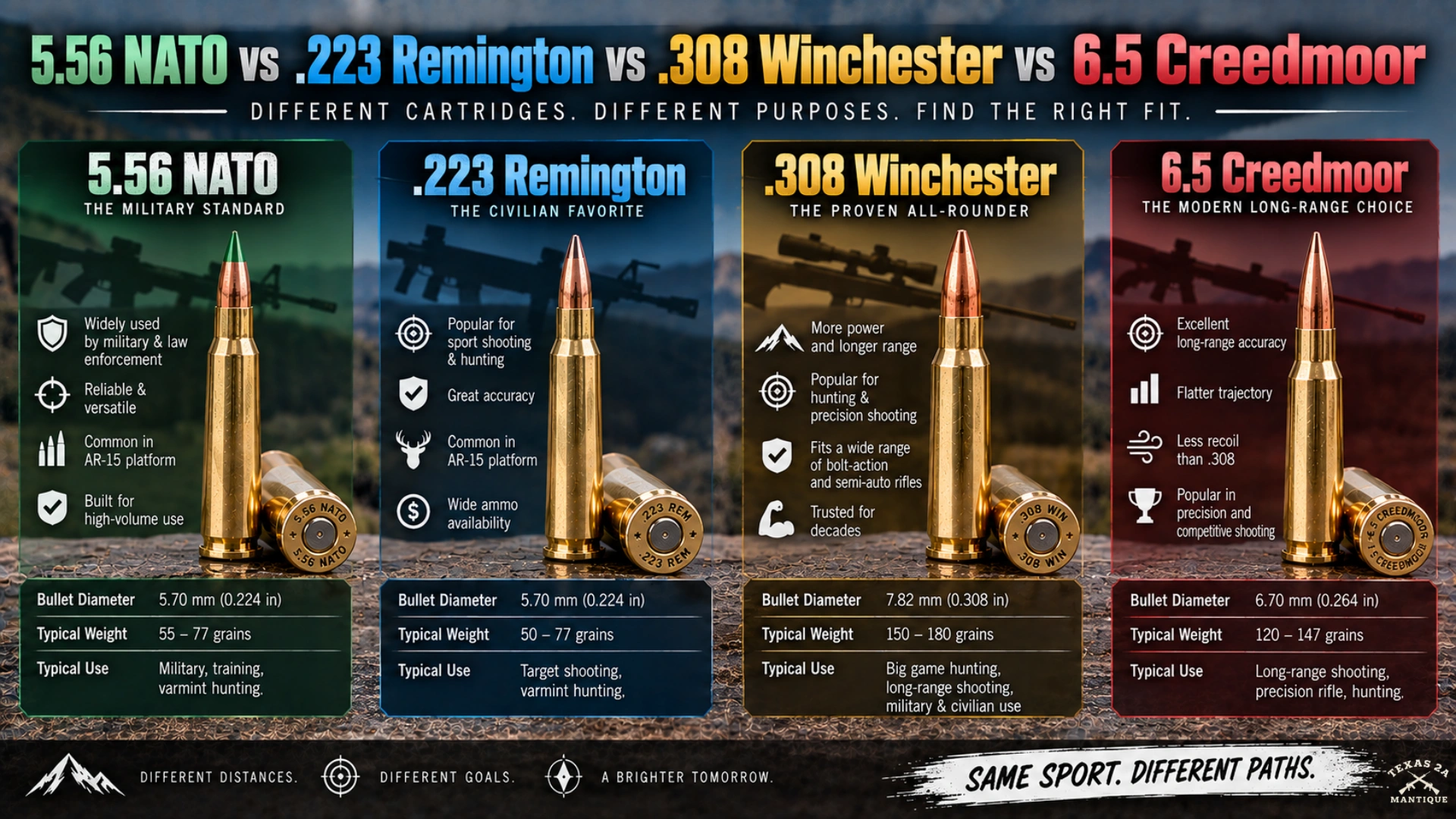
When you start looking at rifle ammunition, the names can be confusing. 5.56 NATO, .223 Remington, .308 Winchester, and 6.5 Creedmoor are all rifle cartridges, but they are not the same thing and they are not designed for exactly the same purpose.
The biggest difference is the size and weight of the bullet, the amount of energy it produces, how much recoil the shooter feels, and how the cartridge performs at different distances.
This guide explains the differences in simple terms so you can understand what each cartridge is and why one may be used instead of another.
First: What Does “Caliber” or “Cartridge” Mean?
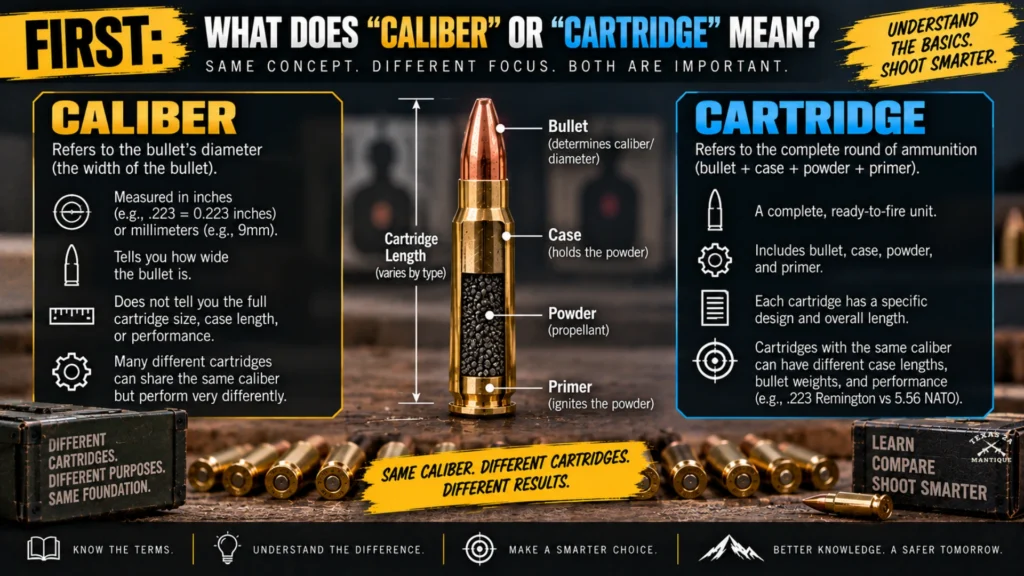
Before comparing these four options, it helps to understand the terminology.
A cartridge is the complete unit of ammunition. It contains the bullet, case, propellant, and primer.
For example:
- 5.56 NATO is a cartridge specification.
- .223 Remington is a cartridge specification.
- .308 Winchester is a cartridge specification.
- 6.5 Creedmoor is a cartridge specification.
You may also see different bullet weights and bullet designs within the same cartridge. That means two boxes of ammunition carrying the same cartridge name can still have different performance characteristics.
So, choosing ammunition is not simply about looking at a number. You need to understand the cartridge and make sure it matches the firearm.
Quick Comparison
| Cartridge | Typical Bullet Weight | Recoil | General Character | Common Applications |
|---|---|---|---|---|
| 5.56 NATO | 55–77 gr | Low | Lightweight, high velocity | Training, target shooting, varmint applications |
| .223 Remington | 40–77 gr | Low | Lightweight sporting cartridge | Target shooting, varmint applications |
| .308 Winchester | 147–178 gr | Moderate | Heavier, more powerful cartridge | Hunting, target and precision shooting |
| 6.5 Creedmoor | 120–147 gr | Moderate | Designed for efficient long-range performance | Long-range target shooting, hunting |
5.56 NATO:
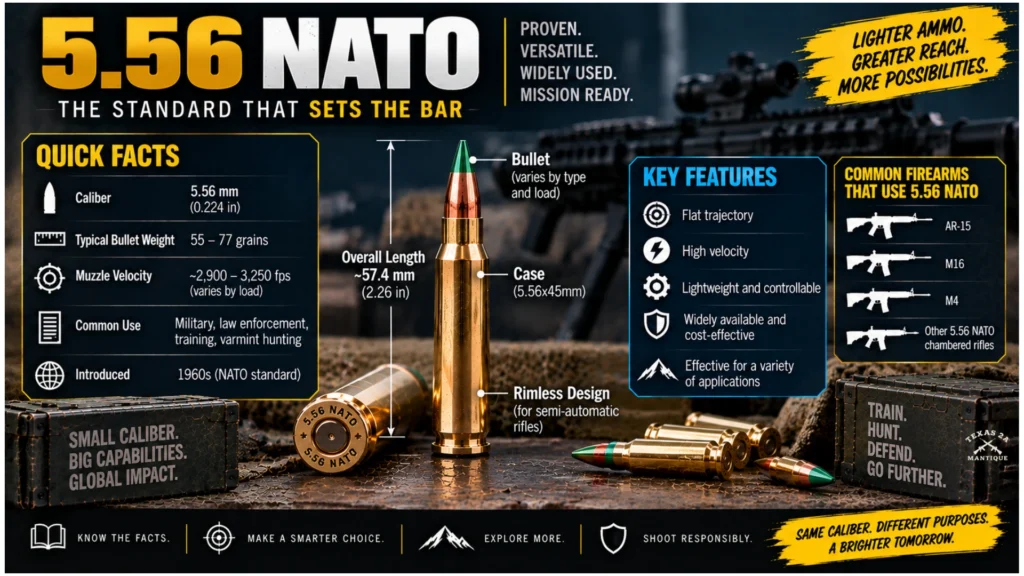
What Is It?
5.56 NATO is a military-standard rifle cartridge that became widely associated with rifles based on the AR-15/M16 family.
The easiest way to understand 5.56 is:
It is a relatively small, lightweight, fast-moving rifle cartridge.
Compared with .308 Winchester or 6.5 Creedmoor, its bullet is considerably lighter. That generally means less recoil and a different performance profile.
What is 5.56 commonly used for?
5.56 is commonly encountered in:
- Rifle training
- Target shooting
- Recreational shooting
- Varmint applications
- Rifles designed around the 5.56 NATO chamber
Its relatively low recoil can also make it easier for many shooters to control compared with larger rifle cartridges.
What makes 5.56 different?
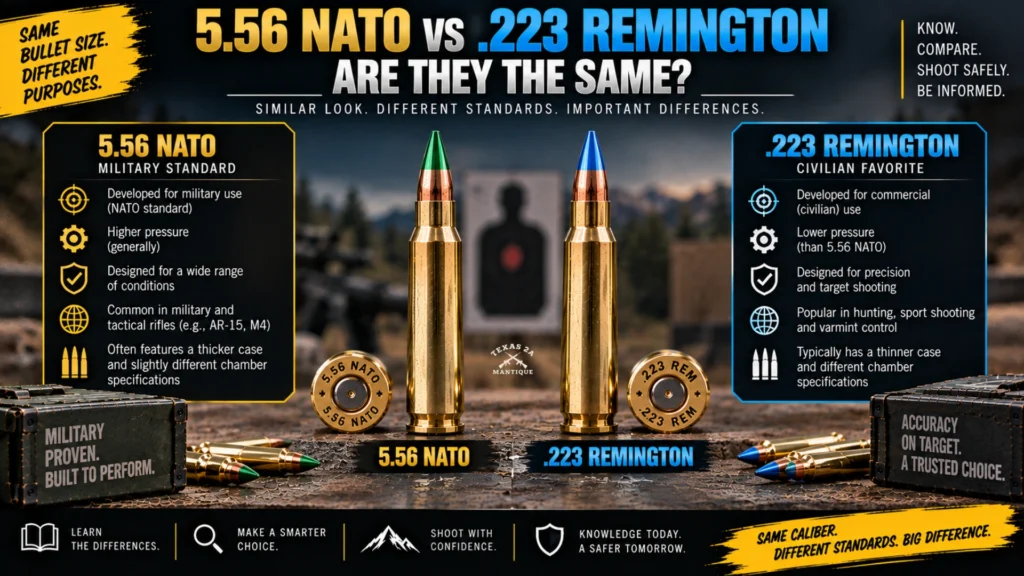
The important point is that 5.56 NATO is not simply another name for .223 Remington.
The cartridges have similar external dimensions, but their chamber and pressure specifications differ.
.223 Remington
What Is It?
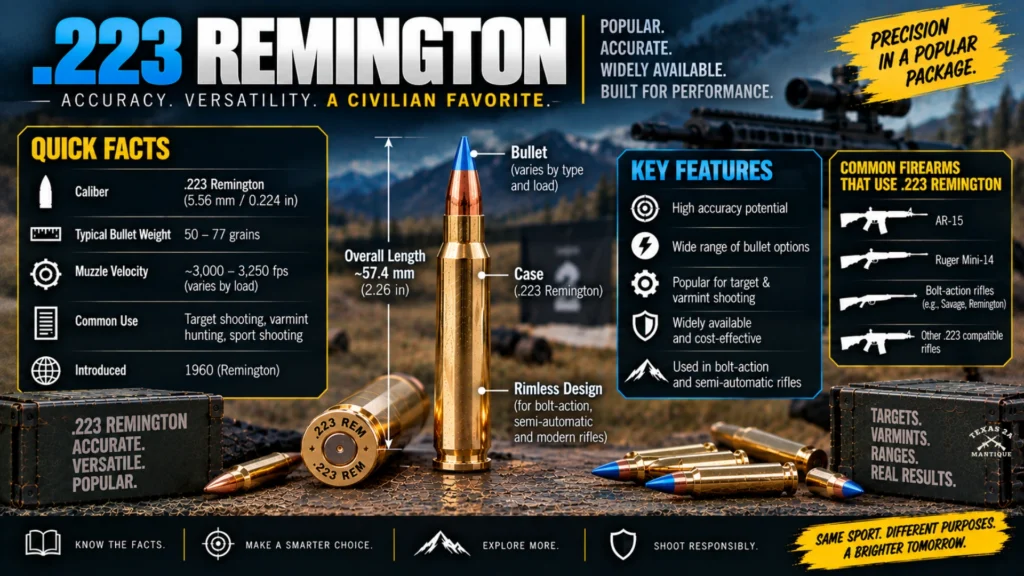
.223 Remington is a commercial rifle cartridge that is very closely related to 5.56 NATO.
It is widely used in both bolt-action sporting rifles and semi-automatic rifles.
In simple terms:
.223 Remington is a lightweight rifle cartridge known for relatively low recoil and high velocity.
What is .223 commonly used for?
It is commonly associated with:
- Target shooting
- Varmint applications
- Predator hunting where legally and ethically appropriate
- Sporting rifles
One reason .223 is popular is its combination of manageable recoil, accuracy potential, and broad availability of different bullet designs.
5.56 NATO vs .223 Remington: Are They the Same?
This is one of the most important questions when discussing these cartridges.
No. They are similar, but they are not identical in specifications.
The major difference involves the chamber and pressure specifications.
A firearm marked 5.56 NATO is generally designed to accommodate 5.56 NATO ammunition and may also be compatible with .223 Remington ammunition, subject to the manufacturer’s specifications.
A firearm marked .223 Remington should not automatically be assumed to be safe for 5.56 NATO ammunition.
There are also chambers such as .223 Wylde, which are designed with characteristics intended to accommodate both types.
The simple rule
Never decide compatibility based only on the fact that two cartridges look similar.
Check:
- The marking on the firearm.
- The firearm manufacturer’s manual.
- The manufacturer’s ammunition specifications.
If there is any doubt, stop and verify before using the ammunition.
.308 Winchester:
What Is It?
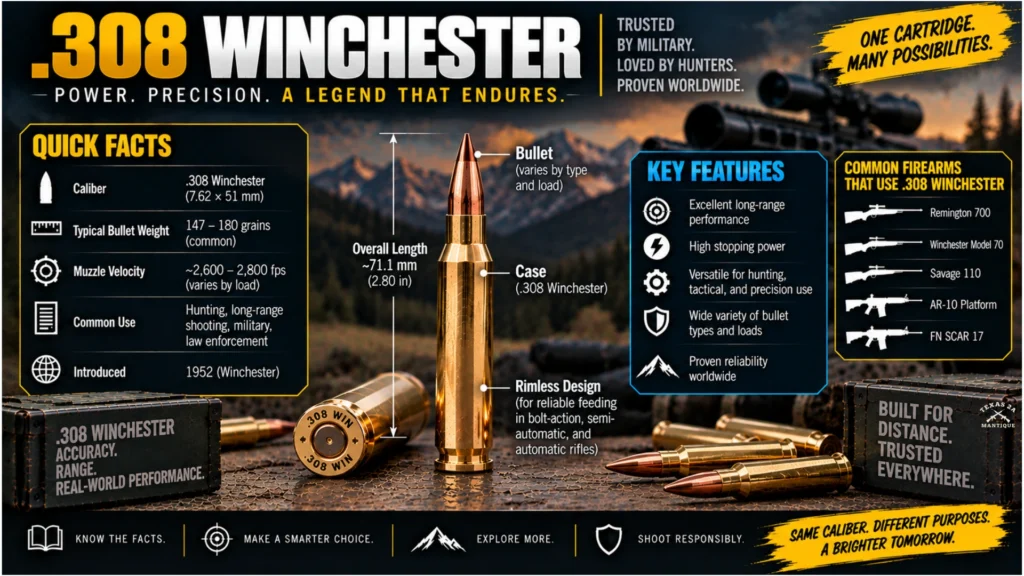
Moving from 5.56/.223 to .308 Winchester is a significant step in cartridge size and bullet weight.
A simple way to understand .308 Winchester is:
It is a heavier rifle cartridge that produces substantially more bullet mass and energy than 5.56/.223.
Typical .308 bullets are much heavier than typical 5.56 or .223 bullets.
What is .308 commonly used for?
.308 Winchester is widely associated with:
- Hunting suitable game
- Target shooting
- Precision rifle applications
- Bolt-action rifles
- Semi-automatic rifles chambered for .308 Winchester
Its long history and wide range of ammunition configurations have made it one of the most established rifle cartridges.
What is the trade-off?
The larger bullet and greater energy also generally mean more recoil and a heavier rifle/ammunition system compared with 5.56/.223.
So, bigger does not automatically mean better. It means the cartridge is designed around a different performance requirement.
6.5 Creedmoor:
What Is It?
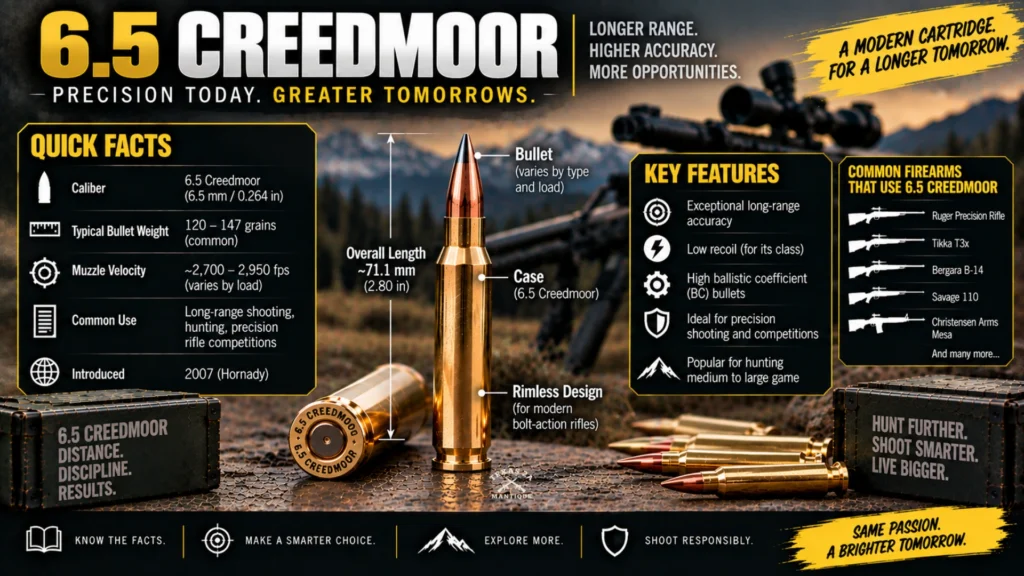
6.5 Creedmoor is a modern rifle cartridge that became especially popular for long-range shooting.
Its main strength is not simply bullet speed.
It is the combination of:
- Efficient bullet design
- High ballistic coefficients
- Good retained velocity
- Manageable recoil
- Consistent long-range performance
In simple terms:
6.5 Creedmoor is designed to perform particularly well when shooting at extended distances.
What is 6.5 Creedmoor commonly used for?
It is commonly associated with:
- Long-range target shooting
- Precision rifle shooting
- Hunting suitable game
- Bolt-action precision rifles
Its long-range characteristics have made it particularly popular among precision shooters.
.308 Winchester vs 6.5 Creedmoor
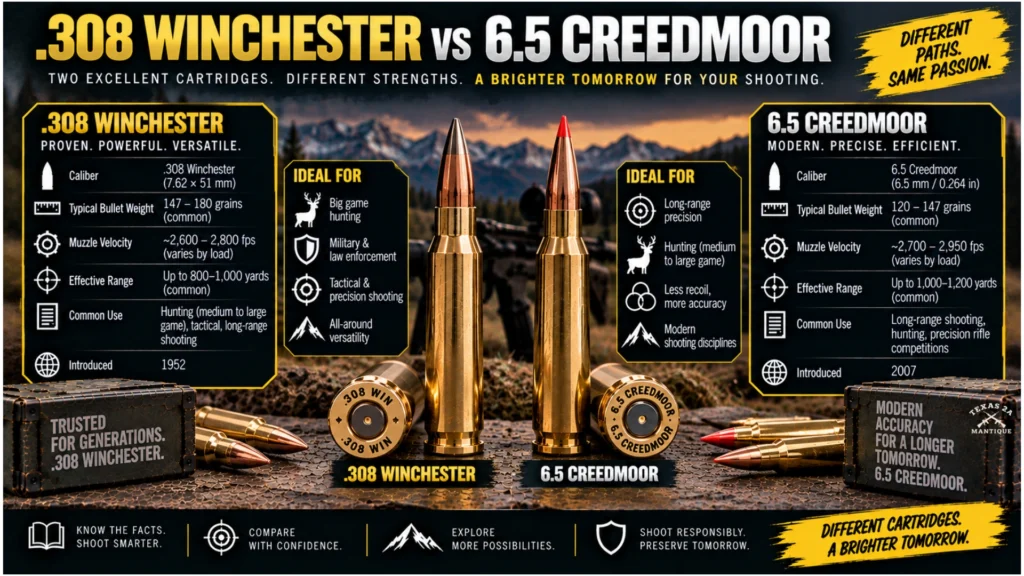
These two cartridges are often compared because both are commonly used for hunting and long-range shooting.
The difference becomes easier to understand when you look at their design priorities.
.308 Winchester
Think:
Heavier bullet + proven versatility
6.5 Creedmoor
Think:
Aerodynamic bullet + efficient long-range performance
At extended distances, 6.5 Creedmoor can have advantages in trajectory and wind performance with suitable loads.
.308 Winchester, however, remains an extremely versatile cartridge with a long history of use.
Neither cartridge is automatically “better.”
The better fit depends on the rifle, application, distance, ammunition, and shooter.
Understanding Bullet Weight
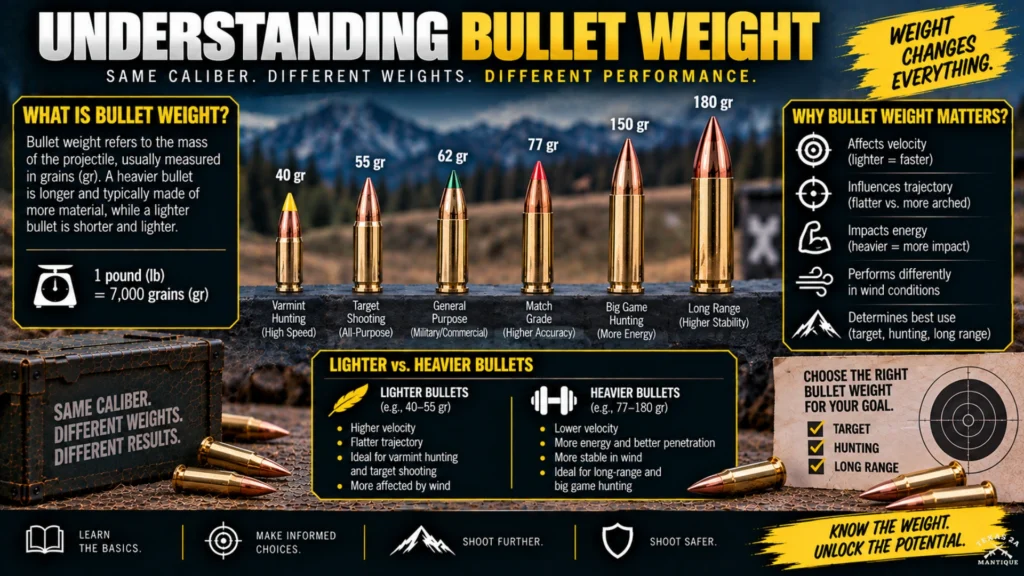
You will often see numbers such as 55 grain, 62 grain, 147 grain, or 140 grain on ammunition.
These numbers describe bullet weight.
For example:
- 55 gr = 55 grains
- 62 gr = 62 grains
- 147 gr = 147 grains
A heavier bullet does not automatically mean better performance.
Bullet weight works together with:
- Bullet shape
- Muzzle velocity
- Ballistic coefficient
- Barrel length
- Twist rate
- Distance
- Intended application
That is why ammunition should be evaluated as a complete load rather than by bullet weight alone.
Understanding Recoil
Recoil is the backward movement or force felt when a rifle is fired.
Generally:
5.56 NATO / .223 Remington → lower recoil
.308 Winchester / 6.5 Creedmoor → more recoil
But recoil depends on more than cartridge size.
It can also be affected by:
- Rifle weight
- Bullet weight
- Powder charge
- Stock design
- Muzzle device
- Shooter position
This is why two rifles chambered for the same cartridge can feel noticeably different when fired.
Understanding Range
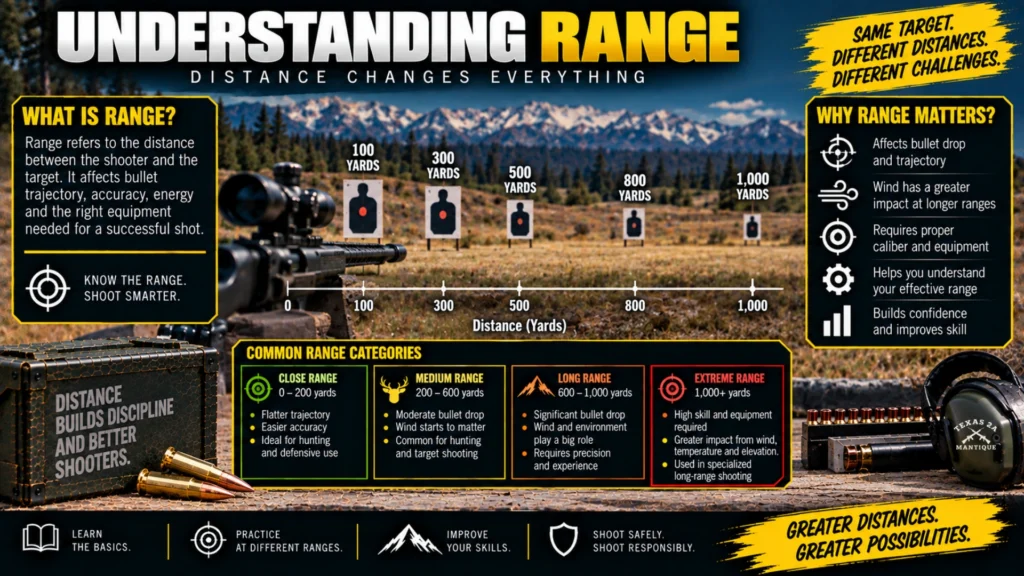
You will often see ammunition described as having a particular “effective range.”
There is no single distance that applies to every rifle and every load.
A cartridge’s real-world performance depends on:
- Bullet design
- Muzzle velocity
- Rifle accuracy
- Barrel length
- Wind
- Temperature
- Elevation
- Shooter ability
For this reason, it is better to think of cartridges as having different strengths at different distances, rather than assuming one cartridge has one fixed effective range.
Which Cartridge Is Commonly Associated With What?
| Application | Commonly Associated Cartridge |
|---|---|
| Low-recoil rifle shooting | 5.56 NATO / .223 Remington |
| Target shooting | 5.56 NATO / .223 Remington / .308 Winchester |
| Varmint applications | .223 Remington / 5.56 NATO |
| Hunting suitable medium game | .308 Winchester / 6.5 Creedmoor |
| Long-range precision shooting | 6.5 Creedmoor / .308 Winchester |
| General-purpose larger-caliber rifle use | .308 Winchester |
What About 7.62×51 NATO and .308 Winchester?
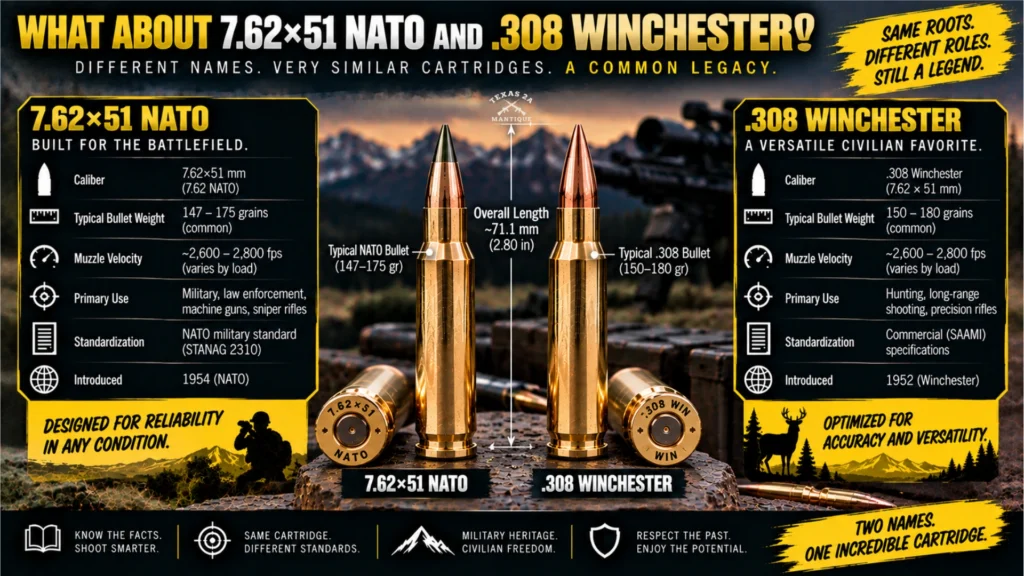
Another common source of confusion is 7.62×51 NATO.
It is closely related to .308 Winchester, but the two are manufactured according to different specifications.
The safest approach is not to assume that the names are interchangeable simply because the cartridges are dimensionally similar.
Follow the firearm manufacturer’s chamber and ammunition specifications.
How to Read a Box of Rifle Ammunition
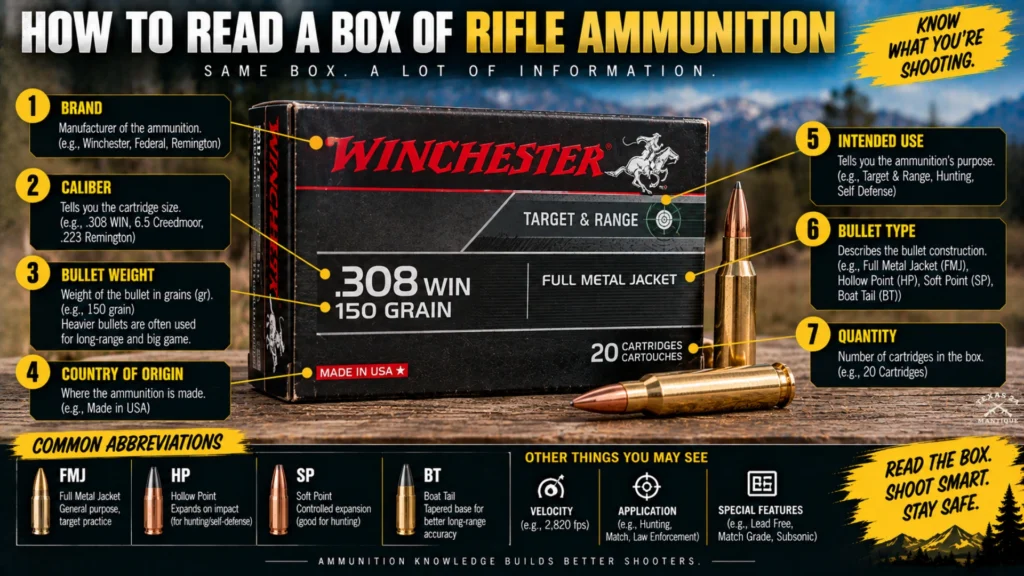
When looking at a box of ammunition, do not look only at the bullet weight.
Pay attention to:
1. Cartridge designation
Examples include:
- 5.56 NATO
- .223 Remington
- .308 Winchester
- 6.5 Creedmoor
2. Bullet weight
Usually shown in grains, such as:
- 55 gr
- 62 gr
- 140 gr
- 147 gr
3. Bullet type
Different bullets are designed for different applications and performance characteristics.
4. Manufacturer specifications
The ammunition manufacturer provides important information about the particular load.
5. Firearm compatibility
This is the most important check.
The ammunition must be appropriate for the chamber of the firearm.
The Most Important Rule: Match the Ammunition to the Rifle
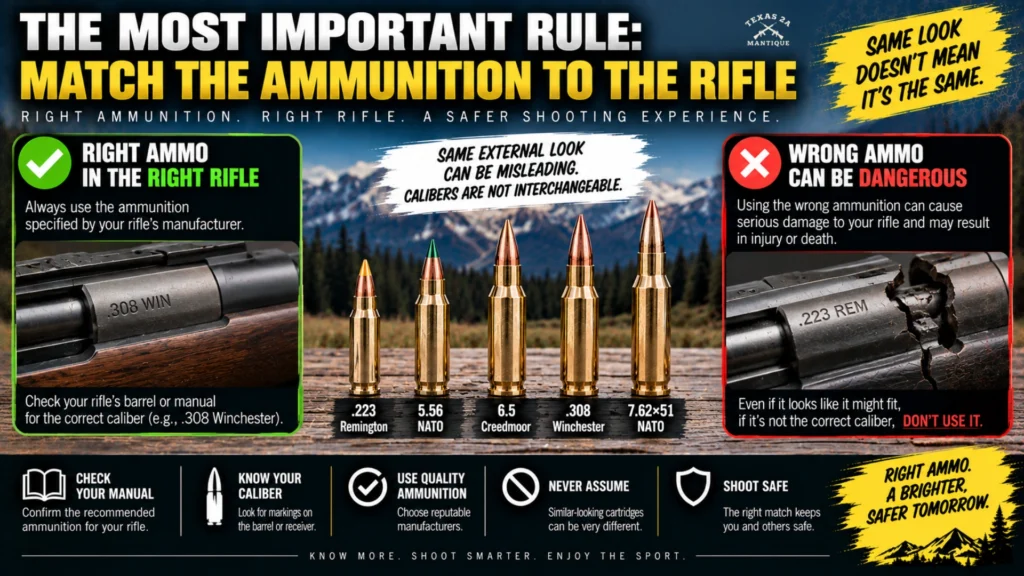
Ammunition should never be selected simply because the cartridge looks similar to another cartridge.
Before using any ammunition:
Check the chamber marking on your firearm and confirm compatibility using the firearm manufacturer’s instructions.
This is especially important when comparing:
- 5.56 NATO and .223 Remington
- .308 Winchester and 7.62×51 NATO
If the firearm or ammunition designation is unclear, do not guess.
Final Takeaway
5.56 NATO and .223 Remington are lightweight, relatively low-recoil rifle cartridges commonly associated with target shooting and varmint applications.
.308 Winchester uses a substantially heavier bullet and is known for its versatility in hunting, target shooting, and precision applications.
6.5 Creedmoor is particularly well known for efficient long-range performance, making it popular for precision shooting and suitable hunting applications.
The most important lesson is that there is no single “best” rifle cartridge for every situation. Each cartridge has different strengths, and the correct ammunition must always match the firearm’s chamber specifications.
At Texas 2A Mantique, understanding ammunition is just as important as understanding the rifle itself. Knowing the difference between cartridges, bullet weights, and ammunition specifications helps firearm owners make informed and responsible decisions.

Leave a Reply