
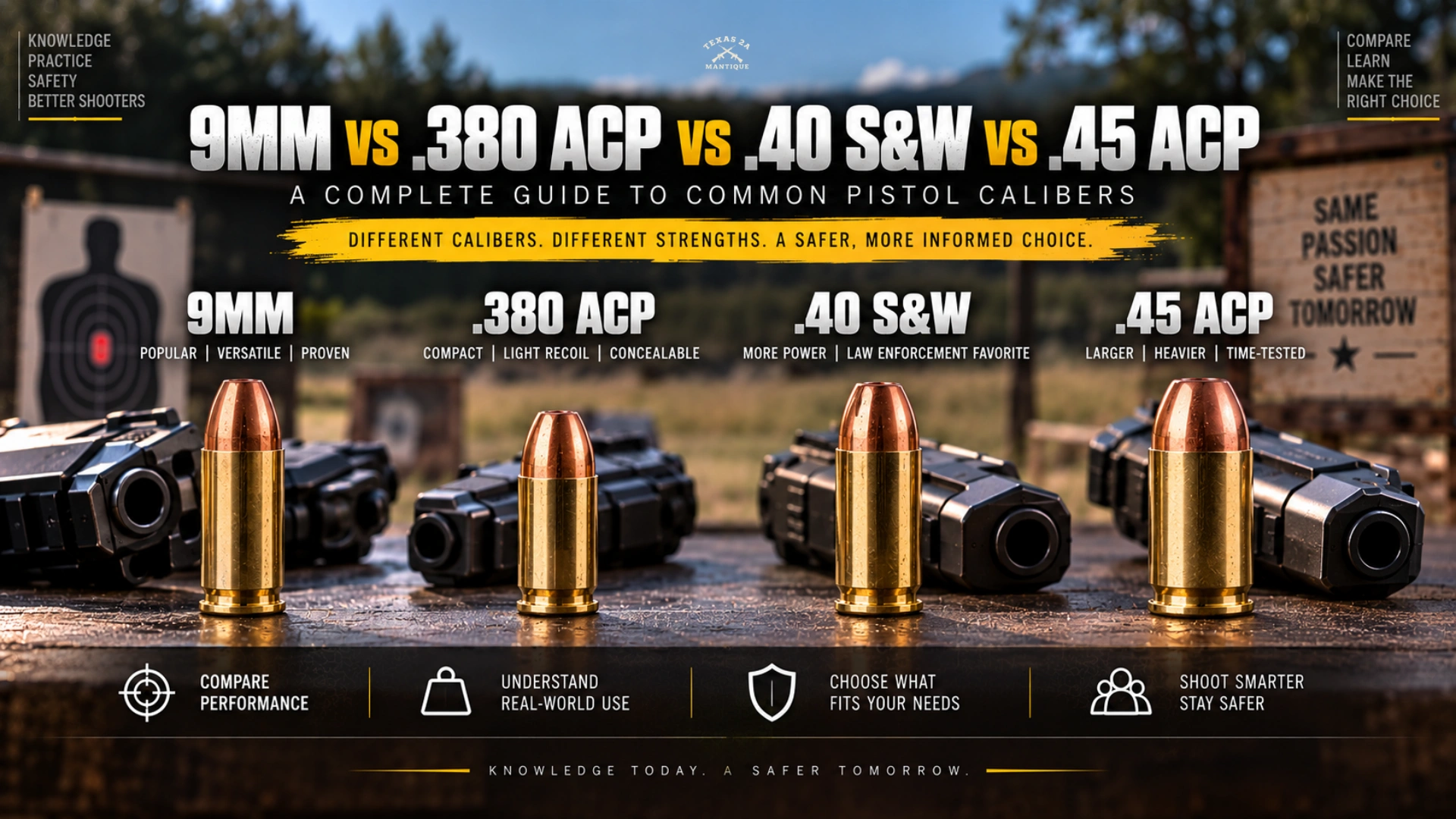
When researching handguns and pistol ammunition, you will quickly come across names such as 9mm Luger, .380 ACP, .40 S&W, and .45 ACP.
For someone who is new to firearms, these names can be confusing. Some use millimeters, some use inches, and some cartridges have more than one commonly used name. Two cartridges may also have similar bullet diameters while being completely different cartridges.
Understanding these differences is important because caliber, cartridge, bullet diameter, and firearm chambering are related terms, but they do not mean exactly the same thing.
This guide explains four well-known pistol cartridges in straightforward language, including their names, history, basic characteristics, and the differences between them.
Understanding Pistol Ammunition
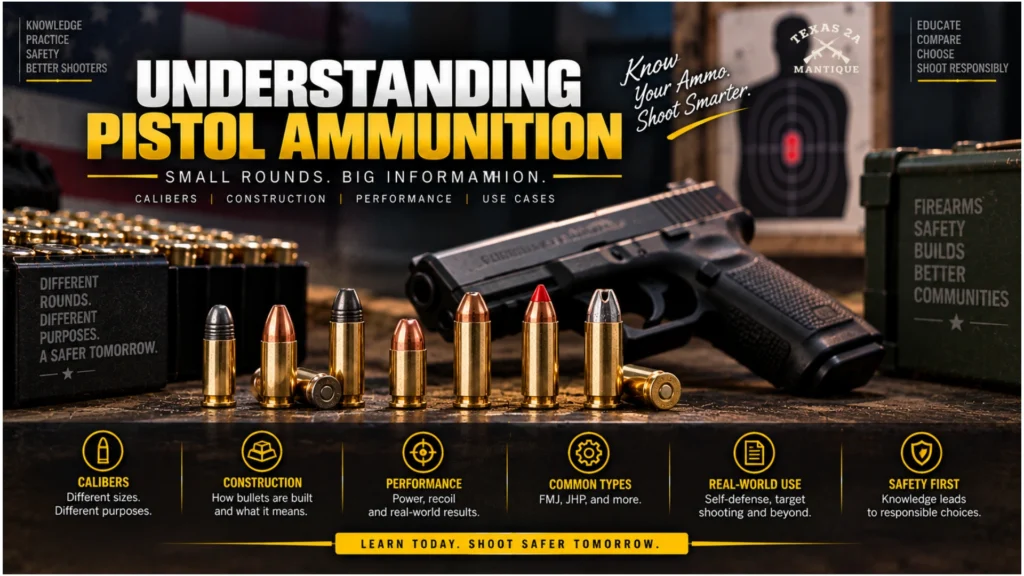
Before looking at individual calibers, it helps to understand what ammunition actually is.
A cartridge is the complete ammunition unit designed to be used in a firearm. A typical cartridge consists of four main components:
- Bullet – the projectile at the front of the cartridge.
- Case – the container that holds the other components.
- Propellant – the material that produces expanding gas when ignited.
- Primer – the component that initiates the ignition process.
The word bullet therefore does not mean the same thing as ammunition. The bullet is only one component of a complete cartridge.
The term caliber is also frequently misunderstood. In general conversation, caliber is used to describe the approximate diameter associated with a firearm’s bore or projectile. It can be expressed in millimeters, such as 9mm, or inches, such as .40 or .45.
However, the caliber number does not completely identify a cartridge.
A cartridge has many specifications, including its case dimensions, overall dimensions, pressure specifications, and chamber requirements. This is why two cartridges can have similar-looking caliber descriptions without being interchangeable.
The difference between 9mm Luger and .380 ACP is a good example.
1. 9mm Luger
What Is 9mm Luger?
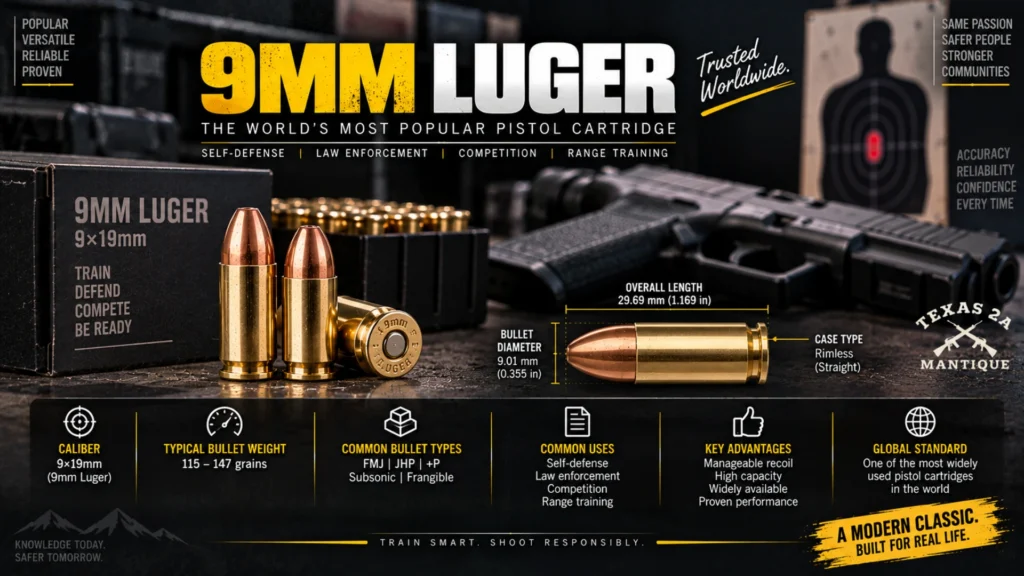
9mm Luger is one of the most widely recognized handgun cartridges in the world.
It is commonly referred to simply as 9mm and is also known as 9x19mm and 9mm Parabellum.
The cartridge has a long history and has been adopted across military, law-enforcement, civilian, and sporting markets.
Because of its widespread use, 9mm has become one of the most familiar names in handgun ammunition.
The important point for beginners is that when someone says “9mm,” they are usually referring to 9mm Luger / 9x19mm, but the exact cartridge designation should always be checked rather than assuming that every cartridge described as 9mm is identical.
Why Is 9mm So Common?
The popularity of 9mm is closely connected to its long history and broad adoption.
Over many decades, the cartridge has been used with a large variety of handgun designs. Its international adoption also means that 9mm is encountered in many different firearm markets.
This has created a large ecosystem around the cartridge, including:
- Handguns chambered for 9mm
- Commercial ammunition
- Military and law-enforcement use
- Sporting applications
- Historical firearm designs
Its widespread use also means that 9mm appears frequently in discussions about modern handgun ammunition.
Understanding the 9mm Name
The “9mm” portion refers to the metric designation associated with the cartridge.
The cartridge is also commonly written as 9x19mm.
The “9” refers to the approximate nominal bullet diameter in millimeters, while the “19” refers to the nominal case length.
This illustrates why a cartridge designation can provide more information than a simple caliber number.
9mm in U.S. Handgun History
9mm has played an important role in the development and adoption of modern handguns.
Its use expanded significantly through military and law-enforcement applications and eventually became common throughout the civilian handgun market.
As a result, 9mm is now one of the primary cartridge names encountered when discussing modern pistols in the United States.
What Makes 9mm Different From the Other Three?
Compared with the cartridges covered in this guide, 9mm has several distinguishing characteristics:
- It uses a metric-based name.
- It has a long international history.
- It has been used extensively by military and law-enforcement organizations.
- It is commonly associated with modern semi-automatic pistols.
- It belongs to a different cartridge specification than .380 ACP despite their similar nominal bullet diameter.
2. .380 ACP
What Is .380 ACP?
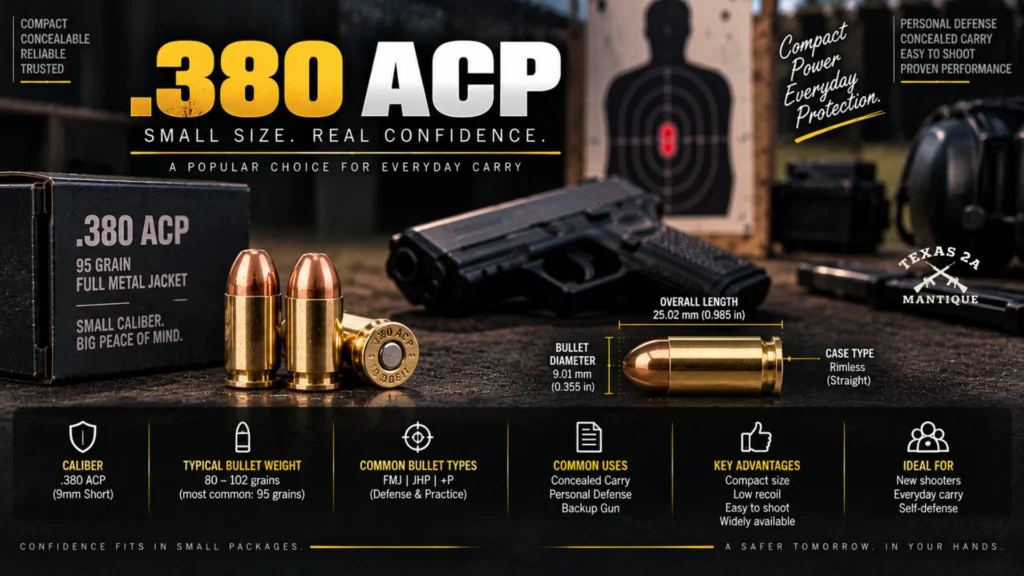
.380 ACP is another established handgun cartridge.
It is commonly called .380 ACP, while .380 Auto is the standardized name used by SAAMI. Historical names include 9mm Browning Short and 9mm Kurz.
The cartridge has become particularly associated with compact handgun designs.
For someone learning about pistol ammunition, .380 ACP is important because it is one of the cartridges most frequently confused with 9mm.
Why Is .380 ACP Called 9mm by Some Names?
This is where cartridge terminology can become confusing.
.380 ACP has a nominal bullet diameter in the same general class as 9mm Luger. Because of this, historical names such as 9mm Browning Short and 9mm Kurz have been used.
However, the similar terminology does not mean that .380 ACP and 9mm Luger are the same cartridge.
They have different cartridge dimensions and specifications.
Therefore, the word “9mm” appearing in a historical or alternate cartridge name should not be interpreted as meaning that the cartridge is automatically the same as 9mm Luger.
.380 ACP and Compact Handguns
.380 ACP has a long association with compact and smaller handgun designs.
This has made it an important cartridge in the history of small semi-automatic pistols.
When people research compact handguns, they will often encounter .380 ACP as a chambering option.
This historical association is one reason the cartridge remains well known even though it occupies a different position in the handgun market from 9mm Luger.
.380 ACP vs 9mm Luger
The easiest way to understand the difference is:
Similar bullet diameter does not mean identical cartridge.
9mm Luger and .380 ACP have different:
- Cartridge dimensions
- Case specifications
- Overall cartridge specifications
- Chamber requirements
Consequently, they should not be treated as interchangeable simply because their nominal bullet diameters are similar.
This is one of the most important pieces of information for anyone beginning to learn about handgun ammunition.
3. .40 S&W
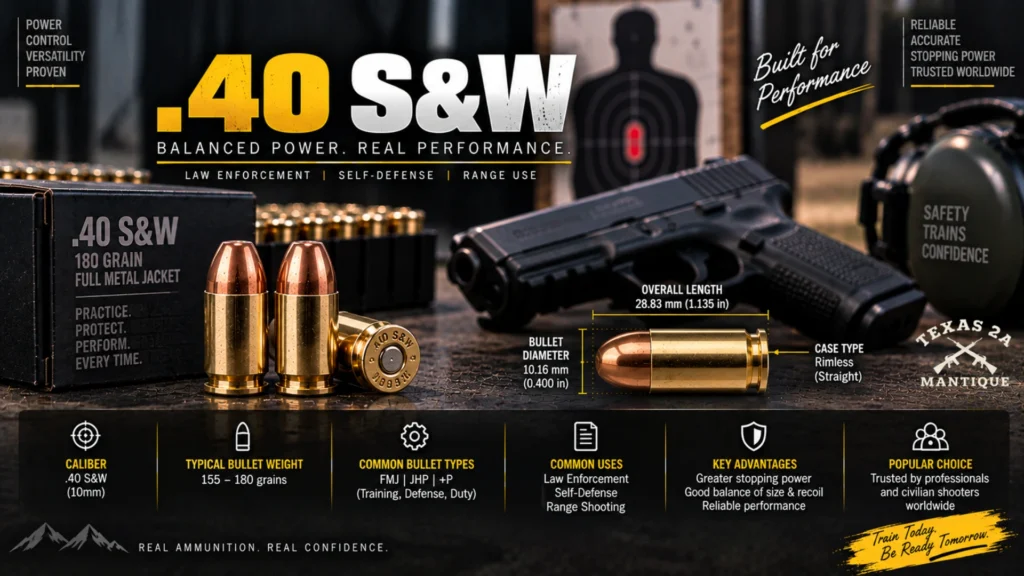
What Is .40 S&W?
.40 S&W is a centerfire handgun cartridge introduced in the United States in 1990.
Unlike 9mm and .45 ACP, which have much longer histories, .40 S&W was developed relatively recently in modern handgun history.
The cartridge became particularly prominent in the American law-enforcement community during the 1990s and 2000s.
This history is an important part of understanding why .40 S&W became such a recognizable handgun caliber in the United States.
What Does .40 S&W Mean?
The “.40” portion refers to its nominal caliber class.
The S&W portion stands for Smith & Wesson, reflecting the cartridge’s development and introduction.
The complete name therefore provides more information than simply saying “.40 caliber.”
As with other cartridges, the full cartridge designation matters when identifying ammunition.
Why Did .40 S&W Become Important?
.40 S&W became particularly prominent in U.S. law enforcement.
During the 1990s and 2000s, many American law-enforcement agencies adopted handguns chambered for .40 S&W.
This gave the cartridge a major role in U.S. handgun history.
Its popularity was therefore not simply the result of its caliber designation. Institutional adoption, firearm availability, and the development of handgun platforms chambered for the cartridge all contributed to its prominence.
.40 S&W Compared With 9mm
The most obvious difference between .40 S&W and 9mm is their nominal caliber class.
- 9mm belongs to the 9mm class.
- .40 S&W belongs to the .40-inch class.
But this is only the beginning of the comparison.
The two cartridges have different case dimensions and specifications and are designed for firearms with different chambering requirements.
Historically, they also represent different periods of handgun development.
9mm has a much longer international history, while .40 S&W became especially prominent in the United States during the late twentieth century.
.40 S&W Today
.40 S&W remains an established handgun cartridge and an important part of U.S. firearms history.
Even when discussing changes in handgun-caliber preferences over time, it is difficult to understand modern American handgun history without understanding the role .40 S&W played in law enforcement.
4. .45 ACP
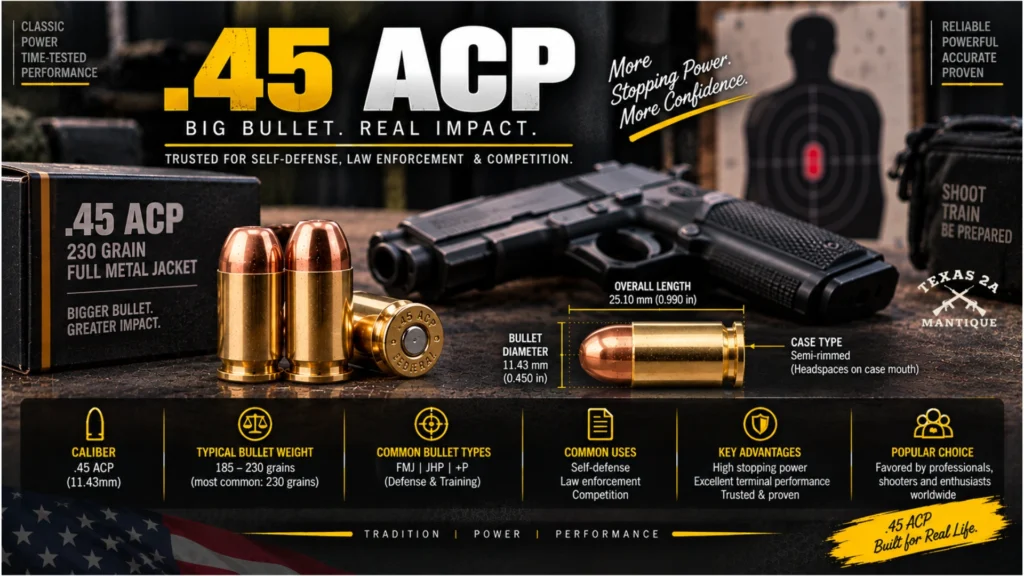
What Is .45 ACP?
.45 ACP is one of the most historically recognizable American handgun cartridges.
The standardized name used by SAAMI is 45 Auto, while 45 ACP remains a widely recognized alternative name.
The cartridge has a long history in American firearms and is particularly associated with the 1911 pistol.
What Does ACP Mean?
ACP stands for Automatic Colt Pistol.
The designation is part of the historical naming system used for cartridges associated with Colt’s automatic-pistol development.
This is why the name .45 ACP contains both a caliber designation and a historical cartridge designation.
.45 ACP and the 1911
The history of .45 ACP is closely connected with the 1911.
The 1911 became one of the most recognizable American service pistols, and its association with .45 ACP helped establish the cartridge as an important part of American firearms culture.
Even today, discussions of traditional American handguns frequently include both the 1911 and .45 ACP.
Why Is .45 ACP Different From 9mm?
The most obvious difference is their nominal bullet diameter.
9mm belongs to the 9mm class, while .45 ACP belongs to the .45-inch class. But their differences go beyond diameter. They have different cartridge dimensions, specifications, histories, and firearm platforms. 9mm has a strong international and modern handgun presence. .45 ACP has a particularly strong connection to American military and civilian handgun history.
The Historical Importance of .45 ACP
The importance of .45 ACP is not limited to its technical specifications.
Its connection with the 1911, military history, law enforcement, competitive shooting, and American firearms culture has made it one of the most recognizable handgun cartridges.
For that reason, .45 ACP continues to appear frequently in discussions comparing traditional and modern handgun calibers.
Comparing the Four Cartridges
The four cartridges can be summarized as follows:
| Cartridge | Other Common Name | Caliber Class | Historical Association |
|---|---|---|---|
| 9mm Luger | 9mm, 9x19mm, 9mm Parabellum | 9mm | International military, law enforcement, civilian and sporting use |
| .380 ACP | .380 Auto, 9mm Browning Short, 9mm Kurz | .380-inch / 9mm-class | Compact and smaller handgun designs |
| .40 S&W | — | .40-inch | U.S. law-enforcement history |
| .45 ACP | .45 Auto | .45-inch | 1911 and American military handgun history |
9mm vs .380 ACP
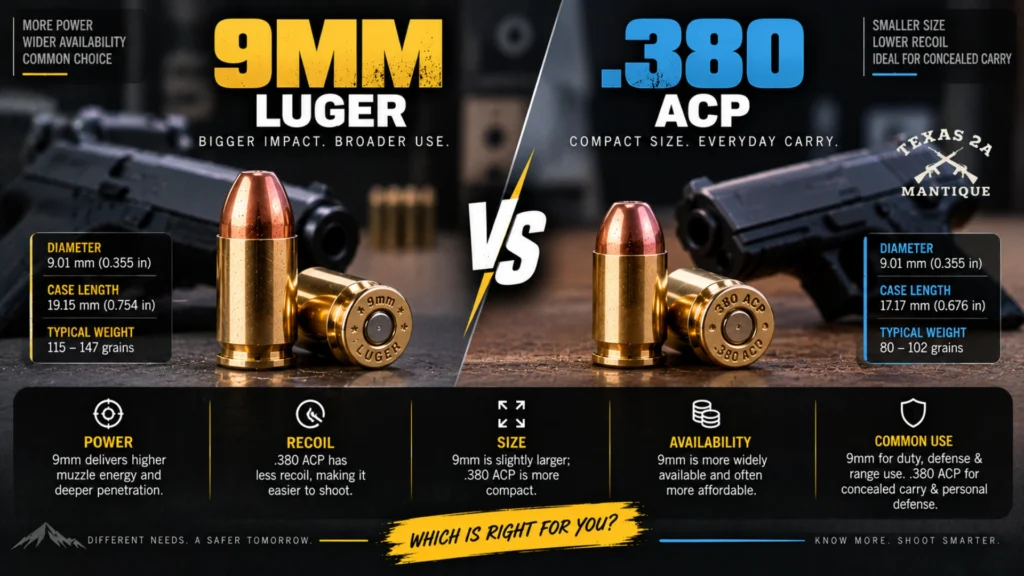
The 9mm vs .380 ACP comparison deserves special attention because it is one of the easiest areas for beginners to misunderstand.
Both cartridges have nominal bullet diameters in a similar general range. However, the cartridges themselves are different. A cartridge is defined by much more than bullet diameter. Its case dimensions, overall dimensions, chamber specifications, and other standardized characteristics are also important.
Therefore:
9mm Luger ≠ .380 ACP
The numbers alone should never be used to determine ammunition compatibility. The firearm’s marked chambering and manufacturer’s specifications are the appropriate reference.
9mm vs .40 S&W
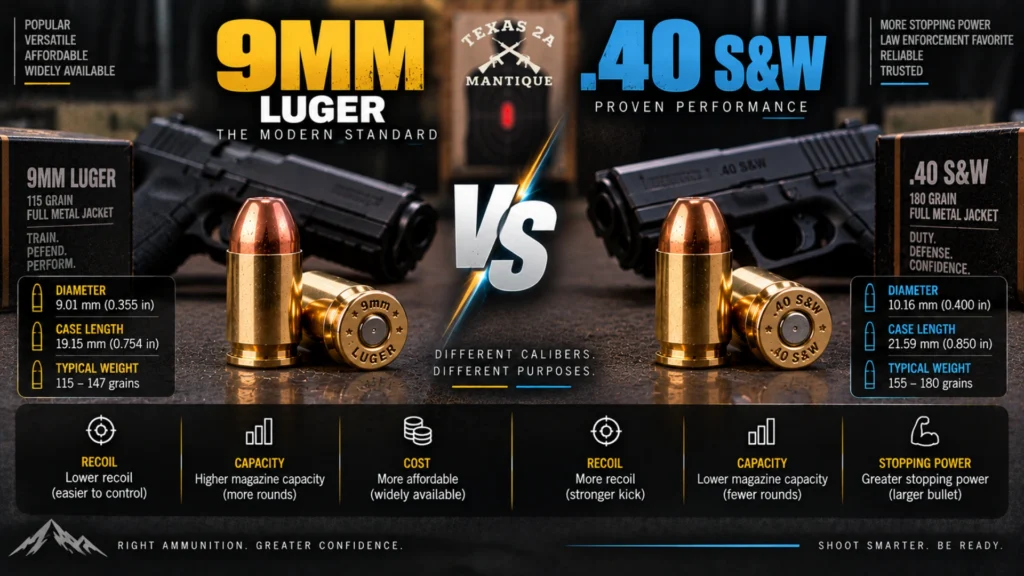
9mm and .40 S&W are both well-known centerfire handgun cartridges, but they represent different cartridge designs and different periods of U.S. firearms history.
9mm has a much longer history and broad international adoption.
.40 S&W was introduced in 1990 and became particularly prominent in American law enforcement.
Their nominal caliber classes are also different:
9mm → approximately 9mm class
.40 S&W → approximately .40-inch class
This difference in caliber is only one part of the comparison. The cartridges also have different dimensions and specifications.
9mm vs .45 ACP
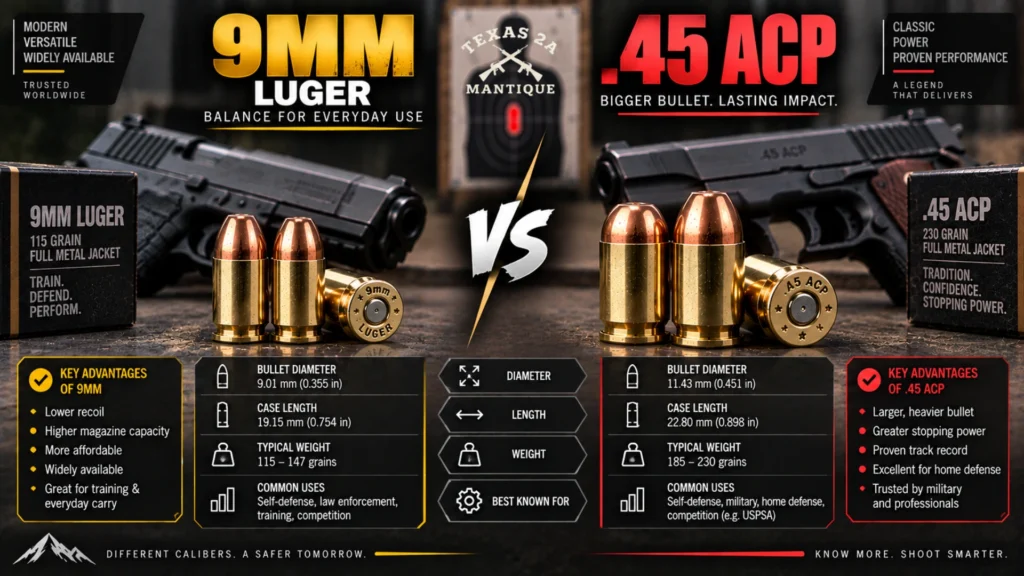
The 9mm vs .45 ACP comparison has been discussed throughout modern handgun history.
The cartridges have substantially different nominal bullet diameters and different historical backgrounds. 9mm is strongly associated with international and modern handgun use. .45 ACP has a particularly strong connection with American military history and the 1911.
Neither cartridge should be understood simply by looking at its diameter. The complete cartridge specification and the firearm chambering are what identify the ammunition.
.40 S&W vs .45 ACP
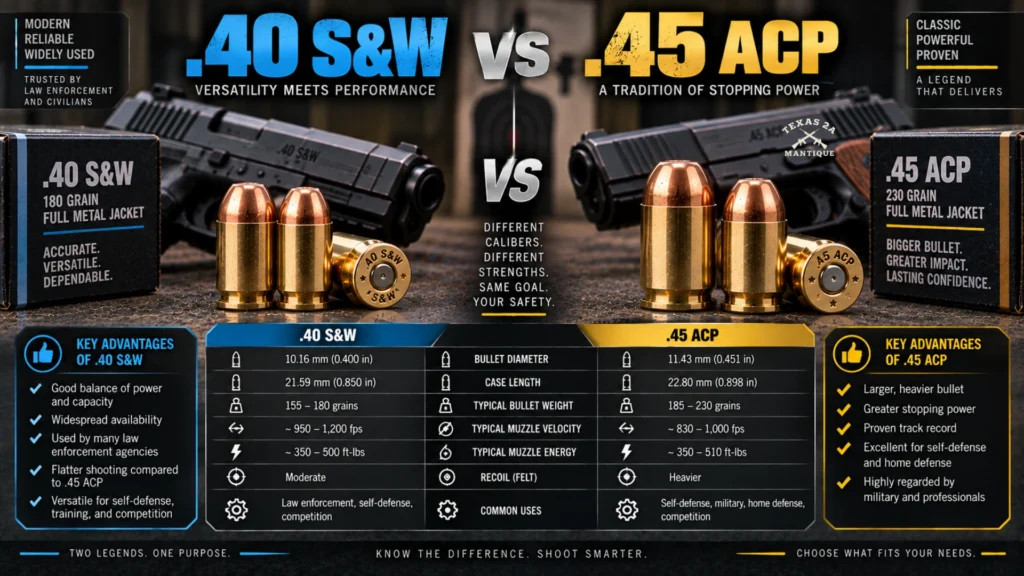
Both .40 S&W and .45 ACP are established handgun cartridges, but their histories are very different.
.40 S&W was introduced in 1990 and became strongly associated with U.S. law enforcement.
.45 ACP has a much longer history and became particularly associated with the 1911 and American military handgun use.
They also have different nominal caliber classes:
- .40 S&W → .40-inch class
- .45 ACP → .45-inch class
Although both are commonly described using inch-based caliber names, they are completely different cartridges.
Why Caliber Alone Is Not Enough
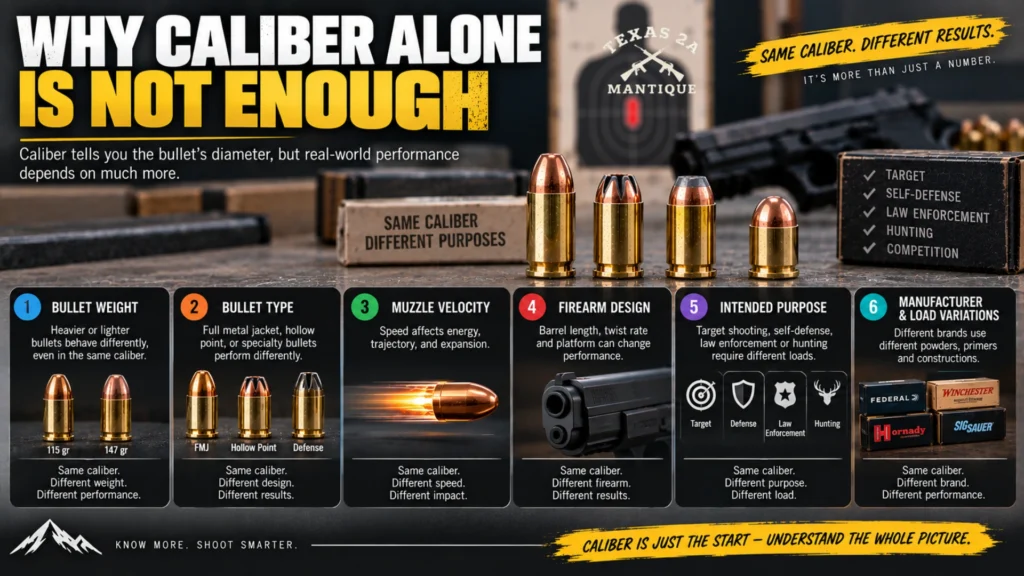
One of the most important concepts to understand is that caliber is not a complete description of ammunition.
For example, someone might see two cartridge names containing “9mm” and assume they are interchangeable.
That assumption can be incorrect.
A cartridge’s identity includes its complete standardized designation and specifications.
This is why:
9mm Luger and .380 ACP are different cartridges.
Likewise, ammunition should not be assumed to be compatible with a firearm simply because the caliber number looks similar.
How to Identify the Correct Cartridge
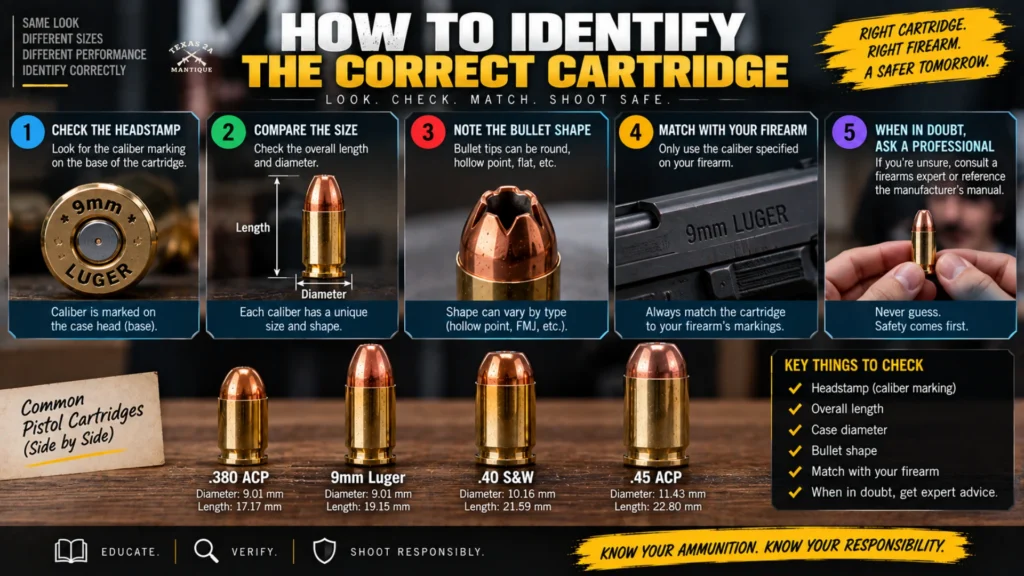
When identifying handgun ammunition, look at the complete cartridge designation rather than relying only on the caliber number.
The firearm should also have a specified chambering.
The basic process is:
- Step 1: Identify the firearm’s chambering
- Step 2: Identify the ammunition designation
- Step 3: Compare the complete designations
- Step 4: When uncertain, stop and verify
This is particularly important with cartridges that have similar names or historical alternative names.
Final Takeaway
Understanding the differences between 9mm, .380 ACP, .40 S&W, and .45 ACP starts with recognizing that each is a distinct cartridge with its own specifications, history, and applications. Caliber numbers and cartridge names should not be treated as interchangeable.
For reliable firearms and ammunition information, Texas 2A Mantique provides educational resources and firearm-related products to help customers make informed decisions and better understand the options available in the Texas firearms community.


Leave a Reply