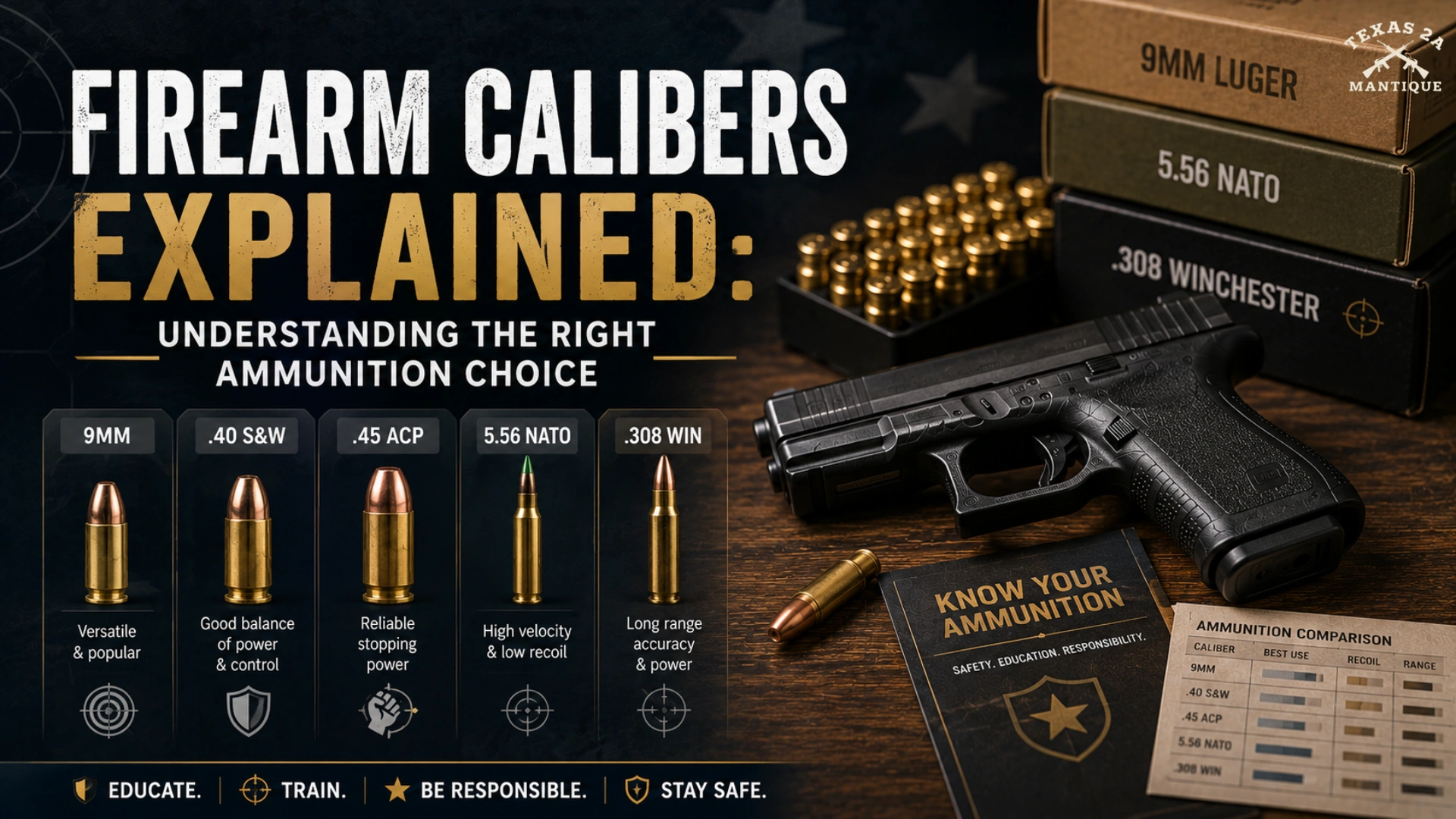
If you’re new to firearms, you’ve probably heard terms like 9mm, .22 LR, .223 Remington, 5.56 NATO, .308 Winchester, or 12 gauge. At first, these numbers and names can seem confusing. Many first-time buyers wonder what they mean and why there are so many different options.
The good news is that firearm calibers are easier to understand than they look. Once you learn a few basic concepts, you’ll be able to understand the differences between common calibers and choose one that matches your needs.
Whether you’re buying your first handgun for home defense, a rifle for hunting, or simply want to learn more about firearms, this guide explains the basics in simple language.
What Is a Firearm Caliber?
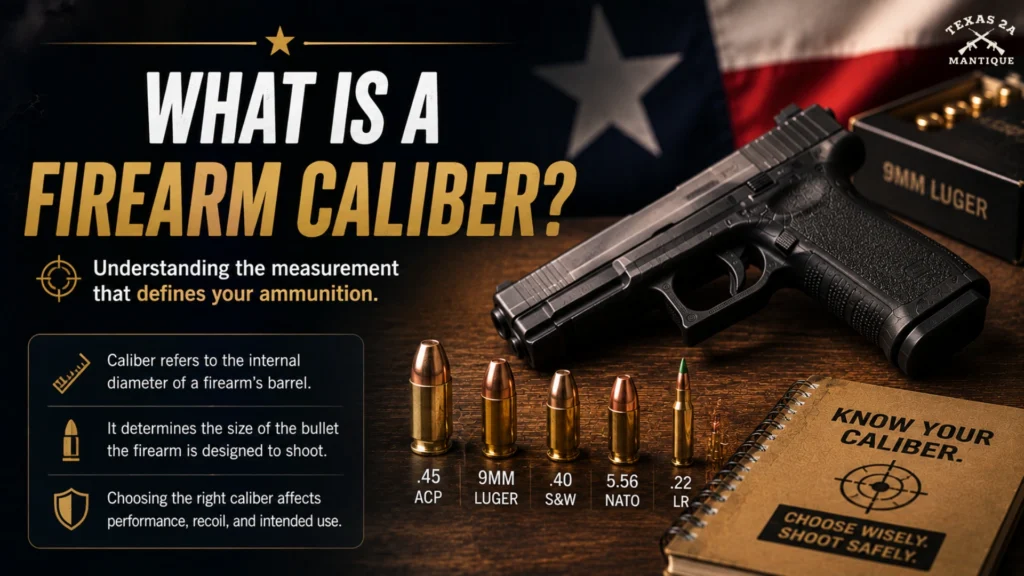
A firearm caliber refers to the diameter of the firearm’s barrel and the bullet it is designed to fire. In simple words, caliber tells you the size of the bullet.
Calibers are measured in two different ways:
- Inches: Examples include .22, .38, and .45.
- Millimeters: Examples include 9mm and 5.56mm.
The measurement system depends mainly on where the cartridge was developed. American cartridges often use inches, while many European and military cartridges use millimeters.
Although caliber tells you the bullet’s diameter, it does not tell you everything about the cartridge. Two cartridges can have similar bullet sizes but very different power levels because of differences in case size, powder, and bullet weight.
Bullet vs. Cartridge
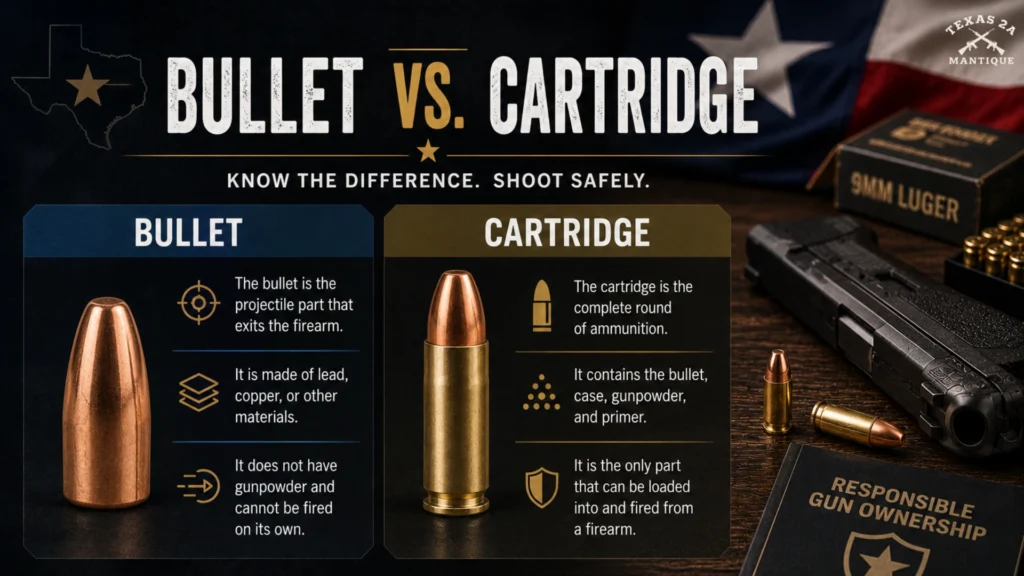
Many people use the word “bullet” to describe the entire piece of ammunition, but there is a difference.
A bullet is only the metal projectile that leaves the barrel after the firearm is fired.
A cartridge (also called a round) is the complete unit of ammunition. It includes:
- Bullet
- Case (usually brass)
- Gunpowder
- Primer
When you pull the trigger, the firing pin strikes the primer, which ignites the powder. The expanding gas pushes the bullet through the barrel and toward the target.
Understanding this difference helps when shopping for ammunition or learning about firearms.
Rimfire vs. Centerfire Ammunition
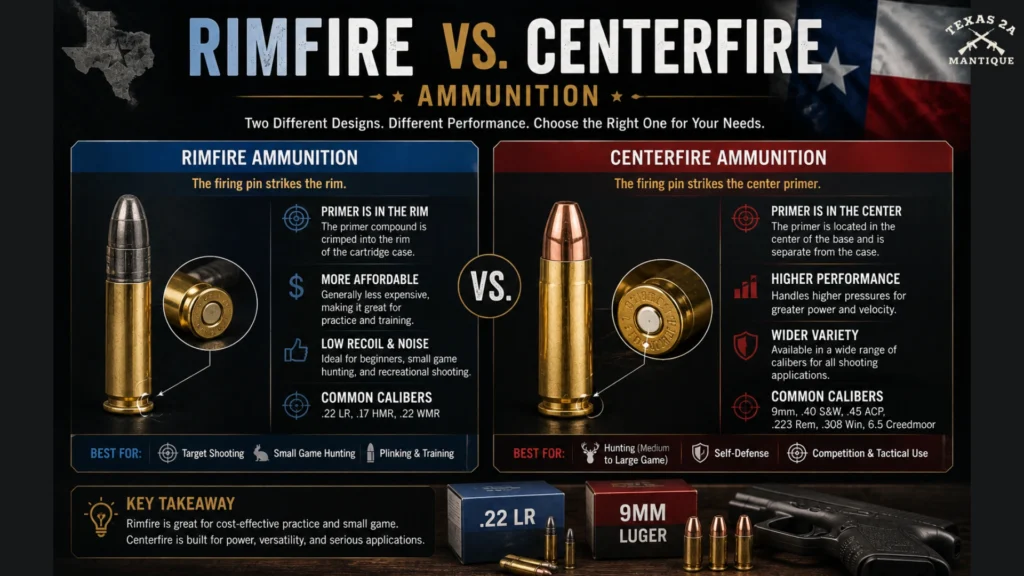
Another important concept is the difference between rimfire and centerfire ammunition.
Rimfire
Rimfire cartridges have the primer built into the rim of the case. When the firing pin hits the rim, it ignites the powder.
The most popular rimfire cartridge is .22 Long Rifle (.22 LR).
Advantages:
- Very affordable
- Low recoil
- Quiet compared to larger calibers
- Excellent for beginners
- Great for target shooting and small-game hunting
Because rimfire ammunition is less powerful, it is generally not used for serious defensive purposes.
Centerfire
Centerfire cartridges have a separate primer located in the center of the case.
Most modern handgun, rifle, hunting, and defensive cartridges are centerfire.
Examples include:
- 9mm
- .380 ACP
- .45 ACP
- .223 Remington
- .308 Winchester
Centerfire ammunition is more reliable, more powerful, and can often be reloaded after firing.
Understanding Bullet Weight
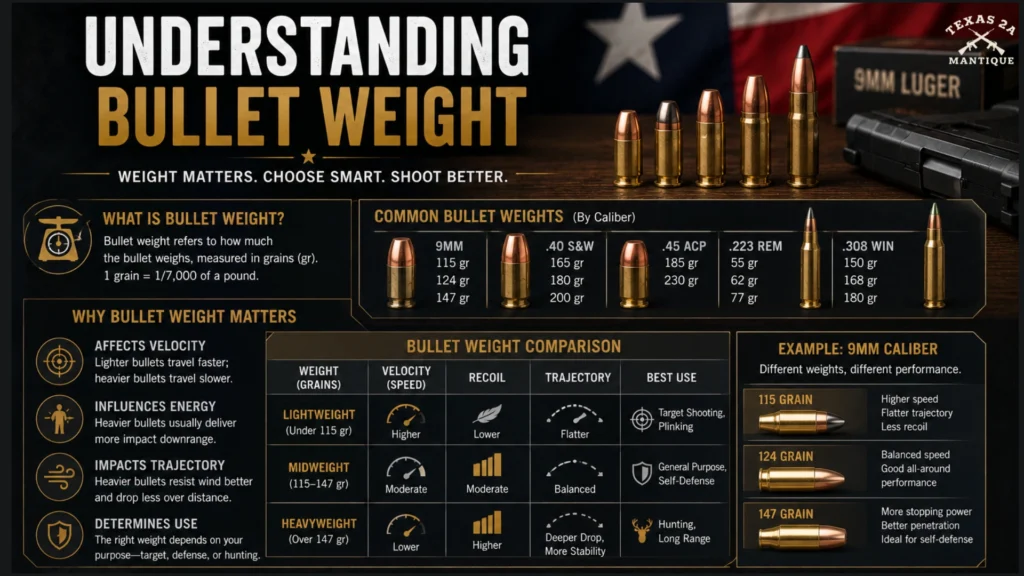
You may notice ammunition boxes marked with numbers such as 115gr, 124gr, or 147gr.
The letters gr stand for grains, a unit used to measure bullet weight.
Generally:
- Lighter bullets travel faster and produce a flatter trajectory.
- Heavier bullets move slower but usually penetrate deeper and carry more momentum.
Different bullet weights allow shooters to choose ammunition for target practice, hunting, competition, or self-defense.
Common Handgun Calibers
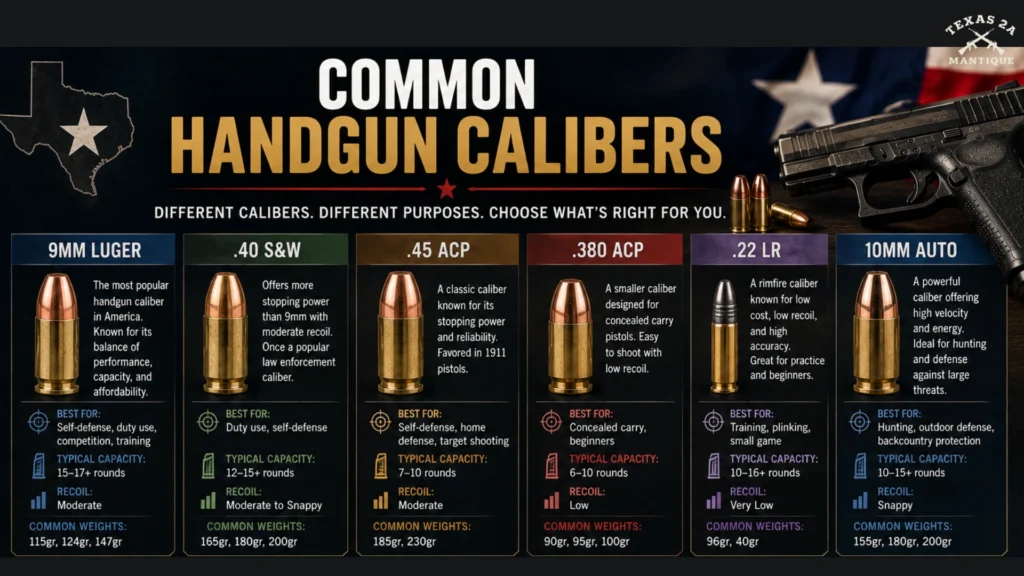
.22 Long Rifle (.22 LR)
The .22 LR is one of the most popular cartridges in the world.
It is widely used for:
- Learning to shoot
- Target practice
- Recreational shooting
- Small-game hunting
Because it produces very little recoil and is inexpensive, it allows beginners to practice shooting without spending a lot of money.
9mm
The 9mm is the most popular handgun caliber today.
It offers an excellent balance between recoil, accuracy, magazine capacity, and stopping power.
Advantages include:
- Easy to control
- Widely available ammunition
- Affordable practice ammo
- Higher magazine capacity than larger calibers
These benefits make the 9mm a favorite among civilians, law enforcement, and military organizations around the world.
.380 ACP
The .380 ACP is commonly used in compact and lightweight pistols designed for concealed carry.
Benefits include:
- Reduced recoil
- Small, easy-to-carry handguns
- Comfortable for many new shooters
Although it is less powerful than the 9mm, many people choose it because of its manageable recoil and compact firearm options.
.40 S&W
The .40 S&W was developed for law enforcement and became very popular during the 1990s.
Compared to the 9mm, it offers:
- More recoil
- Larger bullet
- Slightly lower magazine capacity
Many agencies have since returned to the 9mm because modern ammunition has improved, and the lighter recoil allows faster follow-up shots.
.45 ACP
The .45 ACP has been used for more than a century and is famous for its use in the classic 1911 pistol.
Characteristics include:
- Larger bullet diameter
- Strong recoil
- Good performance with defensive ammunition
Many experienced shooters appreciate the .45 ACP for its history, accuracy, and larger projectile.
.38 Special and .357 Magnum
These cartridges are mainly used in revolvers.
The .38 Special produces moderate recoil and is easy to shoot.
The .357 Magnum is a more powerful version that delivers higher velocity and energy.
One advantage is that revolvers chambered in .357 Magnum can usually fire both .357 Magnum and .38 Special ammunition.
Common Rifle Calibers
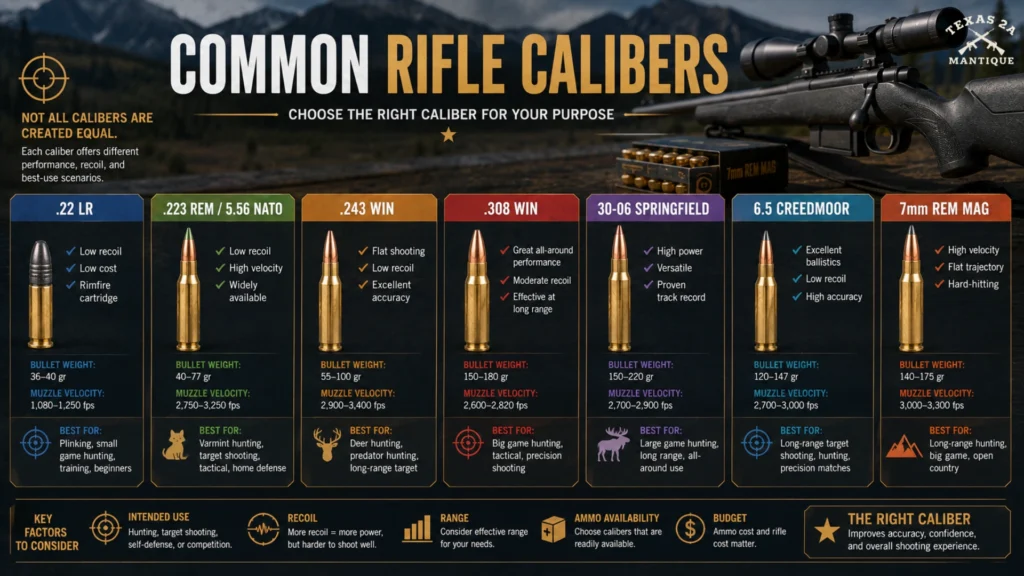
.223 Remington and 5.56 NATO
These are among the most popular rifle cartridges for modern sporting rifles.
Common uses include:
- Target shooting
- Training
- Recreational shooting
- Home defense
- Predator hunting
They produce relatively light recoil, making them comfortable for many shooters.
Although .223 Remington and 5.56 NATO look nearly identical, they are loaded to slightly different pressure levels. Always check your firearm’s markings before using either cartridge.
7.62×39mm
Best known as the cartridge used in the AK-47 platform, the 7.62×39mm offers dependable performance and moderate recoil.
It is commonly used for:
- Recreational shooting
- Hunting
- General-purpose rifle use
Its larger bullet provides solid performance at short and medium distances.
.308 Winchester
The .308 Winchester is a versatile cartridge used for hunting, target shooting, and precision shooting.
Advantages include:
- Excellent long-range accuracy
- Wide variety of bullet weights
- Effective for many hunting applications
Compared with .223 Remington, the .308 produces more recoil but delivers greater power and longer effective range.
.30-06 Springfield
The .30-06 Springfield has been trusted by hunters for more than 100 years.
It remains popular because it can handle a wide range of game animals and is available with many different bullet weights.
Its versatility has made it one of the most respected hunting cartridges ever produced.
Understanding Bullet Types
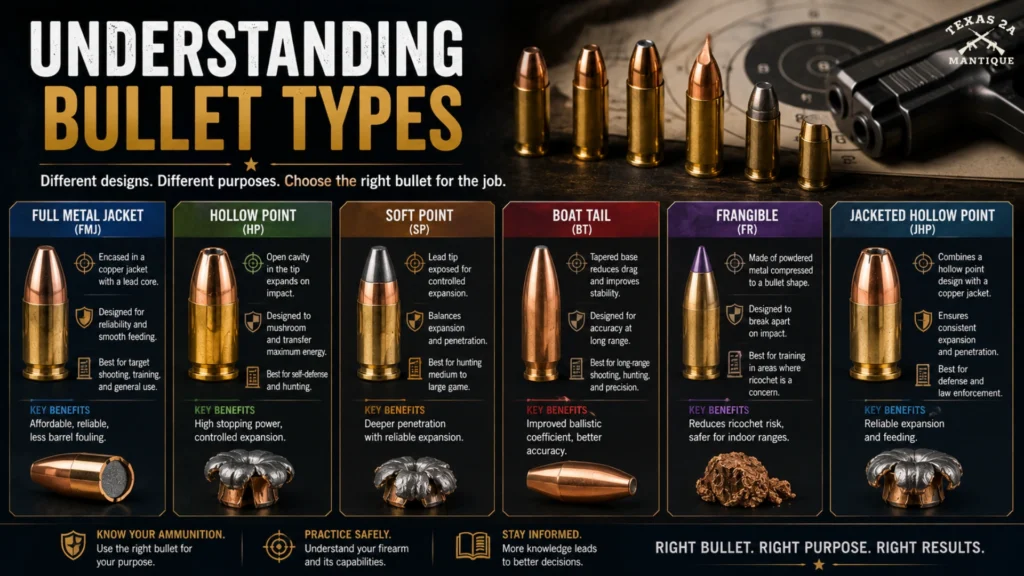
Caliber tells you the size of the bullet, but bullet type determines how it performs.
Full Metal Jacket (FMJ)
FMJ bullets have a soft lead core covered by a metal jacket.
They are commonly used for:
- Range practice
- Target shooting
- Training
They are affordable and feed reliably in most firearms.
Jacketed Hollow Point (JHP)
JHP bullets are designed to expand after impact.
This expansion helps transfer energy more efficiently and reduces the chance of over-penetration.
For this reason, they are commonly chosen for personal defense.
Soft Point (SP)
Soft point bullets expose a small portion of lead at the front.
They expand more than FMJ bullets while still providing good penetration, making them popular among hunters.
Ballistic Tip
Ballistic tip bullets have a plastic tip that improves aerodynamics.
These bullets are often used for hunting because they combine good accuracy with reliable expansion.
Open Tip Match (OTM)
OTM bullets are designed for maximum accuracy rather than expansion.
They are commonly used by competitive and precision shooters.
Understanding Shotgun Gauges
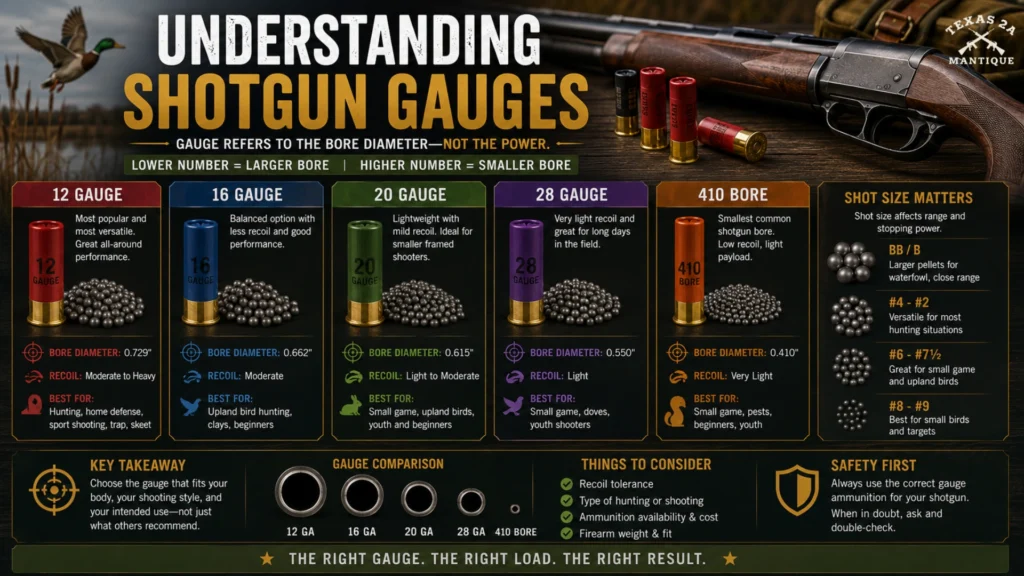
Shotguns use gauge instead of caliber.
The most common gauges include:
- 12 Gauge
- 20 Gauge
- .410 Bore
A 12-gauge shotgun has a larger bore than a 20-gauge shotgun.
Shotgun ammunition comes in three main types:
Birdshot: Contains many small pellets and is commonly used for birds, clay targets, and small game.
Buckshot: Uses fewer but much larger pellets, making it a common choice for defensive use.
Slugs: Contain one large projectile designed for greater accuracy and longer-range shooting.
Recoil and Why It Matters
Recoil is the backward movement you feel when a firearm is fired.
Several factors affect recoil:
- Caliber
- Bullet weight
- Powder charge
- Firearm weight
Smaller calibers such as .22 LR generally produce very light recoil.
Medium calibers like 9mm offer manageable recoil for most shooters.
Larger cartridges such as .45 ACP or .308 Winchester generate noticeably more recoil.
Choosing a caliber with comfortable recoil helps improve accuracy and makes practice more enjoyable.
Choosing the Right Caliber
The best caliber depends on how you plan to use your firearm.
Ask yourself these questions:
- Will you mainly use it for target shooting?
- Do you need it for home defense?
- Are you planning to hunt?
- How much recoil are you comfortable with?
- How much does ammunition cost?
- How often will you practice?
Many experienced shooters recommend choosing a caliber with affordable ammunition because regular practice is one of the best ways to improve shooting skills.
Final Thoughts
Understanding firearm calibers doesn’t have to be difficult. Once you know what caliber means, understand the difference between rimfire and centerfire ammunition, and learn about common handgun and rifle cartridges, choosing the right firearm becomes much easier.
There is no single “best” caliber for every shooter. The right choice depends on your experience level, intended use, comfort with recoil, and budget. A beginner may prefer a .22 LR or 9mm because they are easy to shoot and affordable, while a hunter may choose a .308 Winchester or .30-06 Springfield for greater power and longer-range performance.
At Texas 2A Mantique, we believe that making informed decisions is the first step toward responsible firearm ownership. Whether you’re purchasing your first handgun, selecting a hunting rifle, or expanding your collection, understanding caliber options helps you choose a firearm that fits your needs and shooting goals.
No matter which caliber you choose, the most important part of firearm ownership is practicing regularly, handling every firearm safely, and always using the correct ammunition for your specific firearm. With the right knowledge and guidance from Texas 2A Mantique, you can shop with confidence, improve your shooting skills, and enjoy a safer, more rewarding firearm ownership experience.

Leave a Reply