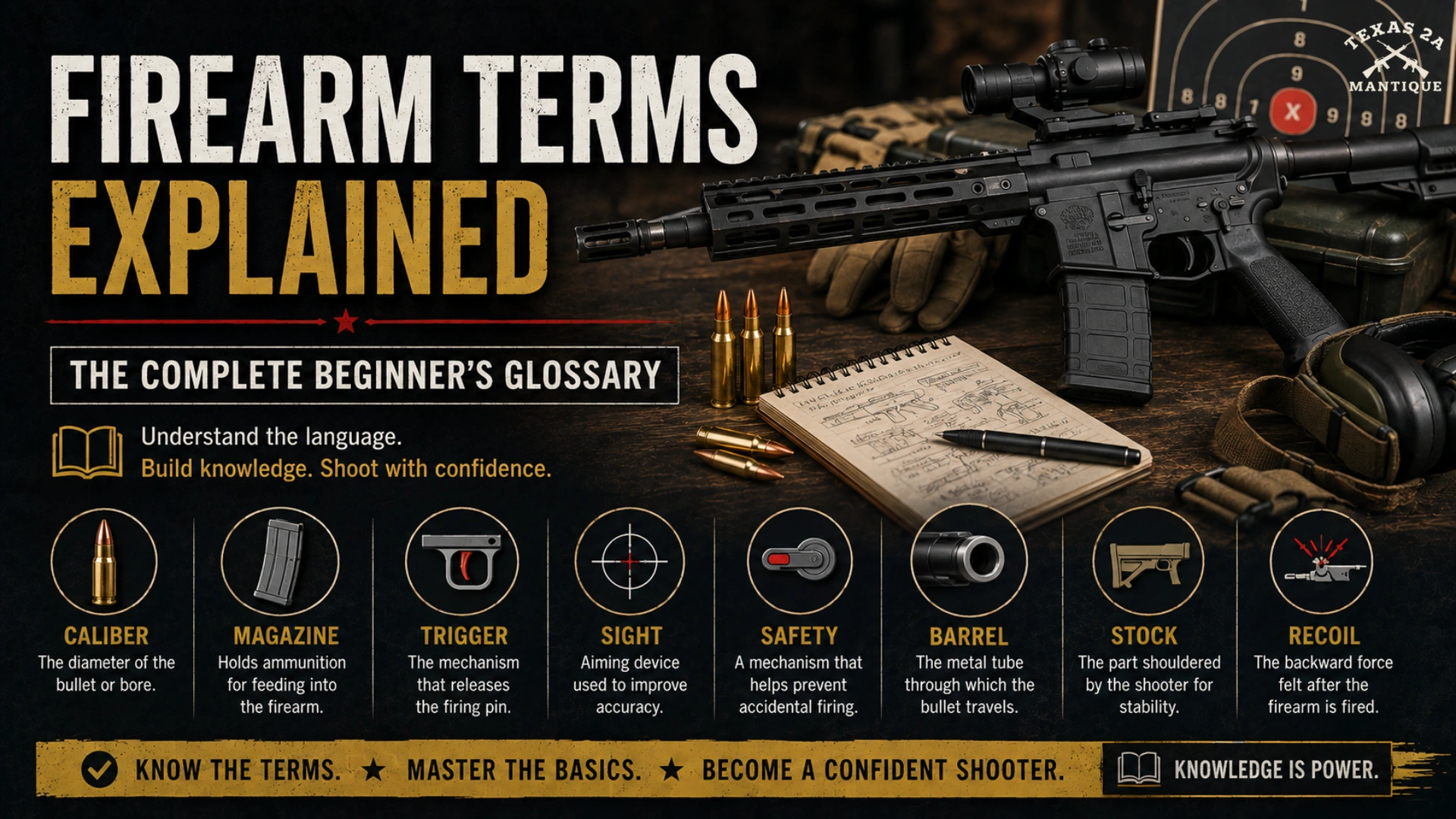
Have you ever visited a firearm store or watched a shooting video and heard words like “chamber clear,” “caliber,” or “muzzle”? If you didn’t understand what they meant, don’t worry. Many beginners feel the same way.
Firearms have their own set of words and terms. At first, they may sound confusing, but once you learn the basics, everything becomes much easier.
This guide explains the most common firearm terms in simple, everyday language. By the end, you’ll understand the words used in firearm stores, safety classes, shooting ranges, and product descriptions. Whether you’re planning to buy your first firearm, take a safety course, or simply learn more, this glossary will help you feel more confident.
Why Is It Important to Learn Firearm Terms?
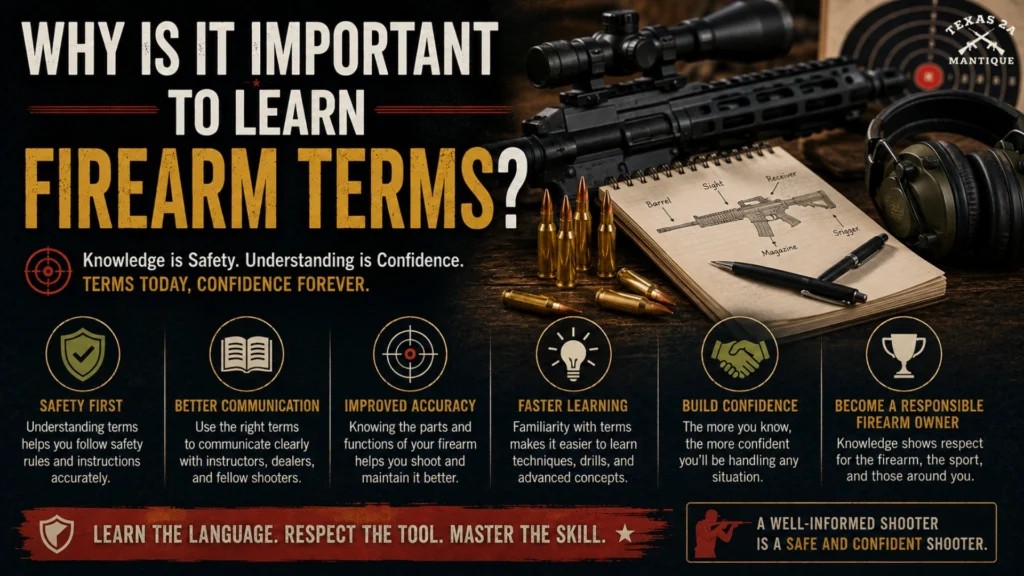
Learning firearm terminology is about more than just knowing the names of parts. It helps you stay safe, communicate clearly, and make better buying decisions.
Here are some of the biggest reasons to learn these terms:
Stay Safe
Many firearm accidents happen because people misunderstand basic firearm terms or safety instructions. For example, someone may think a firearm is unloaded when there is still a round in the chamber. Understanding the correct terms helps you avoid dangerous mistakes.
Communicate Clearly
Firearm instructors, range officers, and gun store staff use these words every day. When you understand them, it’s easier to follow instructions and ask the right questions.
Build Confidence
Firearm manuals, product pages, and safety guides often use technical terms. Once you know what those words mean, reading these documents becomes much easier.
Make Better Buying Decisions
Words like caliber, action, and magazine capacity help describe what a firearm is designed for. Understanding these terms makes it easier to choose the right firearm for hunting, target shooting, or home defense.
Basic Parts of a Firearm
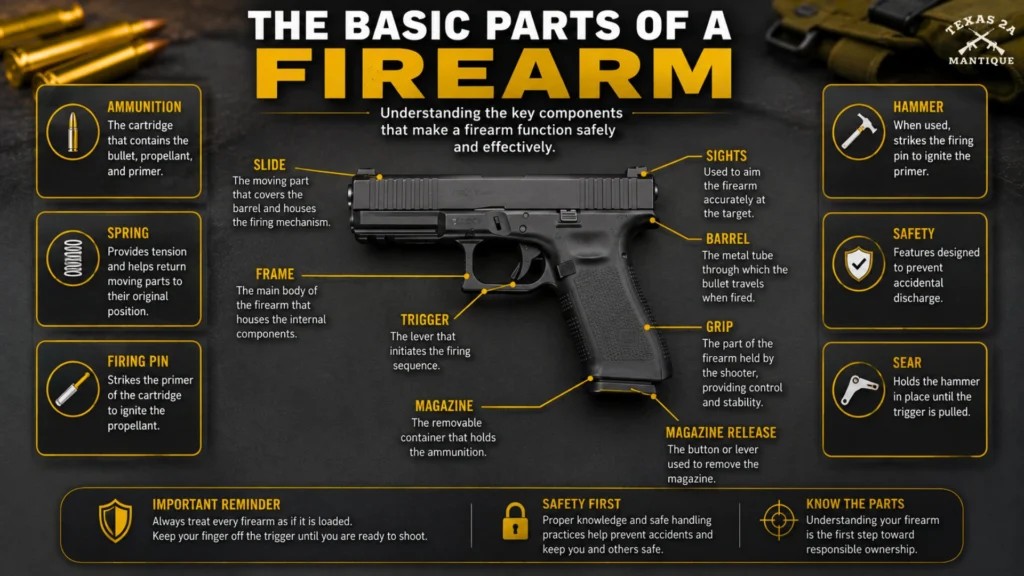
A firearm may look complicated, but it is made up of a few important parts that work together. Learning these parts is the first step to understanding how a firearm works.
Firearm vs. Gun
Many people use the words firearm and gun as if they mean the same thing. In everyday conversations, that’s completely normal. However, firearm is the official and more accurate term. It refers to any handheld weapon that uses an explosion inside a cartridge to fire a bullet through a barrel. The word gun is simply the shorter, more common name that people use in daily life.
Barrel
The barrel is the long metal tube that the bullet travels through after the firearm is fired. You can think of it as a strong, carefully designed tube that guides the bullet toward its target.
In general:
- A longer barrel can improve accuracy over longer distances.
- It can also increase bullet speed.
- However, it makes the firearm larger and heavier.
A shorter barrel is easier to carry and move, especially in tight spaces, but it may reduce bullet speed and long-range accuracy.
Muzzle
The muzzle is the front end of the barrel where the bullet comes out. One of the most important firearm safety rules is:
Always keep the muzzle pointed in a safe direction.
This means you should never point a firearm at anything you are not willing to destroy – even if you believe it is unloaded.
Chamber
The chamber is the small space inside the firearm where a cartridge sits before it is fired.
When someone asks,
“Is the chamber clear?”
they are asking if there is a live cartridge inside the chamber.
To check the chamber safely, open the firearm’s action and look inside. It is also good practice to physically check it with your finger. Every firearm owner should make this a habit.
Trigger and Trigger Guard
The trigger is the small lever you press to fire the firearm. The trigger guard is the protective loop around the trigger. It helps prevent the trigger from being pressed by accident.
A basic firearm safety rule is:
Keep your finger off the trigger until you are ready to shoot.
Instead, keep your finger straight along the side of the firearm while aiming or carrying it.
Grip and Stock
The grip is the part of a handgun that you hold with your hand. It is designed to give you a firm and comfortable hold while shooting. The stock is found on most rifles and shotguns. It rests against your shoulder and helps you control the firearm while aiming and firing.
Receiver
The receiver is the main body of the firearm. It holds many of the important internal parts together. You can think of it as the firearm’s main frame.
In the United States, the receiver is usually the part that has the serial number. Under federal law, it is generally considered the legal firearm, while many other parts can be replaced without changing the firearm’s legal identity.
Other Firearm Terms You Should Know
Sights
Sights help you aim accurately. Basic firearms use iron sights, while others may have optics such as scopes or red dot sights that make aiming faster and easier.
Recoil
Recoil is the backward movement you feel when a firearm is fired. Generally, larger cartridges and lighter firearms produce more recoil.
Muzzle Velocity
Muzzle velocity is the speed of the bullet as it leaves the barrel. It is usually measured in feet per second (FPS). A higher muzzle velocity often means the bullet travels faster and maintains a flatter path over longer distances.
How a Firearm Works: Understanding Action Types
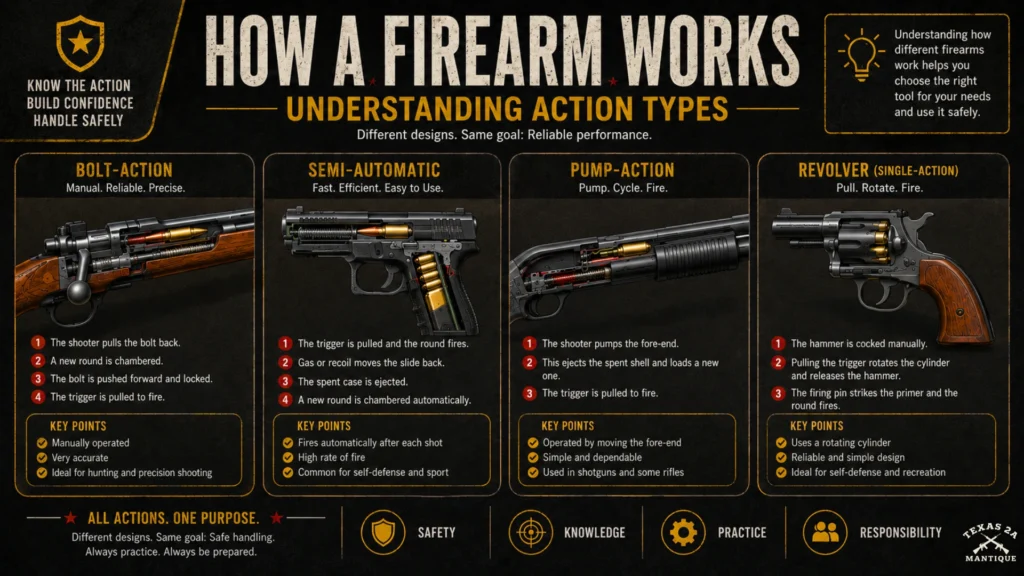
The action is the part of a firearm that loads a cartridge, fires it, and removes the empty case after the shot.
Different firearms use different action types. Each one works in its own way and is designed for different purposes.
Bolt-Action
A bolt-action firearm requires you to move the bolt by hand after every shot. You pull the bolt back to remove the empty case and then push it forward to load a new cartridge.
Best for:
- Hunting
- Long-range shooting
- Precision shooting
Bolt-action firearms are known for their accuracy and reliability.
Lever-Action
A lever-action firearm uses a lever located below the trigger. After each shot, you pull the lever down and back up to load the next cartridge.
Best for:
- Hunting
- Cowboy action shooting
- Collecting classic firearms
Lever-action rifles are easy to use and have a traditional design.
Pump-Action
With a pump-action firearm, you slide the front handle (called the forend) backward and forward to load the next round. This action is most commonly found on shotguns.
Best for:
- Home defense
- Hunting
- Sport shooting
Pump-action firearms are dependable and simple to operate.
Semi-Automatic
A semi-automatic firearm loads the next cartridge automatically after each shot. However, it fires only one round every time you pull the trigger. You must pull the trigger again to fire another shot.
Best for:
- Target shooting
- Home defense
- Hunting
Semi-automatic firearms are popular because they allow faster follow-up shots without manually loading each round.
Revolver
A revolver has a rotating cylinder that holds several cartridges. Each time you pull the trigger, the cylinder turns and lines up the next cartridge with the barrel.
Best for:
- Personal protection
- Target shooting
- Concealed carry
Revolvers are known for their simple design and dependable performance.
Ammunition Terms Explained
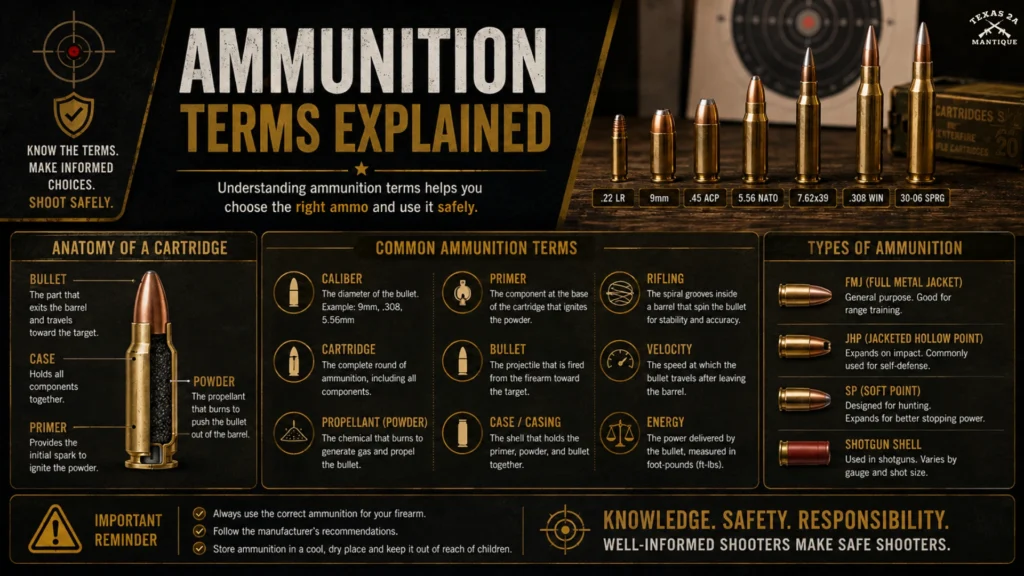
New firearm owners find ammunition terms confusing, especially the difference between a bullet and a cartridge.
Let’s look at the basic terms.
Cartridge
A cartridge is the complete round of ammunition that goes into the firearm.
It contains four main parts:
- Bullet – The part that travels out of the barrel when the firearm is fired.
- Case – The metal container that holds all the parts together.
- Primer – The small ignition component at the base of the cartridge.
- Powder – The propellant that creates pressure to push the bullet through the barrel.
Think of a cartridge as one complete unit that is ready to fire.
Bullet
The bullet is only one part of the cartridge. It is the projectile that leaves the barrel and travels toward the target. Many people say they bought a “box of bullets,” but they usually mean a box of cartridges.
Case
The case is the outer shell that holds the bullet, primer, and powder together. After the firearm is fired, the empty case is removed or ejected from the firearm. Most cases are made from brass, but some are made from steel or aluminum.
Primer
The primer is a small metal cap located at the base of the cartridge. When the firing pin strikes the primer, it creates a small spark. That spark ignites the powder inside the cartridge.
Powder
Modern ammunition uses smokeless powder. When the primer ignites the powder, it burns very quickly and creates high-pressure gas. This pressure pushes the bullet through the barrel and out of the muzzle.
Rimfire vs. Centerfire
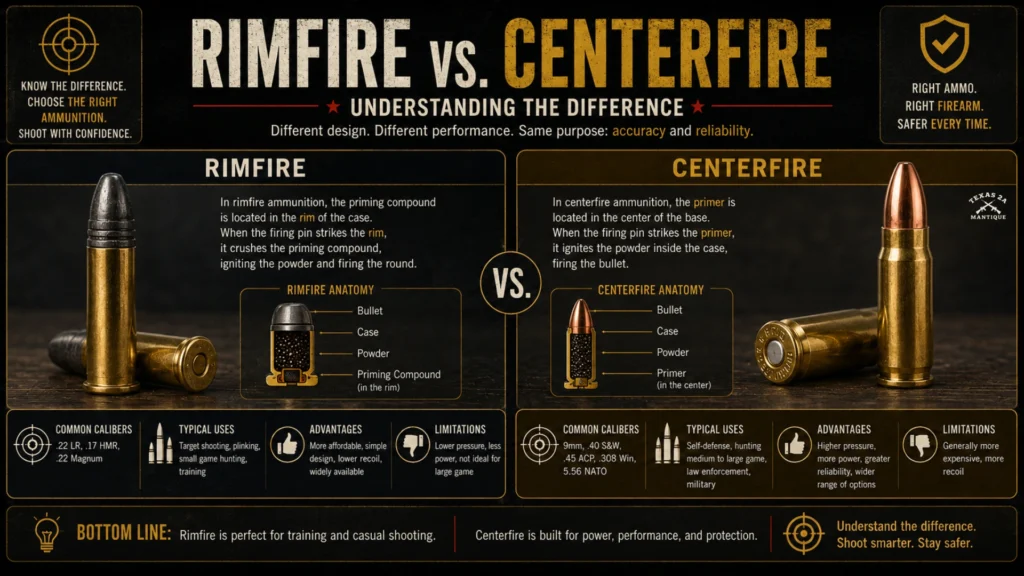
These are two common types of ammunition.
Rimfire
In rimfire ammunition, the primer is built into the rim of the case. A common example is the .22 LR cartridge. Rimfire ammunition is usually less expensive and is often used for target practice and beginner shooting.
Centerfire
In centerfire ammunition, the primer is located in the center of the base of the cartridge. Most handgun and rifle cartridges use centerfire ammunition. It is generally more powerful, more reliable, and can often be reloaded.
Common Bullet Types
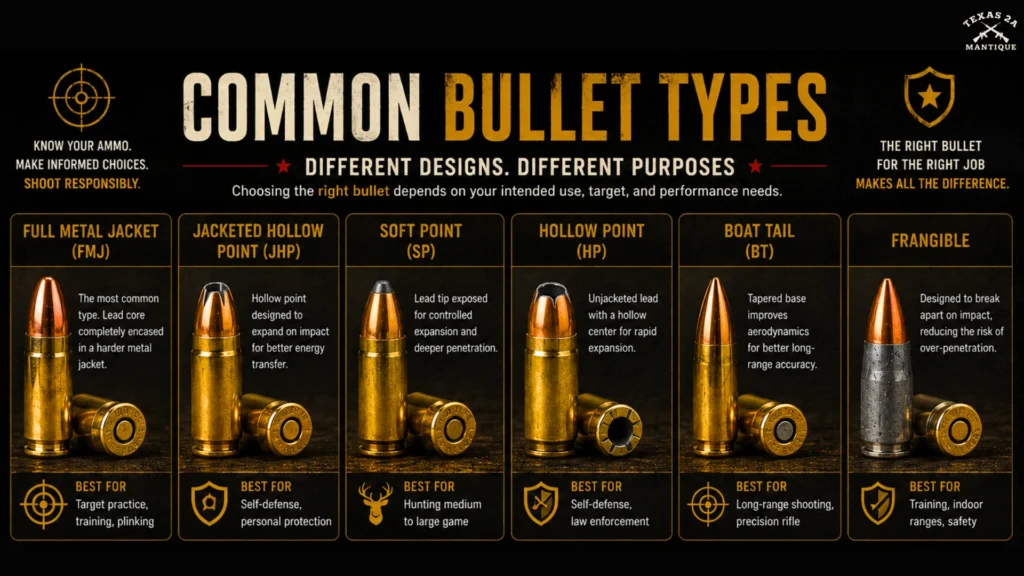
You will often see these two bullet types when shopping for ammunition.
FMJ (Full Metal Jacket)
FMJ bullets have a soft lead core covered with a harder metal jacket. They usually do not expand when they hit a target.
FMJ ammunition is commonly used for:
- Target shooting
- Practice
- Training
JHP (Jacketed Hollow Point)
JHP bullets have a hollow tip that is designed to expand when they hit a target. This design helps transfer more energy to the target.
JHP ammunition is commonly used for:
- Personal defense
- Law enforcement
What Is Caliber?
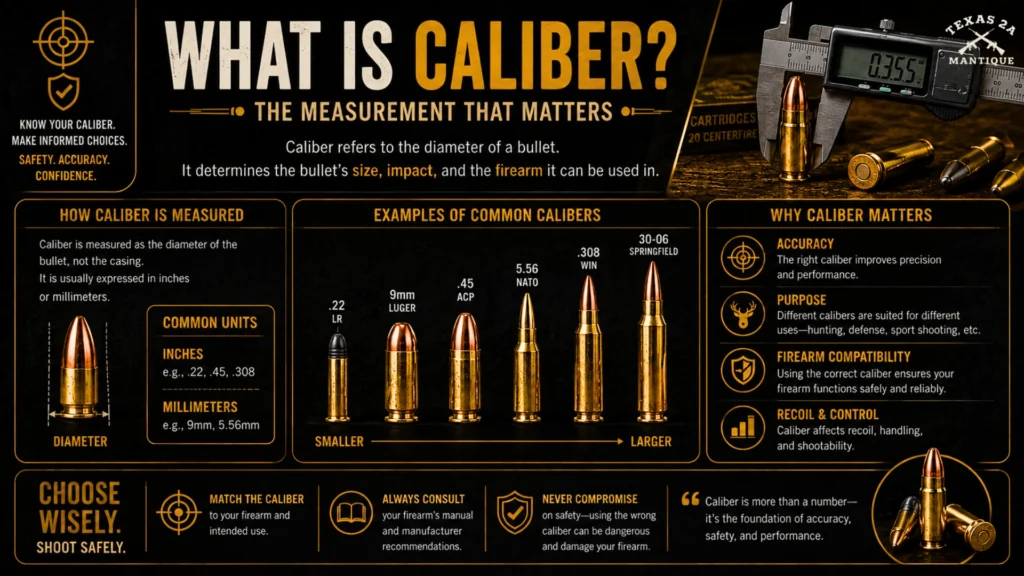
Caliber refers to the approximate diameter of a bullet and the inside diameter of the firearm’s barrel.
It is usually measured in inches or millimeters.
Some common calibers include:
- .22 LR – Low recoil and a good choice for beginners.
- 9mm – One of the most popular handgun calibers for self-defense and target shooting.
- .45 ACP – A larger handgun caliber known for its strong stopping power.
- .223 Remington – Commonly used in rifles for target shooting and hunting small game.
- .308 Winchester – A popular rifle caliber for hunting larger game and long-range shooting.
Each caliber is designed for different purposes. Always use the caliber recommended for your firearm. Using the wrong caliber can be dangerous.
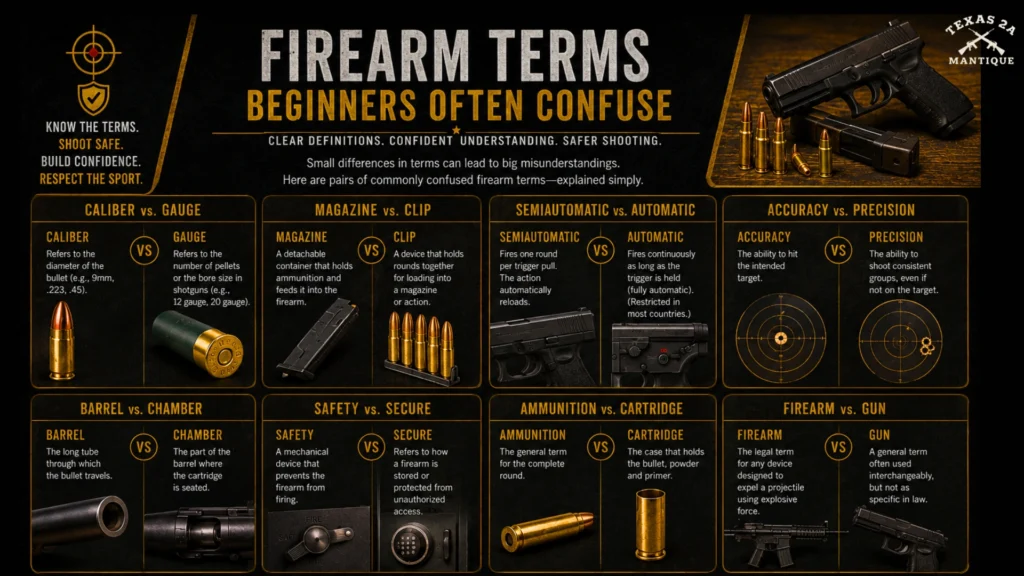
Magazine vs. Clip
These two terms are often confused, but they are not the same.
Magazine
A magazine stores cartridges and feeds them into the firearm.
Magazines can be removable or built into the firearm.
Clip
A clip is a simple device that holds cartridges together to make loading a magazine faster. Unlike a magazine, a clip does not feed ammunition directly into the firearm.
Many people use the word clip when they actually mean magazine, but knowing the difference helps you understand firearm terminology correctly. If you’re buying your first firearm, you’ll hear many new terms. Understanding these words will make the buying process much easier.
FFL (Federal Firearms License)
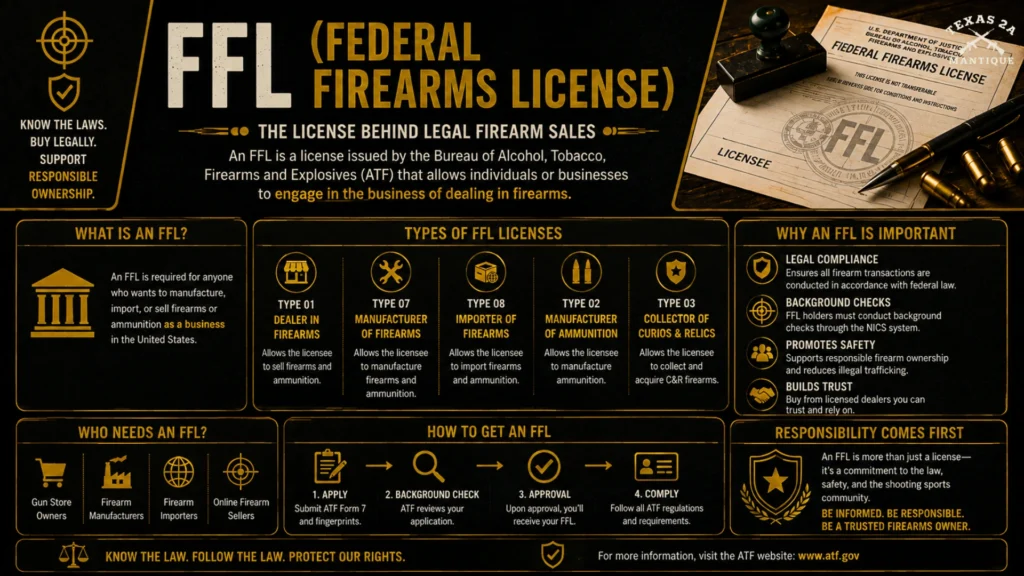
An FFL is a license that allows a business or dealer to legally sell firearms in the United States. When you buy a firearm from a licensed gun store, you are buying it from an FFL dealer.
Background Check
A background check is a process used to confirm that a person is legally allowed to purchase a firearm. For most firearm purchases from licensed dealers, a background check is required before the sale is completed.
NFA (National Firearms Act)
The National Firearms Act (NFA) is a U.S. federal law that regulates certain types of firearms and accessories. Items covered under the NFA usually require additional paperwork, government approval, and other legal requirements before they can be owned.
New vs. Used Firearms
Like cars, firearms can be sold as new or used. A used firearm can be a good value if it has been well maintained. Before buying a used firearm, inspect it carefully or have it checked by a qualified gunsmith to make sure it is safe and in good condition.
MSRP
MSRP stands for Manufacturer’s Suggested Retail Price. This is the price recommended by the manufacturer before a dealer offers discounts or promotions.
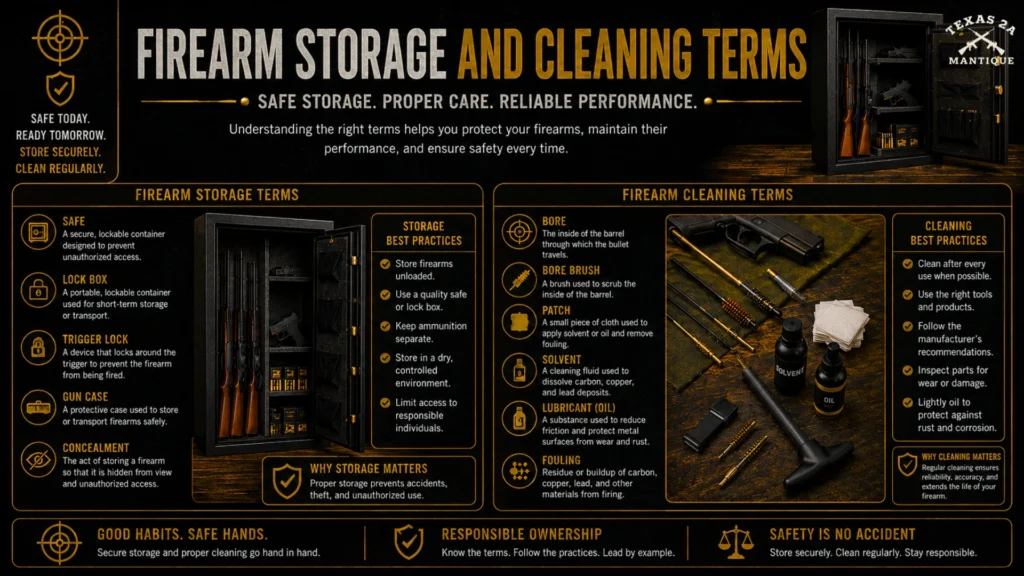
Firearm Storage and Cleaning Terms
Owning a firearm also means taking care of it and storing it safely. Here are some common terms you’ll see in owner’s manuals and safety guides.
Firearm Safe
A firearm safe is a locked storage container designed to keep firearms secure. It helps protect firearms from theft and prevents children or unauthorized people from accessing them.
Trigger Lock
A trigger lock is a safety device placed around the trigger guard. It blocks the trigger from being pulled until the lock is removed. Many firearm owners use a trigger lock as an extra safety measure.
Bore
The bore is the inside of the barrel. Keeping the bore clean helps maintain accuracy and ensures the firearm works properly.
Solvent
A solvent is a cleaning liquid used to remove carbon, dirt, and powder residue from the barrel and other firearm parts. Regular cleaning helps extend the life of your firearm.
Lubricant
A lubricant is a special oil applied to moving parts. It reduces friction, prevents rust, and helps the firearm operate smoothly.
Common Firearm Abbreviations
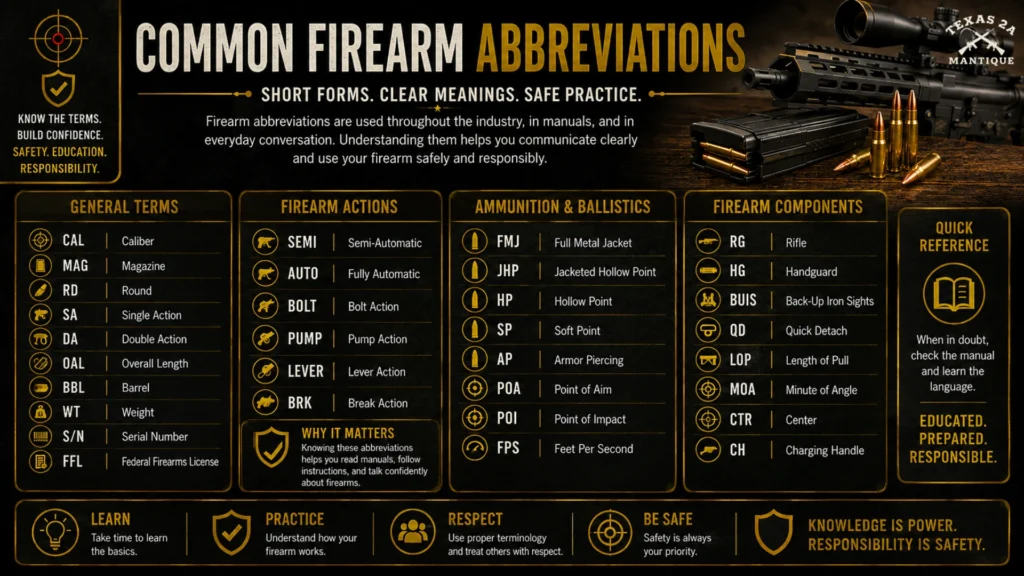
When reading firearm manuals, online forums, or product descriptions, you may come across these abbreviations.
| Abbreviation | Meaning |
| MOA | Minute of Angle – a measurement used to describe shooting accuracy. |
| BCG | Bolt Carrier Group. |
| FFL | Federal Firearms License. |
| FMJ | Full Metal Jacket bullet. |
| JHP | Jacketed Hollow Point bullet. |
| AR | ArmaLite Rifle, named after the company that developed the original design. |
| NFA | National Firearms Act. |
| CCW | Carry Concealed Weapon (a type of permit in some U.S. states). |
Firearm Terms Beginners Often Confuse
Many new firearm owners mix up these common terms.
Bullet vs. Cartridge
A bullet is the projectile that leaves the barrel.
A cartridge is the complete unit of ammunition, including the bullet, case, primer, and powder.
Magazine vs. Clip
A magazine stores and feeds cartridges into the firearm.
A clip simply holds cartridges together to help load a magazine.
They are not the same thing.
Caliber vs. Cartridge
Caliber refers to the size of the bullet or the inside diameter of the barrel.
A cartridge is the complete round of ammunition made for that caliber.
Chamber vs. Barrel
The chamber is where the cartridge sits before firing.
The barrel is the tube the bullet travels through after the firearm is fired.
Semi-Automatic vs. Automatic
A semi-automatic firearm fires one round every time you pull the trigger.
An automatic firearm continues firing while the trigger is held down and ammunition is available.
Rimfire vs. Centerfire
Rimfire ammunition has its primer built into the rim of the cartridge case.
Centerfire ammunition has a separate primer in the center of the case.
How to Keep Learning
Learning firearm terminology is only the first step.
Here are a few ways to improve your knowledge and become a more responsible firearm owner:
- Read your firearm owner’s manual carefully.
- Take a certified firearm safety course.
- Visit a reputable shooting range and learn from an experienced instructor.
- Study diagrams that show the different parts of a firearm.
- Don’t be afraid to ask questions at your local firearm store or shooting range.
The more you practice and learn, the more confident you’ll become.
Final Thoughts
Learning firearm terminology is one of the best ways to become a safer, more informed, and more confident firearm owner. Once you understand essential terms like barrel, chamber, caliber, magazine, action, and ammunition, you’ll find it much easier to read firearm manuals, communicate with firearm professionals, and choose the right firearm for your needs.
At Texas 2A Mantique, we’re committed to helping firearm owners make informed decisions by providing quality firearms, ammunition, accessories, and educational resources. Whether you’re purchasing your first firearm, upgrading your collection, or looking for trusted firearm accessories, our knowledgeable team is here to help you every step of the way.
Browse our carefully selected range of firearms, optics, magazines, ammunition, safes, cleaning supplies, and other shooting essentials to find products that match your needs. We believe that responsible firearm ownership starts with the right knowledge, quality equipment, and ongoing education.
Continue exploring our firearm guides and product collections to expand your knowledge and make confident, responsible purchasing decisions with Texas 2A Mantique.
Leave a Reply