
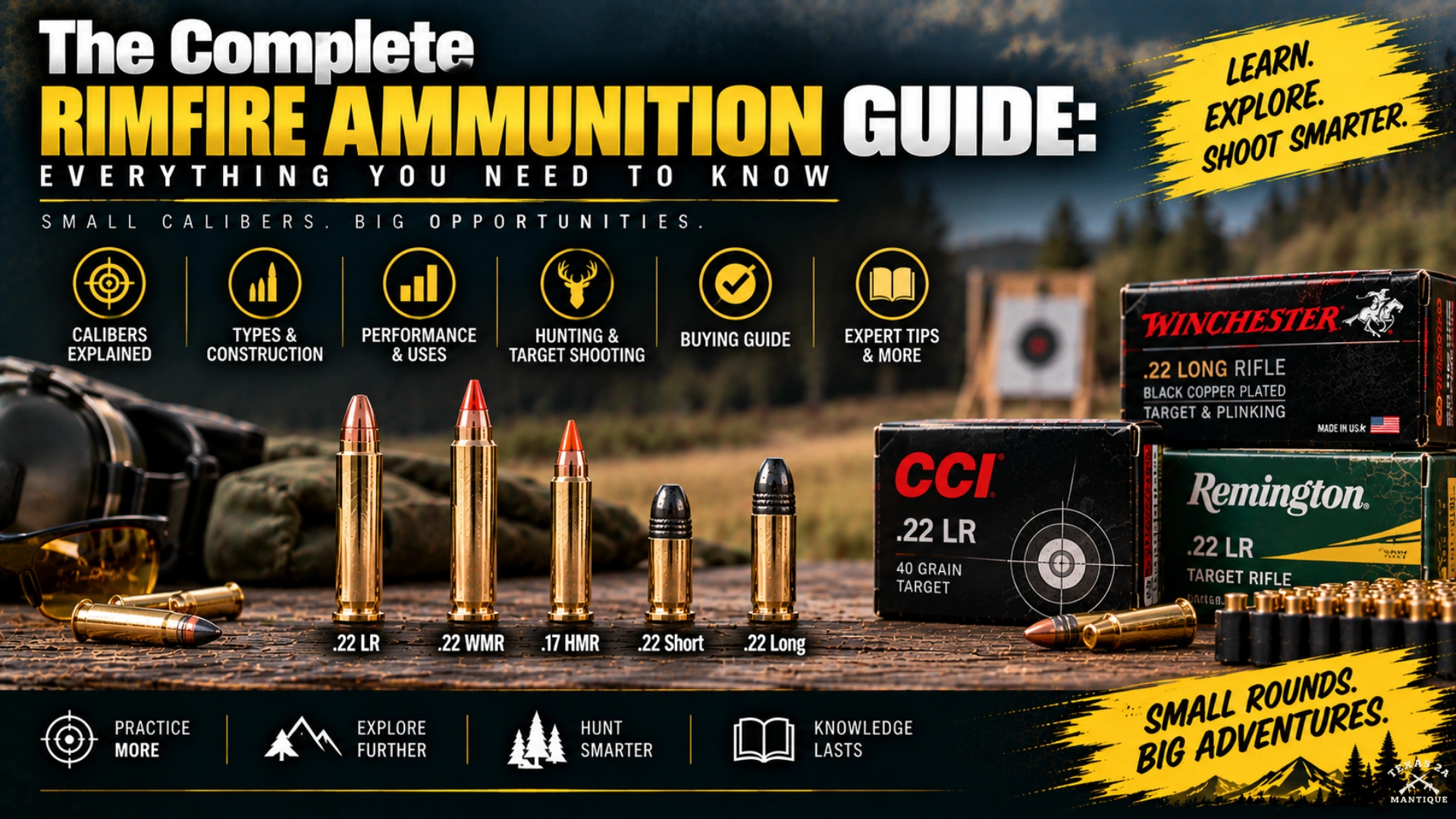
Rimfire ammunition has played an important role in shooting for well over a century. It remains popular with recreational shooters, competitive target shooters, hunters, and people learning the fundamentals of firearm handling. Its relatively low cost, mild recoil, and broad availability make it an accessible category of ammunition, while the wide variety of rimfire cartridges available today provides options for different shooting applications.
For many people, .22 Long Rifle (.22 LR) is practically synonymous with rimfire ammunition. However, the rimfire family extends well beyond .22 LR. Cartridges such as .22 WMR, .17 HMR, .17 HM2, .17 WSM, .22 Short, and newer designs such as .21 Sharp each occupy a different performance niche.
This guide explains what rimfire ammunition is, how it functions, how its major components work together, how the principal rimfire cartridges differ, and how shooters can select and store ammunition responsibly.
1. What Exactly Is Rimfire Ammunition?
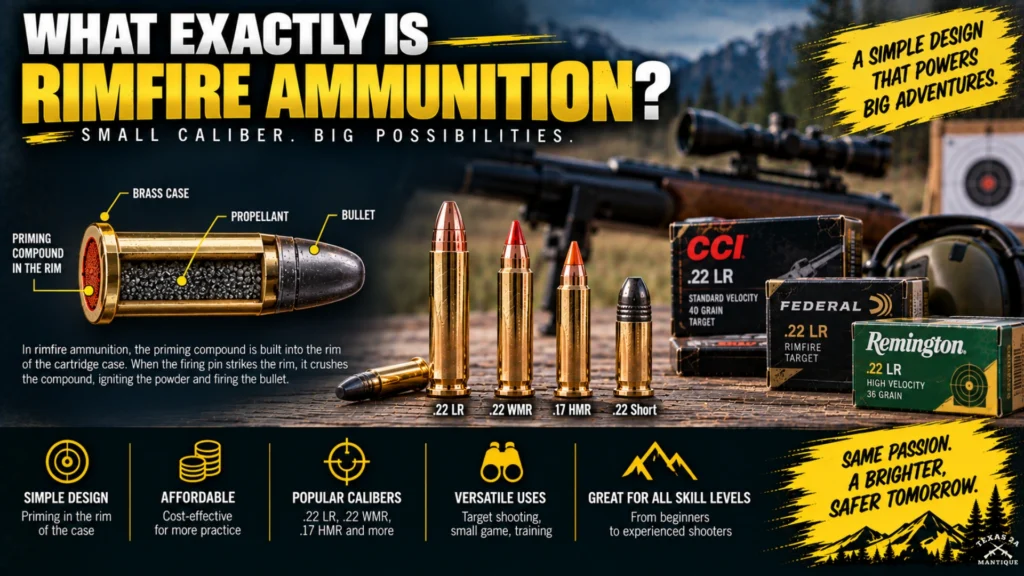
The defining characteristic of rimfire ammunition is where the priming compound is located.
Every metallic cartridge requires an ignition system to initiate the propellant. The ignition system uses a pressure-sensitive priming compound that produces a flame when struck by the firearm’s firing mechanism.
In a rimfire cartridge, the priming compound is distributed inside the hollow rim surrounding the base of the cartridge case.
When the firearm’s firing pin strikes the rim, the rim is compressed against the chamber surface. This impact initiates the priming compound, producing the flame required to ignite the propellant.
Why the Rimfire Design Matters
Lower manufacturing cost:
Rimfire ammunition can be manufactured without a separate primer cup and primer pocket, contributing to its relatively low production cost.
Lower pressure capability:
The cartridge rim must remain thin enough for reliable ignition. This design places practical limits on the pressure levels that rimfire cartridges can safely accommodate compared with many centerfire cartridges.
Non-reloadable case:
Once a rimfire cartridge has been fired, its rim has been mechanically deformed and the priming compound has been consumed. Unlike conventional centerfire cases, rimfire cases are not designed for normal reloading.
These characteristics help explain why rimfire ammunition is inexpensive and widely used for recreational shooting, training, and appropriate small-game applications.
2. The Anatomy of a Rimfire Cartridge
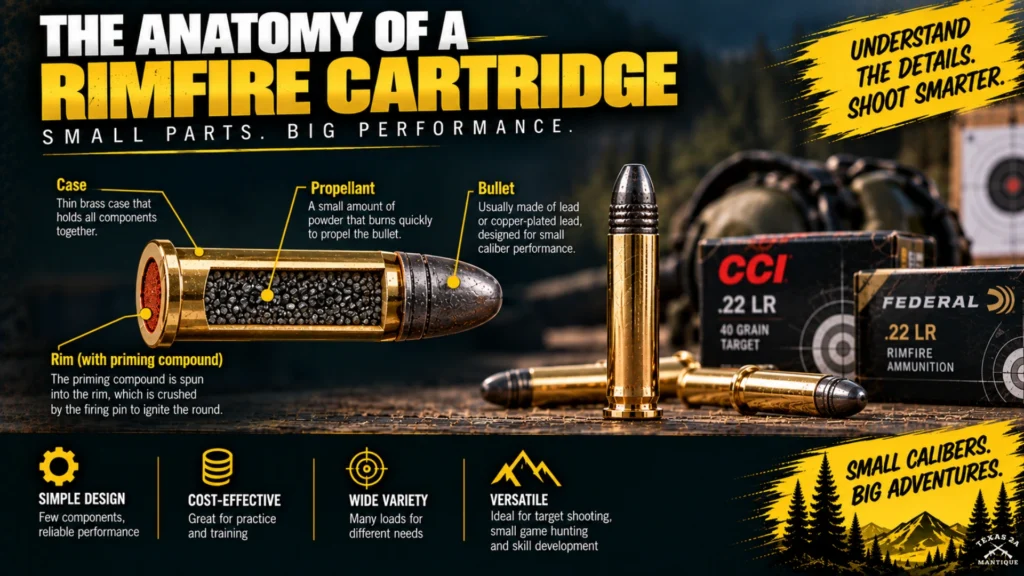
Although rimfire ammunition is relatively simple in construction, each component has a specific function.
1. The Case
The case is the container that holds the cartridge’s internal components. Rimfire cases are generally made from brass or similar copper-based alloys.
Because rimfire cartridges operate within a lower pressure envelope than many centerfire cartridges, their cases can be relatively thin and lightweight.
2. The Rim
The rim is the enlarged edge surrounding the base of the cartridge.
It contains the priming compound and serves as the cartridge’s ignition system. This is the component that distinguishes a rimfire cartridge from a conventional centerfire design.
3. The Propellant
Inside the case is a carefully measured propellant charge.
When the priming compound is initiated, the resulting flame ignites the propellant. The rapidly expanding gases generated during combustion create pressure within the cartridge case.
4. The Bullet
The projectile is the component that leaves the firearm’s barrel.
Rimfire bullets are commonly made from lead, with some ammunition using copper-plated or otherwise treated projectiles. Bullet weight is normally expressed in grains, with 7,000 grains equivalent to one pound.
Bullet weight, construction, and velocity all influence the cartridge’s trajectory and behavior.
How the Ignition Process Works
The basic firing sequence is:
- The firearm’s firing mechanism releases the firing pin.
- The firing pin strikes the cartridge rim.
- The rim is compressed against the chamber surface.
- The priming compound ignites.
- The resulting flame ignites the propellant.
- Expanding gases generate pressure inside the cartridge case.
- The pressure propels the bullet forward through the barrel.
This sequence occurs extremely quickly, but the underlying principle is straightforward: rim impact initiates the primer, the primer ignites the propellant, and expanding gases propel the projectile.
3. Major Rimfire Cartridges Explained
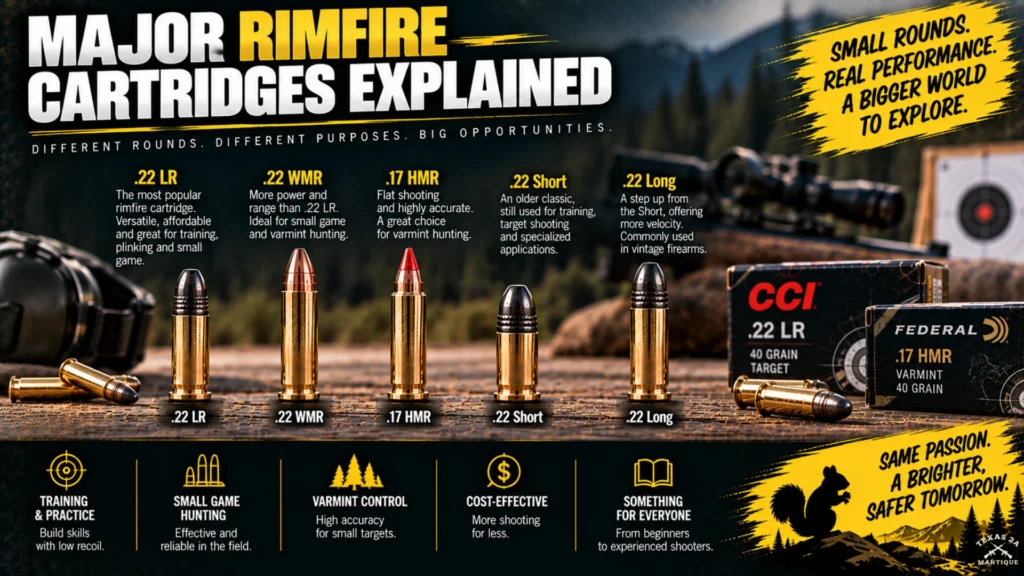
Rimfire ammunition is not a single cartridge type. Different cartridges were developed with different combinations of velocity, trajectory, projectile weight, range, and intended application.
.22 Long Rifle (.22 LR)
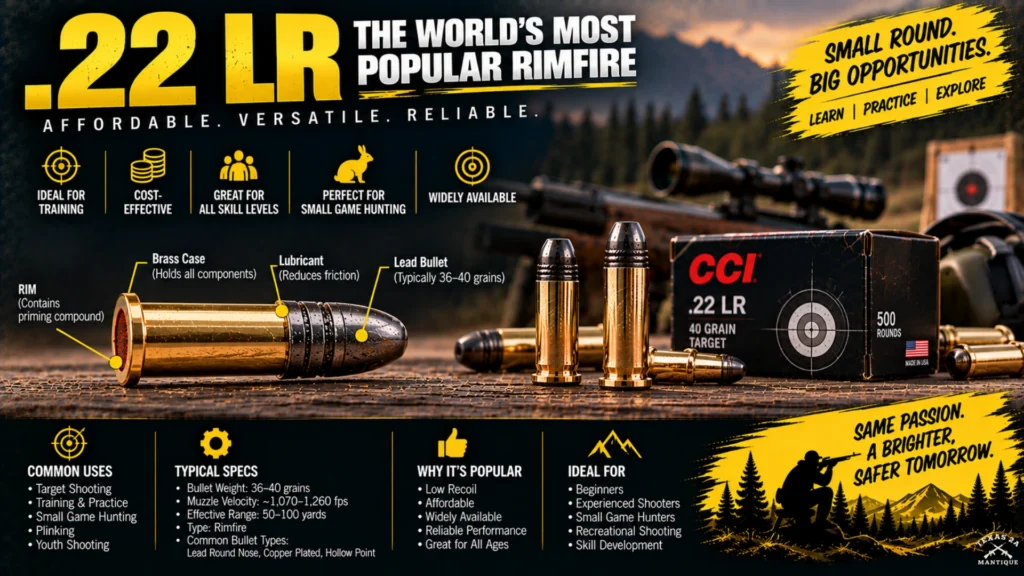
The .22 Long Rifle, commonly abbreviated .22 LR, is by far the most familiar and widely used rimfire cartridge.
Developed in the late 19th century, .22 LR became popular because it combines relatively low recoil with economical ammunition and useful accuracy.
Typical characteristics include:
- Bullet weight: approximately 30–40 grains
- Velocity: roughly 1,000–1,600 fps depending on ammunition
- Recoil: very mild
- Common applications: recreational target shooting, formal target shooting, training, and appropriate small-game hunting
Subsonic .22 LR
Some .22 LR ammunition is specifically loaded at subsonic velocities, meaning the projectile remains below the local speed of sound.
Standard-velocity and high-velocity ammunition may cross the sound barrier, producing a distinct sonic crack. Subsonic ammunition can avoid that particular sound component.
Actual performance varies with ammunition, barrel length, environmental conditions, and firearm configuration.
Why .22 LR Is So Popular
Its combination of low recoil, comparatively low noise, affordability, and widespread availability makes .22 LR a common choice for developing fundamental shooting skills.
For new shooters, these characteristics can allow greater concentration on fundamentals such as safe firearm handling, sight alignment, trigger control, and consistent shooting technique.
.22 Winchester Magnum Rimfire (.22 WMR)
The .22 Winchester Magnum Rimfire, commonly called .22 WMR or .22 Magnum, was developed to provide substantially greater performance than .22 LR while retaining the rimfire design.
Typical characteristics include:
- Bullet weight: approximately 30–50 grains
- Velocity: up to around 2,200 fps depending on load
- Common applications: small-game hunting and varmint-related applications where the cartridge’s additional velocity and energy are appropriate
Compared with .22 LR, .22 WMR generally provides a flatter trajectory and greater downrange performance.
However, .22 WMR ammunition is not interchangeable with .22 LR ammunition. Firearms must be chambered specifically for the cartridge they are designed to use.
.17 Hornady Magnum Rimfire (.17 HMR)
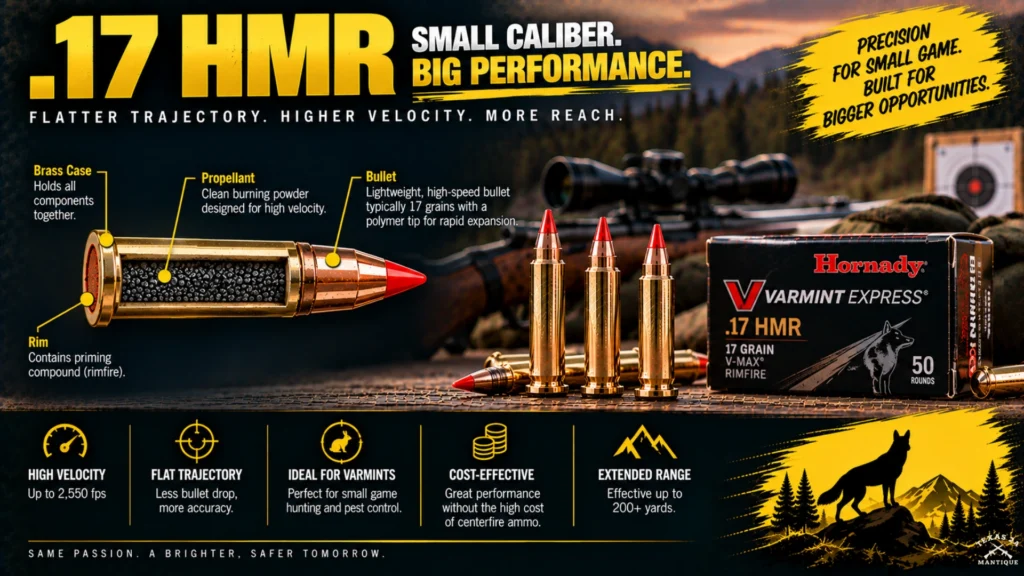
The .17 HMR was introduced in the early 2000s and was developed by necking down a .22 WMR-based case to accommodate a much smaller .17-caliber projectile.
The combination of a lightweight projectile and high velocity gives .17 HMR a relatively flat trajectory compared with traditional .22-caliber rimfire cartridges.
Typical characteristics include:
- Velocity: up to approximately 2,650 fps depending on load
- Common applications: precision target shooting, varmint hunting, and pest-control applications where appropriate
Its relatively flat trajectory can make range estimation and trajectory compensation less demanding than with slower rimfire cartridges.
.17 Hornady Mach 2 (.17 HM2)
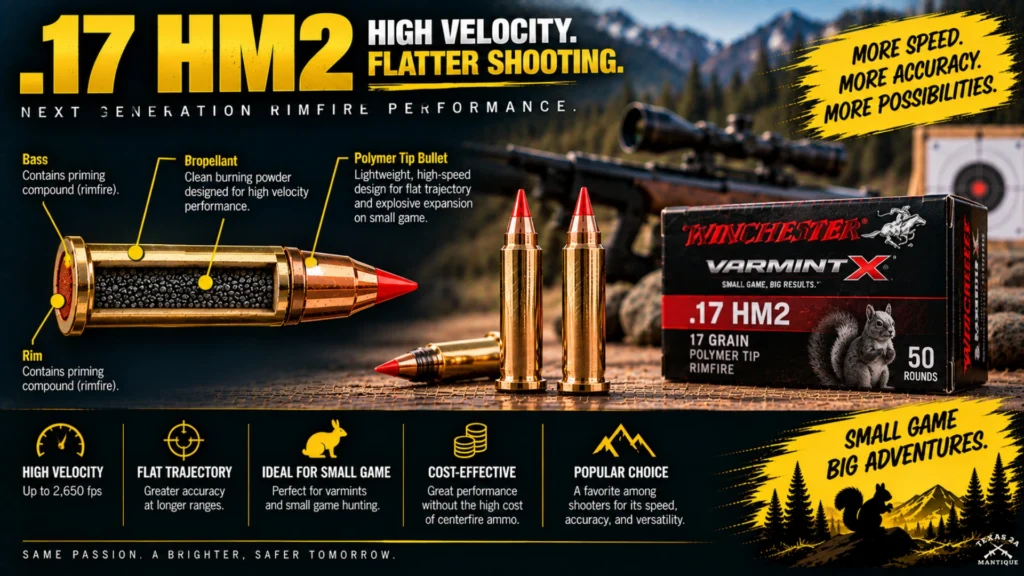
The .17 HM2, also known as .17 Mach 2, follows a similar design philosophy to .17 HMR but uses a case derived from .22 LR rather than .22 WMR.
It occupies a lower-performance position than .17 HMR while offering a higher-velocity trajectory than conventional .22 LR ammunition.
Typical velocity is around 2,100 fps, depending on ammunition.
Its intended applications include appropriate small-game hunting and target shooting.
The cartridge can be viewed as a middle option between traditional .22 LR performance and the more powerful magnum rimfire cartridges.
.17 Winchester Super Magnum (.17 WSM)
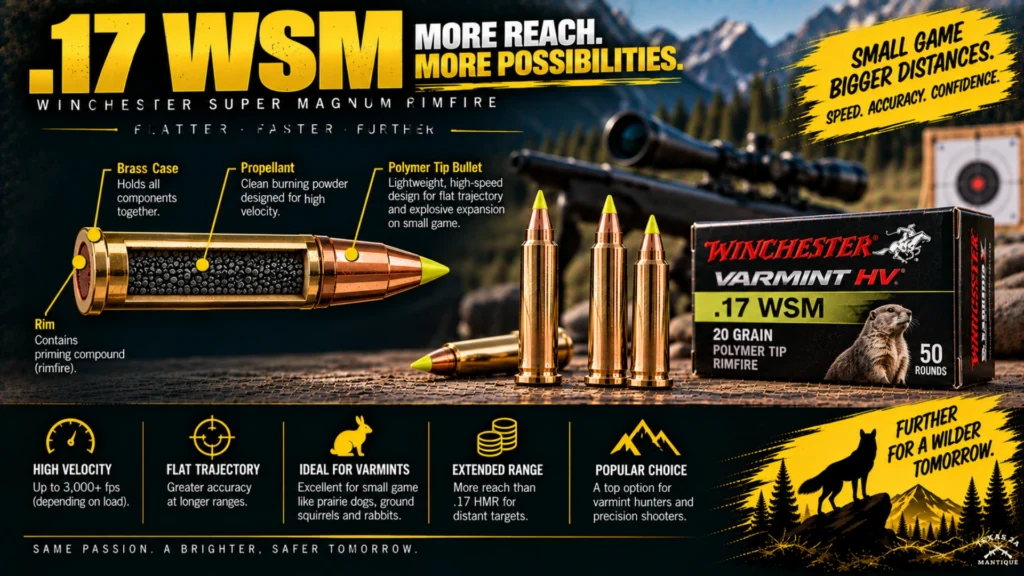
The .17 WSM represents a significant step upward in rimfire performance.
It uses a larger and stronger case design capable of handling higher pressures than conventional rimfire cartridges.
With suitable ammunition, .17 WSM can exceed 3,000 fps with a 20-grain projectile.
Its principal applications include:
- Extended-range varmint shooting
- Pest-control applications
- Small-predator applications where legally and ethically appropriate
The .17 WSM demonstrates how far rimfire technology can be pushed while remaining within the rimfire category.
.21 Sharp
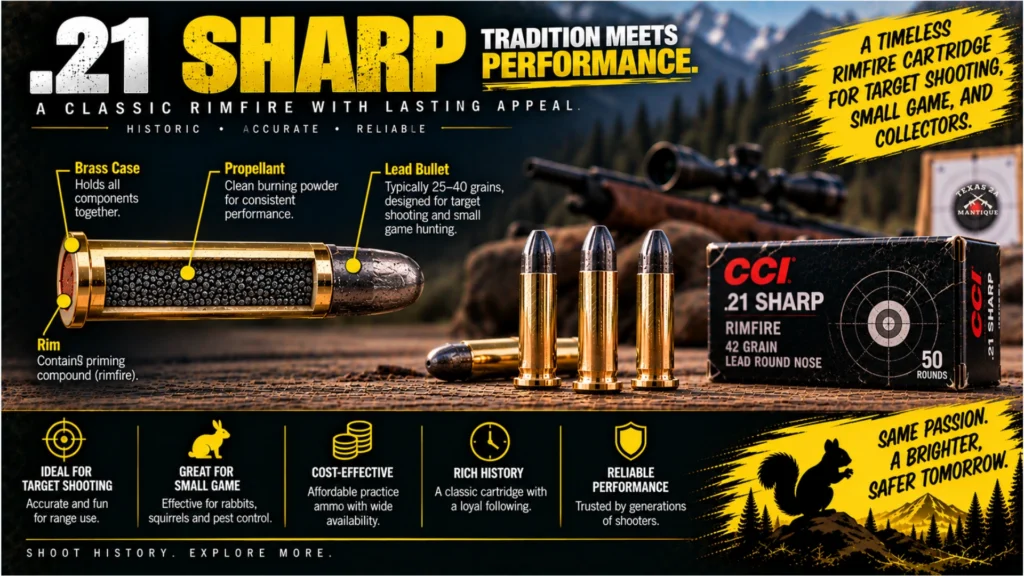
.21 Sharp is a newer rimfire cartridge designed to occupy a performance space between established .22 WMR and .17 HMR offerings.
Its design focuses on efficient performance and accuracy while using a different projectile configuration from traditional .22-caliber and .17-caliber rimfire cartridges.
Because it is newer than many established rimfire cartridges, availability may vary by location, manufacturer, retailer, and firearm compatibility.
As with every cartridge, the firearm must specifically be chambered for .21 Sharp before it is used.
.22 Short
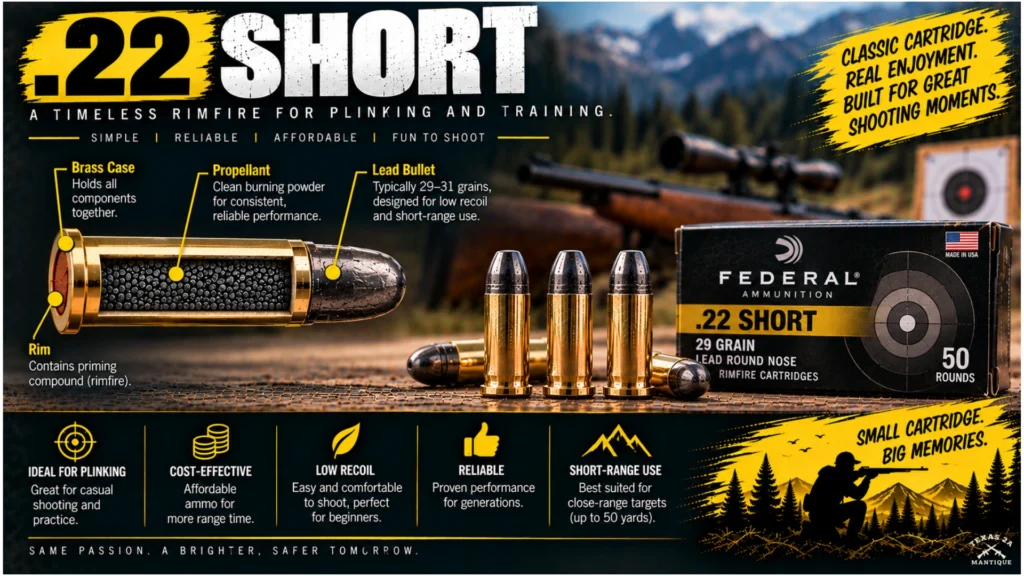
The .22 Short is one of the oldest rimfire cartridges still encountered today.
It is smaller and generally less powerful than .22 LR.
Historically and currently, its applications have included light target shooting and situations where reduced recoil and lower report are desirable, subject to the firearm being specifically chambered for .22 Short.
4. Rimfire Ballistics at a Glance
| Cartridge | Typical Velocity | General Application | Relative Performance |
|---|---|---|---|
| .22 Short | ~700–1,000 fps | Light target shooting | Lowest |
| .22 LR | ~1,000–1,600 fps | Target shooting, training, small game | Low |
| .17 HM2 | ~2,000–2,100 fps | Small game, flatter trajectory | Low–Medium |
| .22 WMR | ~1,800–2,200 fps | Small game, varmint applications | Medium |
| .17 HMR | ~2,500–2,650 fps | Precision shooting, varmint applications | Medium–High |
| .21 Sharp | High velocity | Intermediate rimfire applications | Medium–High |
| .17 WSM | ~2,800–3,000+ fps | Extended-range varmint applications | Highest |
These figures are general ranges rather than guarantees. Actual velocity depends on the specific ammunition load, projectile weight, barrel length, firearm, and environmental conditions.
The original guide presents these cartridges as occupying different performance levels within the rimfire category.
5. Rimfire Ammunition Manufacturers
Ammunition consistency can have a noticeable effect on reliability and accuracy, particularly with rimfire ammunition.
The source identifies several established manufacturers with rimfire product lines:
- Federal: Federal produces a broad range of rimfire ammunition, from economical recreational loads to specialized target ammunition.
- Sellier & Bellot: Sellier & Bellot offers a variety of rimfire cartridges, including .22 LR and .22 Short ammunition in different configurations.
- CCI: CCI is particularly well known for its extensive rimfire ammunition lineup, including specialized and match-oriented products.
- Winchester, Remington, and Hornady: These manufacturers also produce established rimfire ammunition lines covering several cartridges, including .17 HMR and .17 WSM offerings.
- Why Ammunition Testing Matters: Different firearms can show different accuracy preferences even when they are the same make and model.
For precision-oriented shooting, shooters may find that one ammunition load produces more consistent groups than another in a particular firearm.
This is why ammunition selection should consider firearm compatibility, intended use, reliability, and demonstrated performance, rather than simply choosing a brand based on reputation.
6. How to Choose the Appropriate Rimfire Cartridge
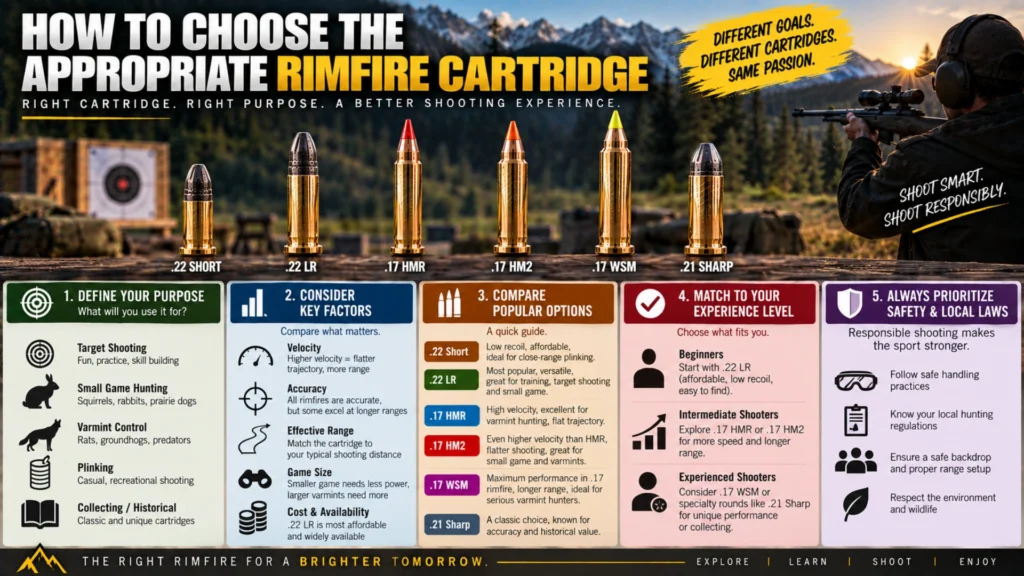
The correct cartridge depends primarily on the firearm’s chambering and the intended application.
Recreational Shooting and Training
For general recreational shooting and basic training, .22 LR is commonly selected because of its low recoil, widespread availability, and relatively low ammunition cost.
Small-Game Applications
For appropriate small-game hunting, .22 LR and .17 HM2 can provide different combinations of trajectory and performance depending on distance, firearm, ammunition, and applicable hunting regulations.
Varmint Applications
.22 WMR and .17 HMR provide higher performance than .22 LR and can be suitable for certain varmint applications where their capabilities and local regulations permit.
Extended-Range Rimfire Applications
.17 WSM offers greater velocity and downrange performance than the other rimfire cartridges discussed in this guide.
Reduced-Noise Shooting
Where a firearm is legally configured for suppressed use, subsonic .22 LR ammunition can eliminate the projectile’s supersonic crack. The firearm, ammunition, and suppressor must all be legally compatible and properly matched.
Most Important Rule
Never choose ammunition solely based on appearance or perceived performance. The cartridge must match the firearm’s chambering exactly.
The source emphasizes this point particularly in its safe-storage and handling section.
7. Rimfire vs. Centerfire
| Characteristic | Rimfire | Centerfire |
|---|---|---|
| Primer location | Inside the cartridge rim | Separate primer in the center of the case |
| Reloadable | No | Generally yes |
| Relative ammunition cost | Lower | Generally higher |
| Pressure capability | Lower | Generally higher |
| Typical applications | Training, target shooting, small game | Broad range including hunting and other applications |
The distinction between the two systems begins with primer location but ultimately affects cartridge construction, pressure capability, manufacturing cost, and reloadability.
Rimfire ammunition is therefore not simply a cheaper version of centerfire ammunition. It is a different cartridge architecture designed around a different ignition system and performance envelope.
8. Safe Storage and Handling of Rimfire Ammunition
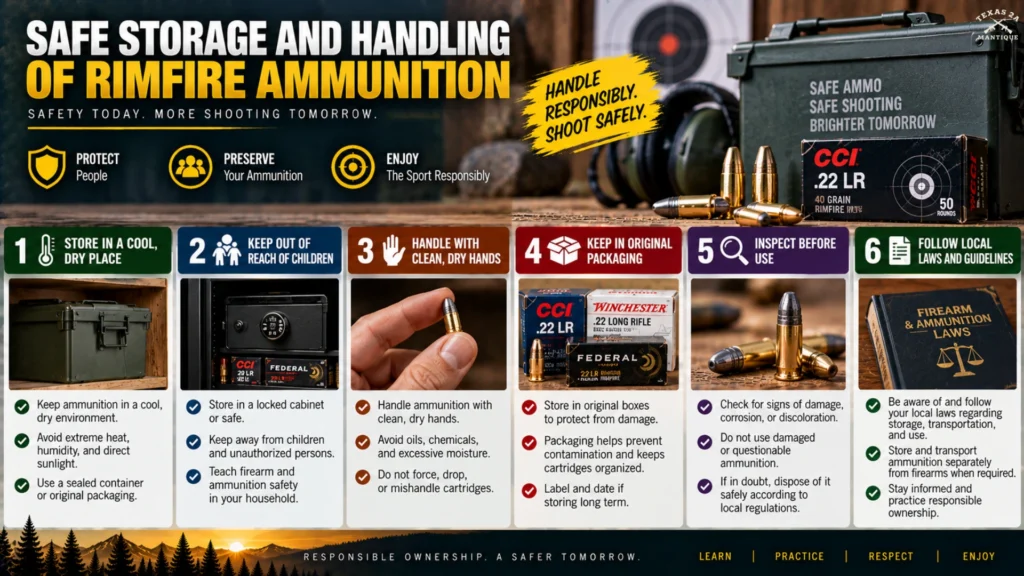
Proper ammunition storage is an important part of responsible firearm ownership.
Keep Ammunition Dry
Moisture and excessive humidity can contribute to corrosion and deterioration of ammunition components. Ammunition should be stored in a clean, dry environment.
Keep Ammunition Clearly Identified
Whenever possible, keep ammunition in its original packaging or in clearly labeled containers.
This is particularly important because some rimfire cartridges can look superficially similar despite being completely different chamberings.
Verify the Chambering
Before loading ammunition, verify that the cartridge designation on the ammunition packaging corresponds exactly with the firearm’s chambering.
Never assume that similar-looking cartridges are interchangeable.
Restrict Unauthorized Access
Ammunition should be kept away from children and unauthorized users. Appropriate locked storage should be used where required or appropriate, and all applicable laws concerning storage and transportation should be followed.
Use Older Stock First
Properly stored ammunition can remain usable for many years, but maintaining an organized inventory and using older ammunition before newer purchases can help keep ammunition stock organized.
9. Final Thoughts
Rimfire ammunition represents one of the most diverse and enduring categories of metallic ammunition.
The familiar .22 LR remains popular because of its combination of affordability, mild recoil, and versatility. At the same time, cartridges such as .22 WMR, .17 HMR, .17 HM2, .17 WSM, .22 Short, and .21 Sharp demonstrate how different rimfire designs can target very different performance requirements.
Understanding rimfire ammunition means understanding more than cartridge names and velocity figures. It means knowing how the ignition system works, recognizing the differences between cartridge designs, understanding that ammunition must match the firearm’s chambering, and handling and storing ammunition responsibly.
Texas 2A Mantique offers a range of rimfire ammunition from established manufacturers for customers looking for ammunition appropriate to their firearms and intended use.
Always purchase, store, transport, and use ammunition responsibly and in full compliance with all applicable federal, state, and local laws.


Leave a Reply