
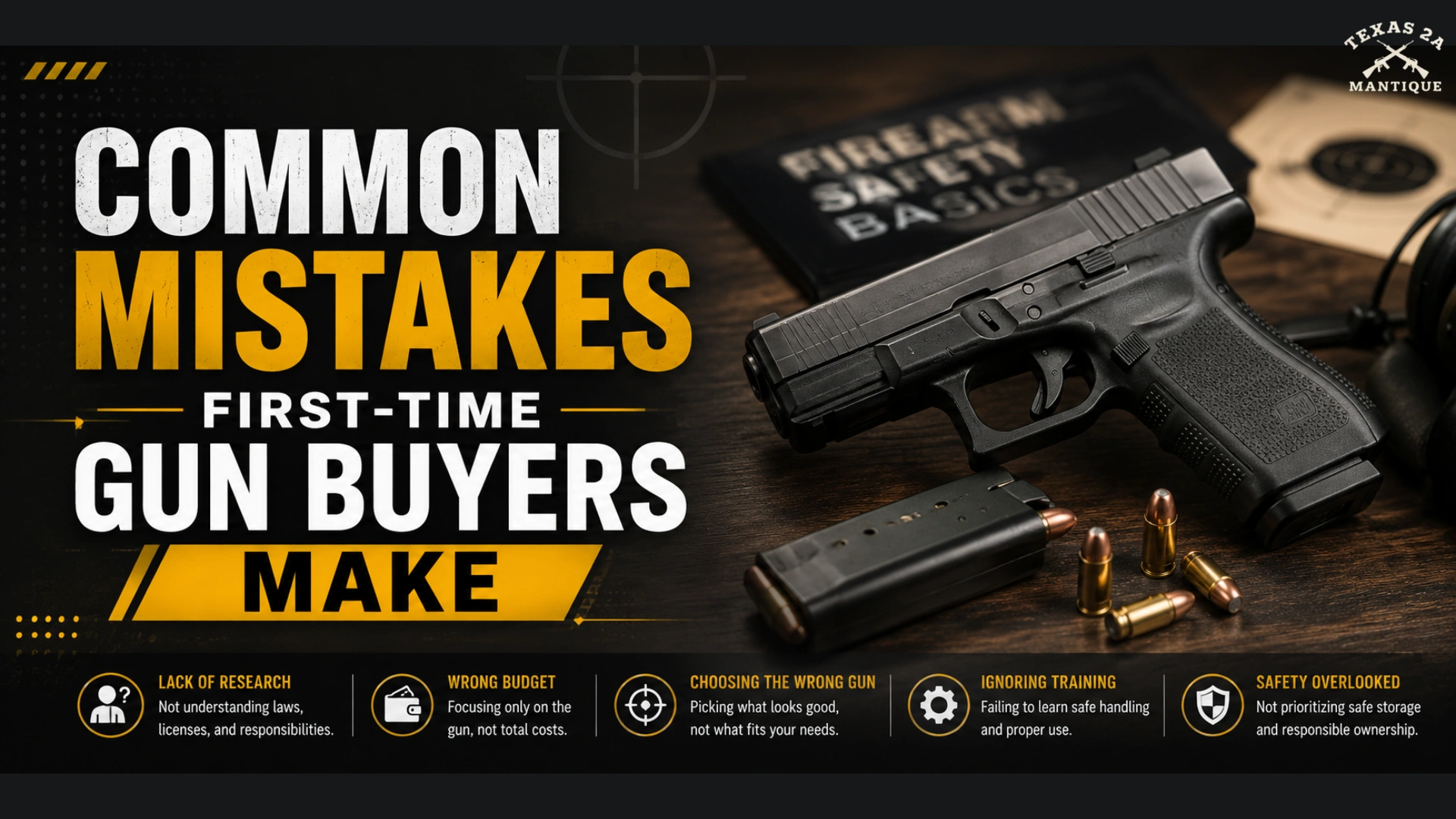
Buying a gun for the first time in Texas can be a confusing experience. You may have questions about firearm types, calibers, prices, safety training, storage, paperwork, and Texas gun laws. You may also be wondering, do you need a permit to buy a gun in Texas?
For many first-time buyers, the biggest challenge is not finding a firearm. It is knowing how to make a responsible and informed decision.
Some buyers choose a firearm because it is inexpensive. Others select a popular model they saw online or follow a friend’s recommendation without considering whether it actually fits their needs. Others purchase a firearm before thinking about training, storage, maintenance, or the ongoing costs of ownership.
The better approach is to slow down and understand the complete buying process before making a decision.
In this guide, we cover 14 common mistakes first-time gun buyers make in Texas, along with practical ways to make the buying experience more informed, responsible, and straightforward.
1. Start With Your Needs, Not a Specific Gun
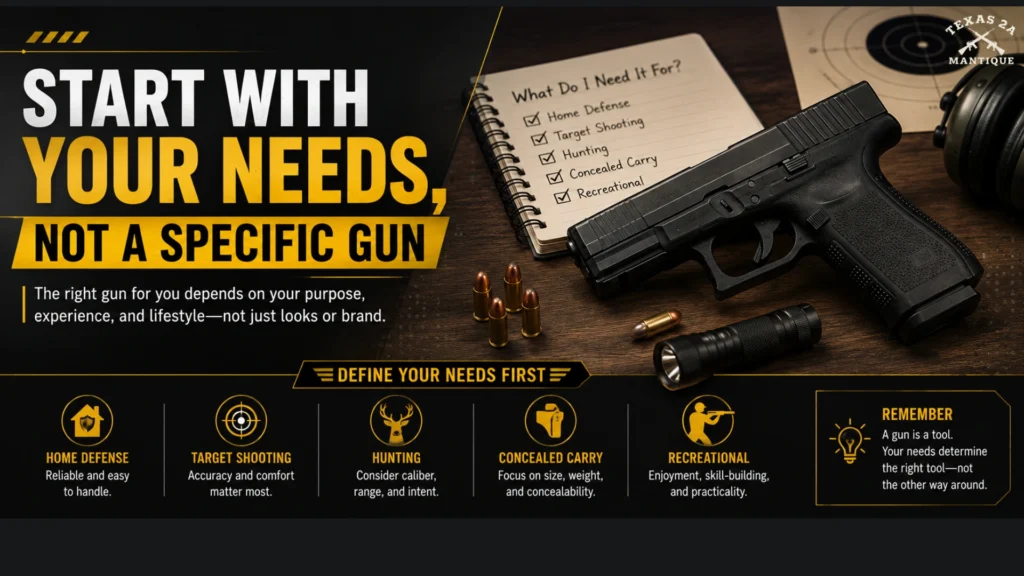
One of the easiest mistakes for a first-time buyer is deciding on a particular firearm before deciding what they actually need.
Before looking at models, think about your intended lawful purpose. A firearm used for hunting may have different requirements from one intended for recreational range use, collecting, or another lawful purpose.
Your environment, frequency of use, experience level, storage situation, and willingness to train should all be part of the decision.
Ask yourself:
- What is my lawful reason for owning a firearm?
- Where will I use it most often?
- How frequently do I expect to practice?
- Where will I store it?
- Who else could potentially access it?
- Am I prepared to receive appropriate training?
- Am I prepared for ongoing maintenance and ownership costs?
Starting with these questions helps you avoid buying a firearm simply because it looks appealing or happens to be popular.
At Texas 2A Mantique, this needs-first approach can help first-time buyers focus on finding an option that fits the individual rather than simply choosing a popular model.
2. Look Beyond the Purchase Price
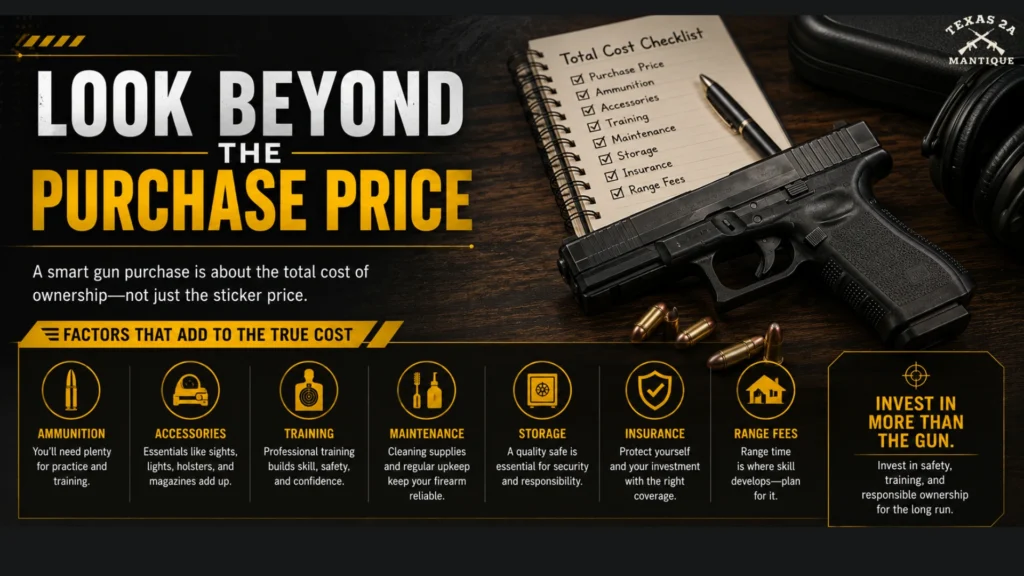
Price is naturally an important consideration, but the price shown on the firearm is not the full cost of ownership.
After purchasing a firearm, you may also need to budget for training, secure storage, ammunition, cleaning supplies, range fees, eye and hearing protection, cases, locks, and future maintenance.
A buyer who spends the entire budget on the firearm may later discover that there is not enough money available for training or appropriate storage.
At the same time, buying the most expensive option does not necessarily mean you are making the best decision.
Build a realistic ownership budget
Before purchasing, consider the complete cost of responsible ownership.
Your budget should account for:
- The firearm
- Safety training
- Secure storage
- Ammunition
- Cleaning and maintenance supplies
- Range expenses
- Eye and hearing protection
- Appropriate cases or locks
- Future maintenance needs
Thinking about the total cost before you buy can help you make a more practical decision.
3. Choose Size and Caliber Based on Fit and Purpose
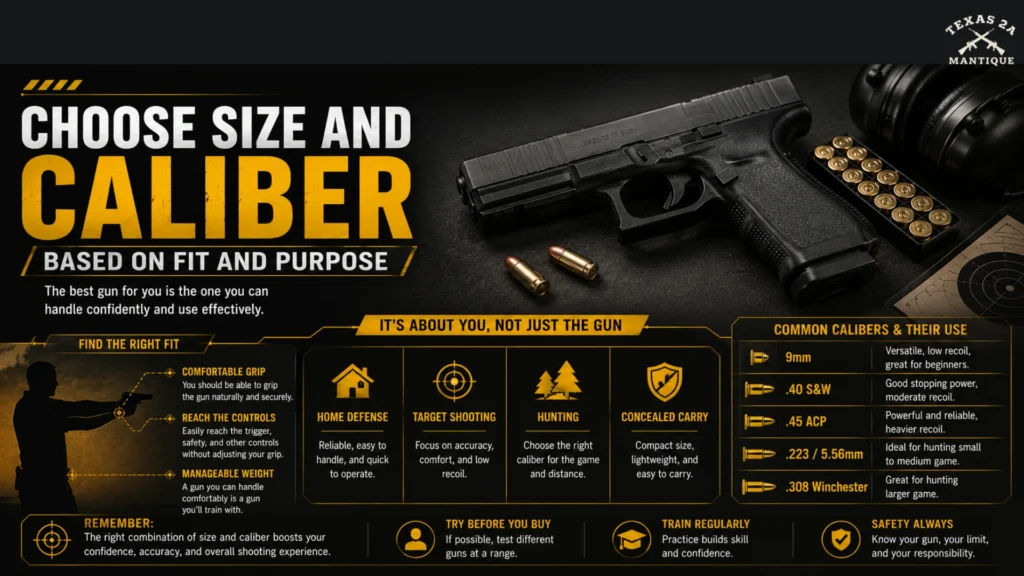
Caliber is another area where first-time buyers can easily become influenced by popularity.
A friend may recommend a particular caliber. An online reviewer may call one option the best. A particular cartridge may also be extremely common. But popularity alone does not make a firearm the right choice for every individual.
Recoil, firearm weight, controls, ammunition availability, and intended use all deserve consideration.
For a first-time buyer, the goal should be finding an option that they can safely and comfortably handle while also fitting their intended lawful use and budget.
Consider these factors before deciding
- Can you comfortably manage the firearm?
- Can you operate its controls without difficulty?
- Is ammunition reasonably available?
- Does the firearm suit your intended purpose?
- Can you find appropriate training for it?
- Does it fit within your overall ownership budget?
There is no single caliber that is automatically the best first gun for every beginner. The better choice depends on the individual and their circumstances.
4. Handle a Firearm Before You Buy It

Online photographs and specifications can help you create a shortlist, but they cannot tell you everything about how a firearm will feel in your hands.
Grip size, weight distribution, control placement, and overall ergonomics can feel very different from one model to another.
A firearm that receives excellent reviews online may not feel comfortable or natural for you.
Whenever legally permitted, handling appropriate firearms before making a purchase can help you compare different options based on your own experience.
Pay attention to:
- How the firearm feels in your hands
- Overall weight
- Grip size
- Control placement
- Whether the controls are easy for you to understand and operate
- Whether the firearm feels appropriate for your intended use
Personal fit should be part of your decision instead of relying entirely on photographs or online reviews.
5. Make Safety Training Part of the Purchase
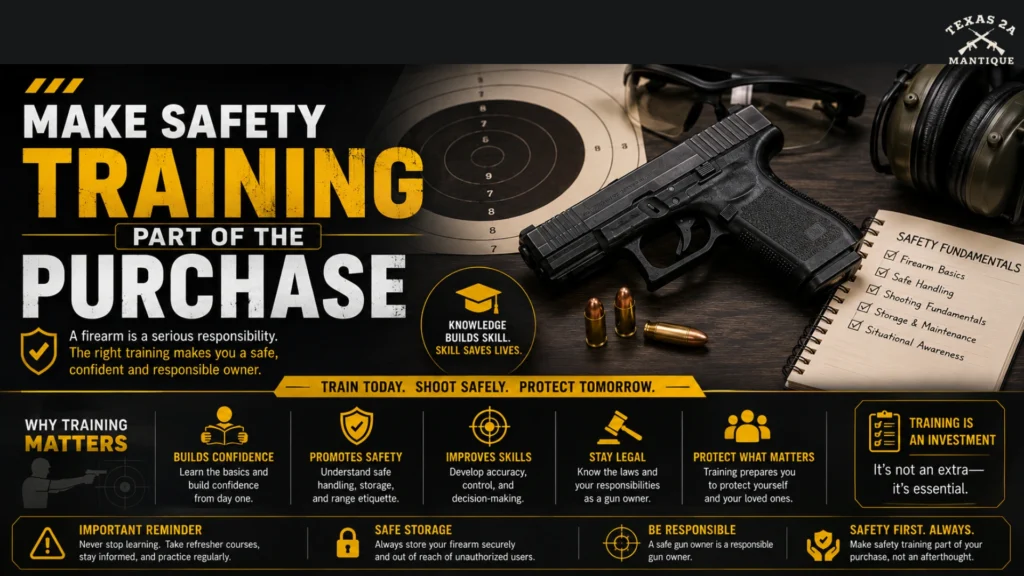
Buying a firearm and learning how to handle it safely are two different things.
Reading the owner’s manual is important, but a manual cannot replace practical instruction. New owners may benefit from learning safe handling habits, loading and unloading procedures, appropriate muzzle awareness, and what to do when something unexpected happens.
Safety should be treated as an ongoing responsibility rather than something you check off once.
Training should come early
- Consider taking an appropriate firearm safety course with a qualified instructor before or soon after acquiring a firearm.
- Continued training and practice can also help reinforce safe habits over time.
- The goal is not simply to know how a firearm works. It is to develop consistent and responsible handling habits.
6. Plan Secure Storage Before Bringing a Firearm Home
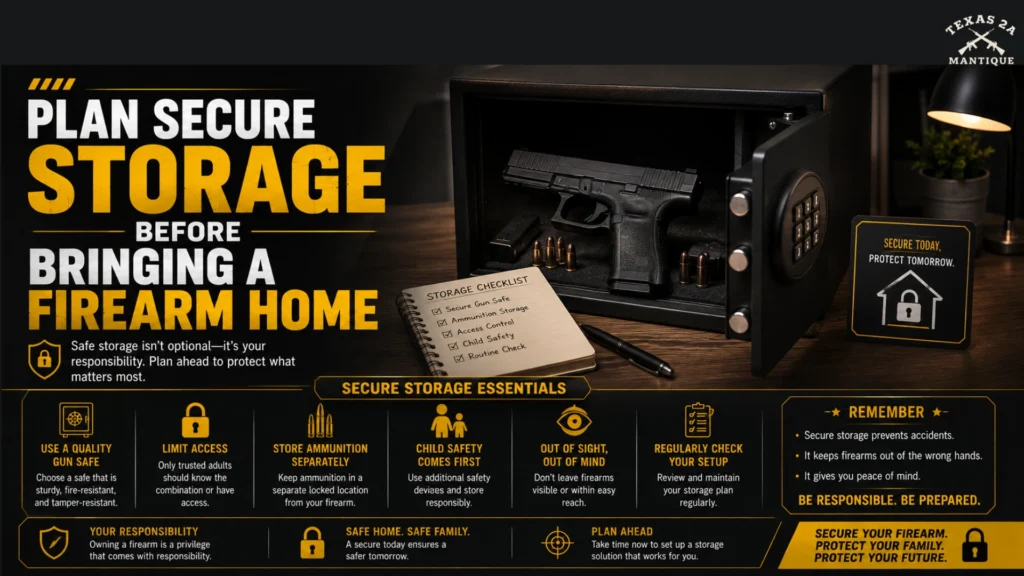
Storage should never be an afterthought.
A common mistake is purchasing a firearm first and deciding where to keep it later. This can lead to inappropriate storage in places such as unlocked drawers, closets, or vehicles.
Secure storage is particularly important when children, roommates, guests, or other people may have access to the property.
Think about your storage plan in advance
Before purchasing, determine:
- Where the firearm will be stored
- Who could potentially access the storage location
- What secure storage option is appropriate
- How unauthorized access will be prevented
- How ammunition will be stored
- Whether your storage arrangement meets your circumstances and applicable requirements
Options can include a gun safe, locking cabinet, or lockable case.
Planning storage before the purchase means you are prepared to secure the firearm from the moment you bring it home.
7. Understand Texas Gun Laws Before You Buy

Texas firearm laws are another area where assumptions can cause problems.
Information from friends, social media, or another state may not accurately describe the rules that apply to your situation in Texas.
One of the most common questions first-time buyers ask is:
Do you need a permit to buy a gun in Texas?
According to the source material for this guide, Texas does not require a state permit to purchase or possess a firearm, and Texas does not have a state waiting period or state firearm registration requirement.
However, this does not mean that there are no legal requirements.
Federal law and Texas law can apply at the same time. Requirements can also vary depending on factors such as age, eligibility, the type of transaction, and whether you are purchasing, possessing, or carrying a firearm.
Texas also has rules concerning carrying firearms, including its Constitutional Carry framework for eligible individuals.
Verify current requirements
Because firearm laws can change, do not rely on outdated information or advice from someone who bought a firearm years ago.
Check current information through official sources such as:
- Texas Department of Public Safety
- Texas.gov
- Bureau of Alcohol, Tobacco, Firearms and Explosives (ATF)
Pay particular attention to current requirements concerning eligibility, age, purchasing, carrying, and restricted locations.
8. Know What to Expect When Buying From a Dealer
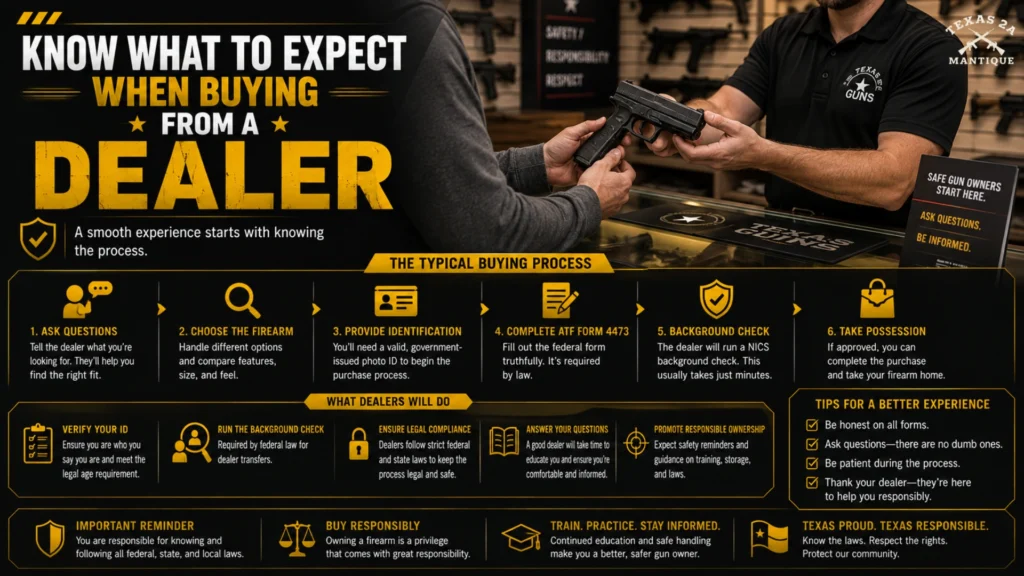
For someone buying a firearm for the first time, the purchasing process can seem complicated simply because it is unfamiliar.
When purchasing from a federally licensed firearms dealer, commonly known as an FFL, there is a federally regulated process.
The source material identifies several important steps, including:
- Providing appropriate identification.
- Completing ATF Form 4473.
- Completing the applicable background-check process through the FBI’s National Instant Criminal Background Check System (NICS).
- Completing the transaction when all applicable requirements are satisfied.
Texas does not have a state waiting period according to the source material.
However, not every firearm transaction works the same way. Private sales and interstate transfers can involve different legal requirements.
Prepare before visiting the dealer
Bring appropriate identification and understand that completing federal paperwork and a background check is a normal part of a dealer transaction.
If you are considering a private transaction or a firearm transfer involving another state, ask about the applicable legal process before proceeding.
9. Remember the Costs That Come After the Purchase
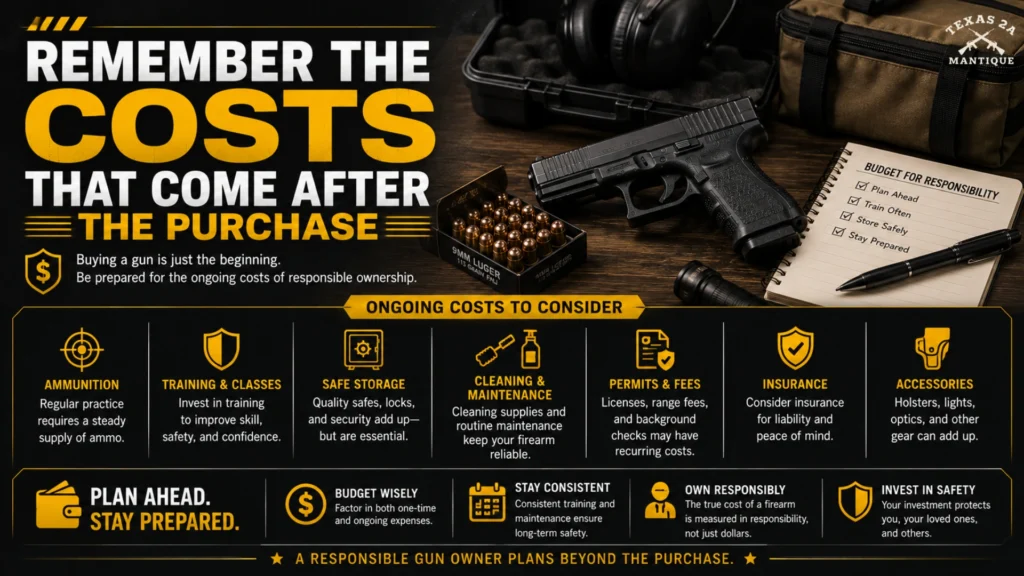
Many first-time buyers plan their budget around one number: the price of the firearm.
The real cost of ownership can be higher.
Training, secure storage, ammunition, cleaning supplies, range fees, safety equipment, cases, locks, and maintenance can all contribute to the overall expense.
Create a complete ownership budget
Before purchasing, make sure you have considered the costs associated with:
- Training
- Secure storage
- Ammunition
- Cleaning and maintenance
- Range use
- Eye and hearing protection
- Cases and locks
- Future maintenance or replacement needs
A realistic budget helps ensure that buying the firearm does not leave you unprepared for the responsibilities that come afterward.
10. Don’t Buy Every Accessory at Once
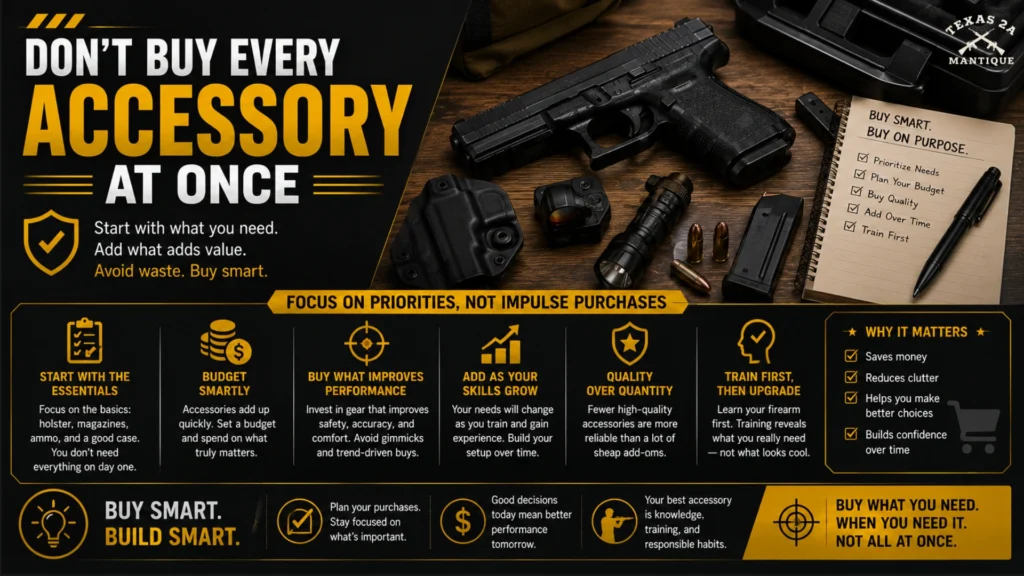
It is easy for a new firearm owner to become overwhelmed by the number of accessories available.
Online videos and advertisements may make certain products appear essential, even when they may not be necessary for your particular situation.
Buying too many accessories immediately can increase your costs and distract you from more important priorities such as training, safe storage, and learning the firearm.
Start with the essentials
- Focus first on the equipment and resources required for safe and responsible ownership.
- After you gain experience, you can better determine whether additional equipment is appropriate for your needs.
- Making decisions based on actual experience is generally more useful than buying accessories simply because they are popular online.
11. Use Online Reviews as Research, Not the Final Answer
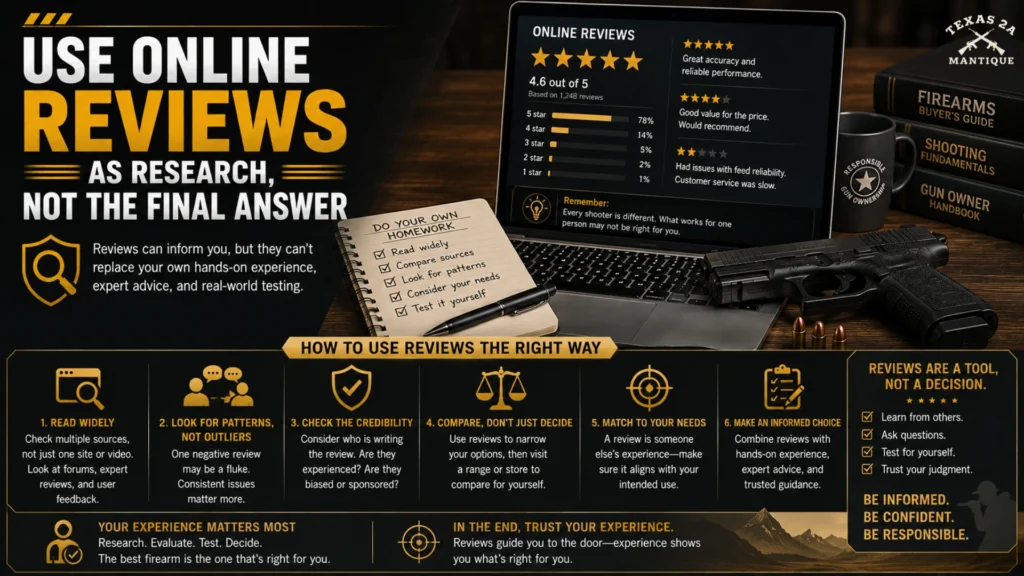
Online reviews can be useful when researching firearms, but they should not be the only factor in your decision. A reviewer may have years of experience, different hand size, a different intended use, and a completely different budget from yours.
Their recommendation can still be useful, but it does not automatically mean the firearm is right for you.
Build your own shortlist
When comparing options, consider:
- Reliability information from multiple sources
- Ergonomics and overall fit
- Manufacturer support
- Warranty coverage
- Maintenance requirements
- Intended use
- Training availability
- Long-term ownership experiences
Use online reviews to learn more, then evaluate whether the information actually applies to your circumstances.
12. Don’t Let Social Media Trends Make the Decision
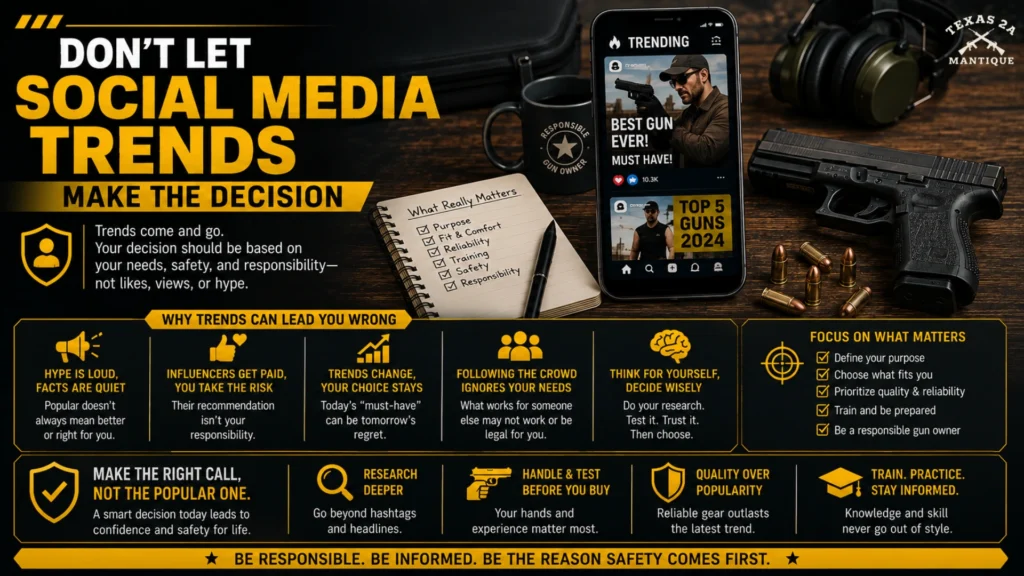
A firearm can become extremely popular because it appears frequently on social media, YouTube, forums, or other online platforms. That popularity does not necessarily mean it is the right option for a first-time buyer.
Online content is often created for a specific audience, and the firearm featured in that content may be selected for reasons that do not apply to you.
Ask yourself before following a trend
Does this firearm actually fit:
- My intended purpose?
- My budget?
- My experience level?
- My storage plan?
- My training needs?
- My applicable legal requirements?
If it does, it may deserve further consideration. If it does not, popularity should not be the deciding factor.
13. Understand That Ownership Requires Ongoing Maintenance
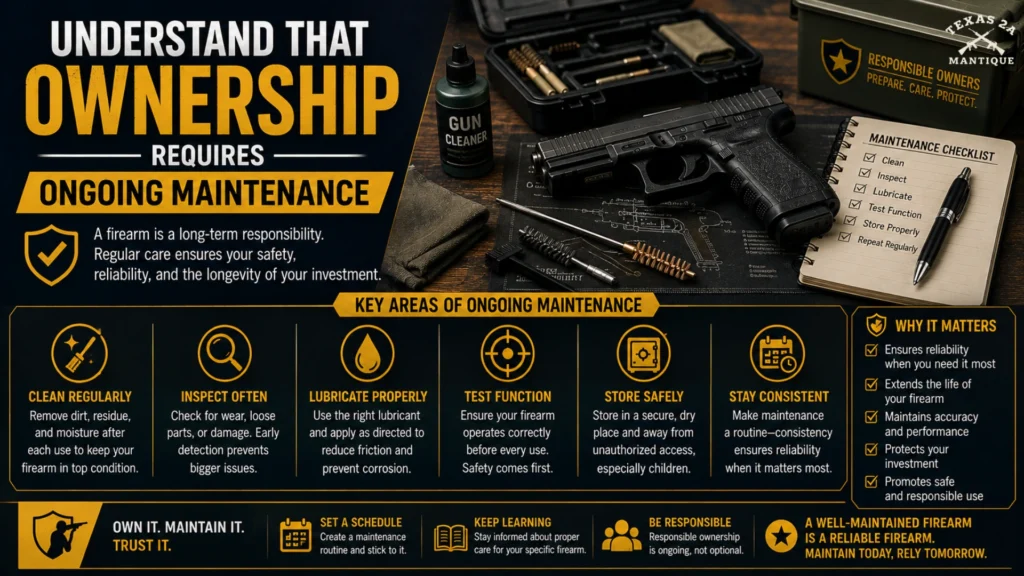
Buying a firearm is not the end of the responsibility.
Like other mechanical equipment, firearms require appropriate care and maintenance. Different models can have different manufacturer recommendations, so it is important not to assume that every firearm should be maintained in exactly the same way.
Follow the manufacturer’s instructions
Read the owner’s manual and follow the manufacturer’s recommendations for cleaning, maintenance, inspection, and service.
Keep the firearm securely stored and address mechanical concerns appropriately rather than ignoring them.
Responsible ownership continues long after the purchase is complete.
14. Continue Practicing After You Buy
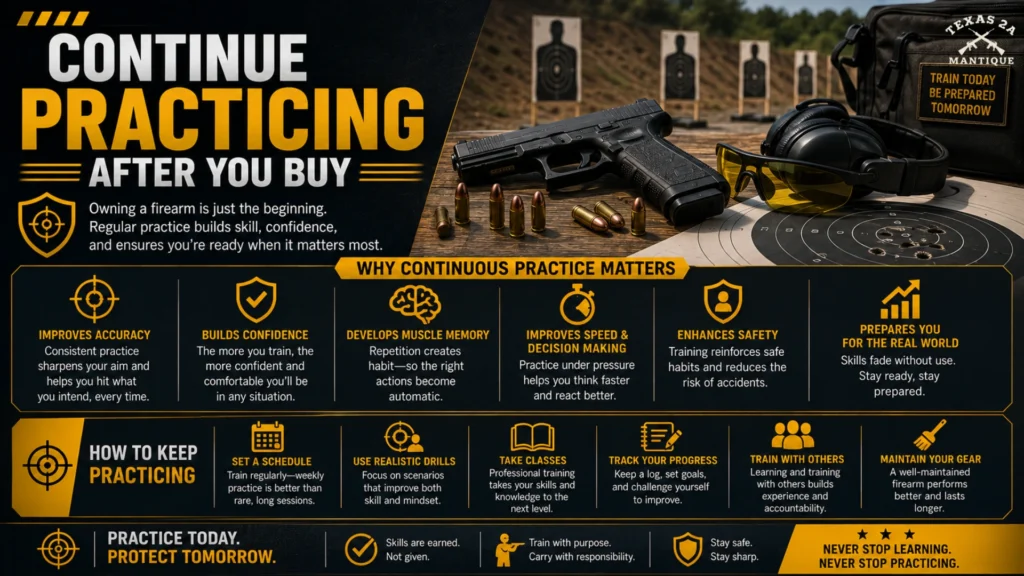
Some first-time buyers purchase a firearm, take it home, store it away, and rarely revisit the skills they need to handle it safely.
Simply owning a firearm does not automatically create proficiency.
Appropriate practice can help reinforce safe handling habits and maintain familiarity with the firearm.
Make continued learning part of ownership
Practice only in lawful and appropriate environments and follow applicable range rules.
If you are still developing your skills, working with a qualified instructor can be more useful than trying to teach yourself everything.
The goal should be safe, consistent, responsible habits, not simply spending more time shooting.
First-Time Gun Buyer Checklist
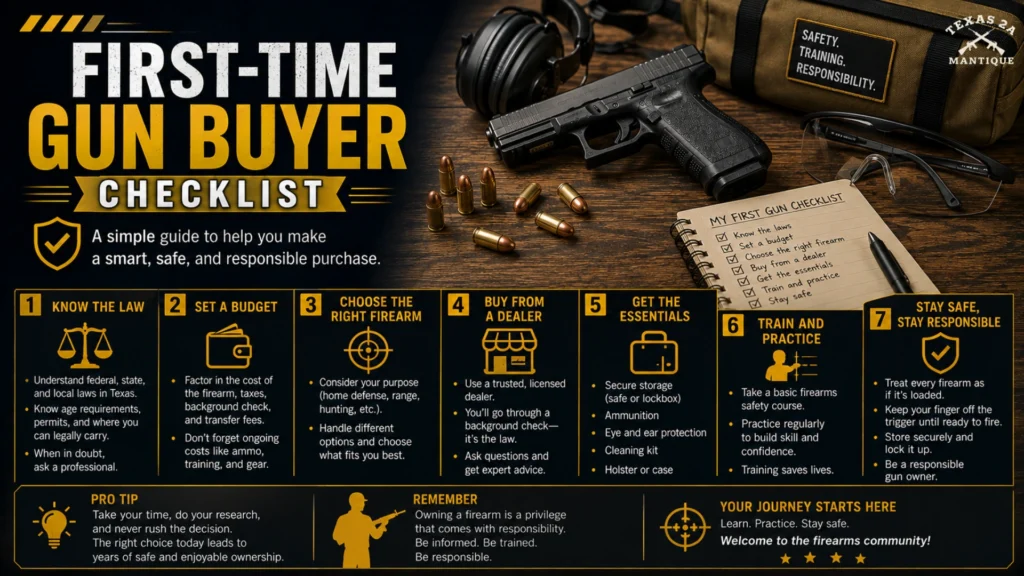
Before making a purchase, use this checklist to review the major areas covered in this guide.
Before Buying
- Understand your lawful purpose for owning a firearm
- Research firearm types and basic features
- Compare several suitable options
- Consider size, fit, and caliber
- Understand applicable federal age and purchase requirements
- Review current Texas firearm laws
- Understand applicable carry rules
- Create a complete ownership budget
- Plan secure storage
- Research appropriate safety training
- Understand the purchasing process
Before Taking It Home
- Confirm that you meet applicable legal requirements
- Have appropriate identification
- Understand the required paperwork
- Read the owner’s manual
- Have secure storage ready
- Have appropriate eye and hearing protection
- Know where you can legally and safely practice
After Buying
- Store the firearm securely every time
- Prevent unauthorized access
- Follow the manufacturer’s maintenance instructions
- Complete appropriate safety training
- Practice safely and legally
- Continue developing responsible handling habits
- Stay informed about applicable law changes
This checklist brings together the key preparation, purchasing, storage, training, and ownership points covered throughout the guide.
Important: Firearm laws can change and may depend on individual circumstances. This article is for general educational purposes and is not legal advice. Always verify current Texas and federal requirements through official government sources before buying, possessing, carrying, or storing a firearm.
Frequently Asked Questions About Buying a Gun in Texas
What should I consider when buying my first gun?
Start with your lawful purpose rather than a particular model.
Consider the firearm’s size, fit, caliber, controls, cost, training requirements, storage, maintenance, ammunition availability, and applicable legal requirements.
The best first firearm is not necessarily the cheapest, most expensive, or most popular option. It should be an appropriate choice for your circumstances.
Should I handle a firearm before buying it?
Whenever legally permitted, handling suitable options before purchasing can help you evaluate fit, weight, controls, and ergonomics.
Online reviews and specifications can be useful for research, but they cannot completely replace personal evaluation.
How much should I budget for my first firearm?
There is no single amount that works for everyone.
Instead of budgeting only for the firearm, consider the complete cost of responsible ownership, including secure storage, training, ammunition, maintenance, safety equipment, and range expenses.
Is firearm training important for first-time buyers?
Training is an important part of responsible firearm ownership.
A qualified instructor can help new owners develop appropriate safe-handling habits and better understand how to handle their firearm responsibly.
What should I do before bringing a firearm home?
Make sure you understand the applicable legal requirements, have appropriate storage prepared, understand the firearm’s owner’s manual, and have considered appropriate safety training.
Planning these things before the purchase can make the transition to ownership more responsible and less stressful.
Final Thoughts
Buying your first gun in Texas does not have to be an overwhelming process.
The most important thing is to slow down and make an informed decision.
Start with your needs rather than a specific firearm. Consider the complete cost of ownership instead of only the sticker price. Evaluate appropriate options carefully, understand the purchasing process, verify current Texas and federal requirements, arrange secure storage, and make safety training part of your ownership plan.
Avoid choosing a firearm simply because it is popular online or because someone else recommends it. Your decision should be based on your own circumstances, lawful purpose, ability to safely handle the firearm, budget, training, storage, and long-term responsibilities.
Responsible ownership also continues after the purchase. Secure storage, appropriate maintenance, continued education, and safe practice all remain important.
At Texas 2A Mantique, we help first-time buyers approach firearm ownership with better information and a clearer understanding of the decisions involved.

Leave a Reply